Before the pandemic, English learners in Wisconsin were not the state's starkest attendance outlier. Their chronic absenteeism rate was 15.1%, only 2.2 points above the state average. The gap was real but modest, and LEP students were closer to the statewide pattern than most at-risk subgroups.
By 2025, that gap has quadrupled to 8.3 points. English learners now have a 25.6% chronic rate, the largest excess versus pre-COVID of any subgroup in the state's data.
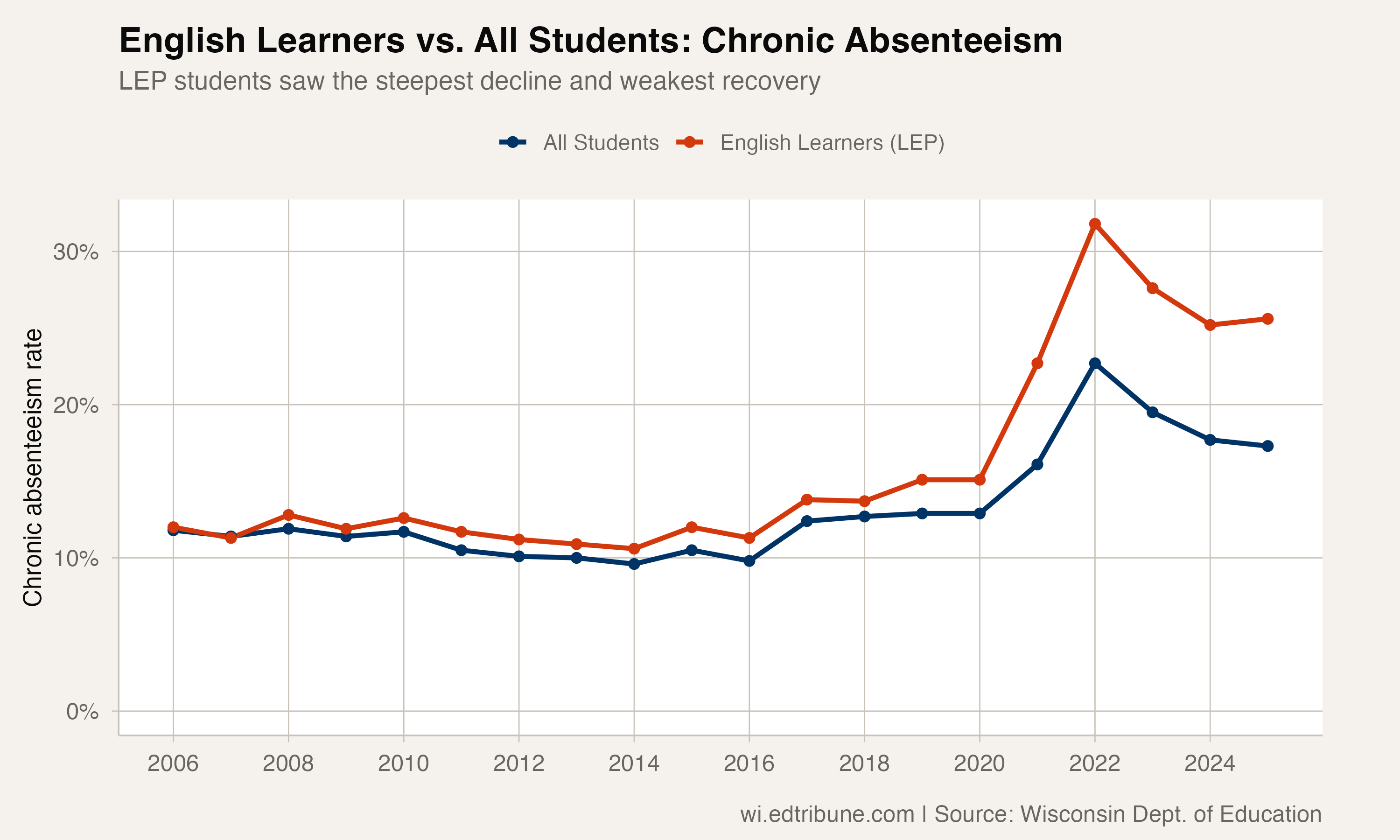
The Steepest Decline
When ranked by how much worse each subgroup's chronic rate has gotten since 2019, English learners stand at the top. Their 10.5 percentage-point increase exceeds every racial group, exceeds special education students, and exceeds the economically disadvantaged category.
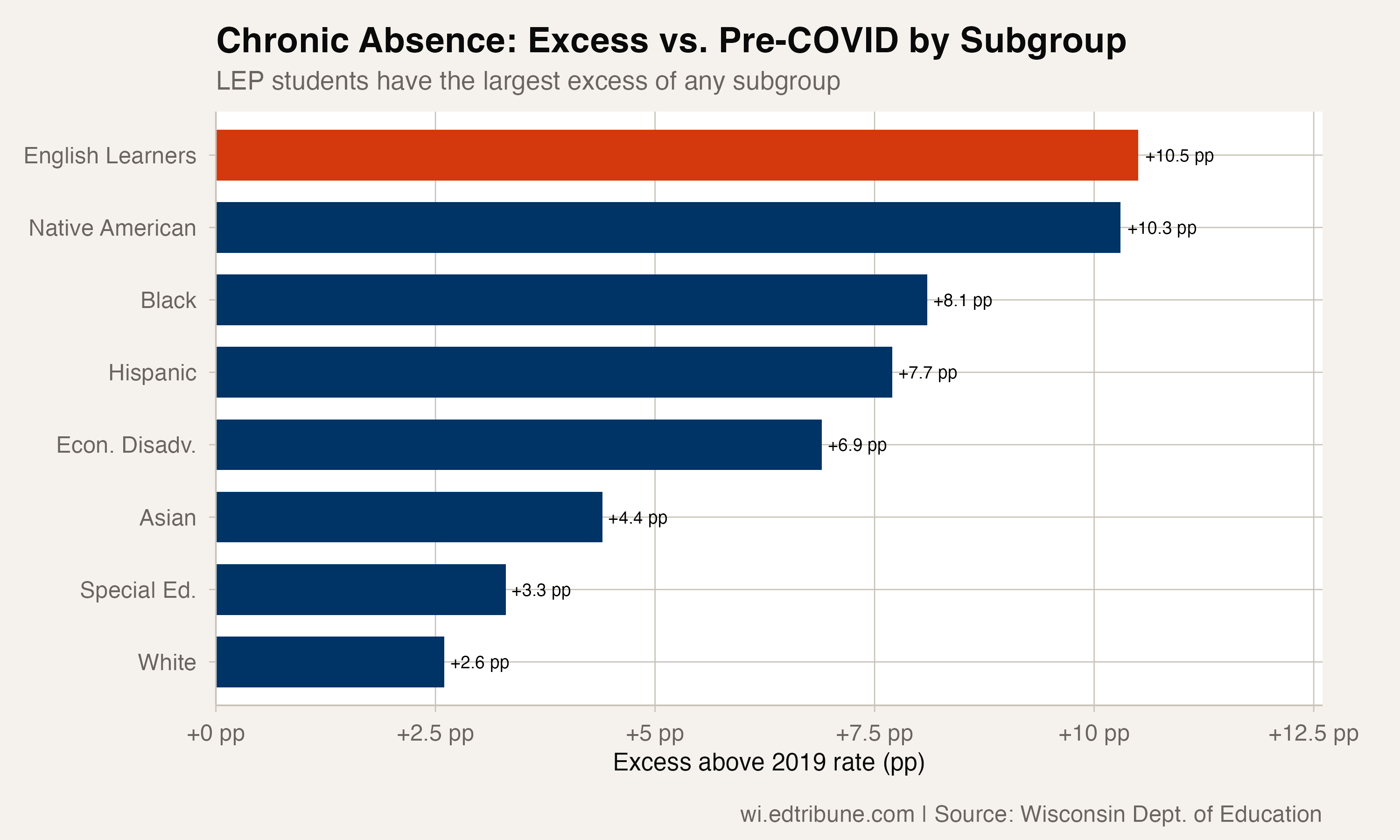
This finding is counterintuitive. English learners are not the group with the highest chronic rate. That distinction belongs to Black students (46.3%) and Native American students (38.9%). But they are the group that has moved the farthest from where they were before the pandemic.
The distinction matters because it suggests, but does not prove, that the pandemic disrupted something specific about English learner attendance, and that the disruption has proven resistant to the recovery happening in other populations.
A Quadrupled Gap
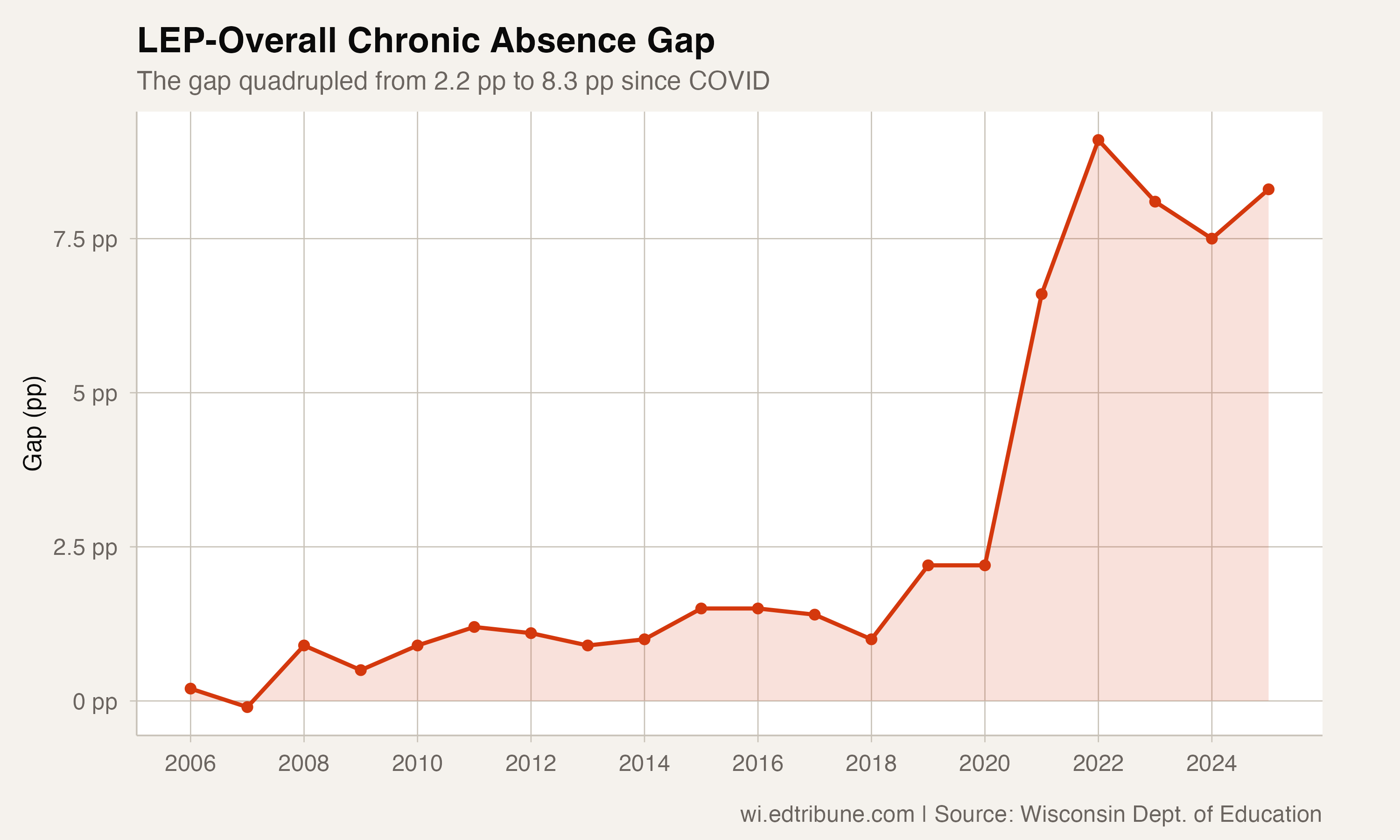
The LEP-to-overall gap was 2.2 points in 2019. It peaked at over 9 points during the pandemic and has settled at 8.3 points in 2025. English learners have gone from a group that was roughly in line with statewide attendance patterns to one of the most chronically absent populations in the state.
Wisconsin's English learner population has grown 41.1% since 2006, reaching 55,859 students in 2025. A Wisconsin Policy Forum review of English learners found that Spanish, Hmong, Somali, Arabic, and Chinese were among the state's most common EL languages in the years before the pandemic. Each community faces different attendance barriers.
Suggestive context: national attendance researchers point to family-school relationships, transportation, health, and school climate as recurring chronic-absence barriers, and English learner attendance guidance emphasizes communication with families in languages they understand (Attendance Works; WestEd/WEEAC). The Wisconsin data used here cannot isolate which of those mechanisms is driving the LEP increase.
A Growing Population with a Growing Problem
The compounding challenge is that Wisconsin's LEP population is expanding at the same time its attendance is deteriorating. More English learners are entering the system each year, and a larger share of them are chronically absent.
This has implications beyond attendance. Chronic absence reduces exposure to instruction, and national attendance research links missing 10% or more of school to weaker academic progress and later graduation risks (Attendance Works). For English learners, that lost instructional time also means less daily exposure to academic English.
The data does not explain what intervention would work. But it does show that English learner attendance has recovered less than every comparison group in the state data.
Detailed code that reproduces the analysis and figures in this article is available exclusively to EdTribune subscribers.
Discussion
Sign in to join the discussion.
Loading comments...