Before the pandemic, the attendance divide between Wisconsin's lower-income and higher-income students was already wide. Students who are economically disadvantaged had a 22.5% chronic absenteeism rate in 2019, compared to 6.2% for students who are not, a 16.3-point gap.
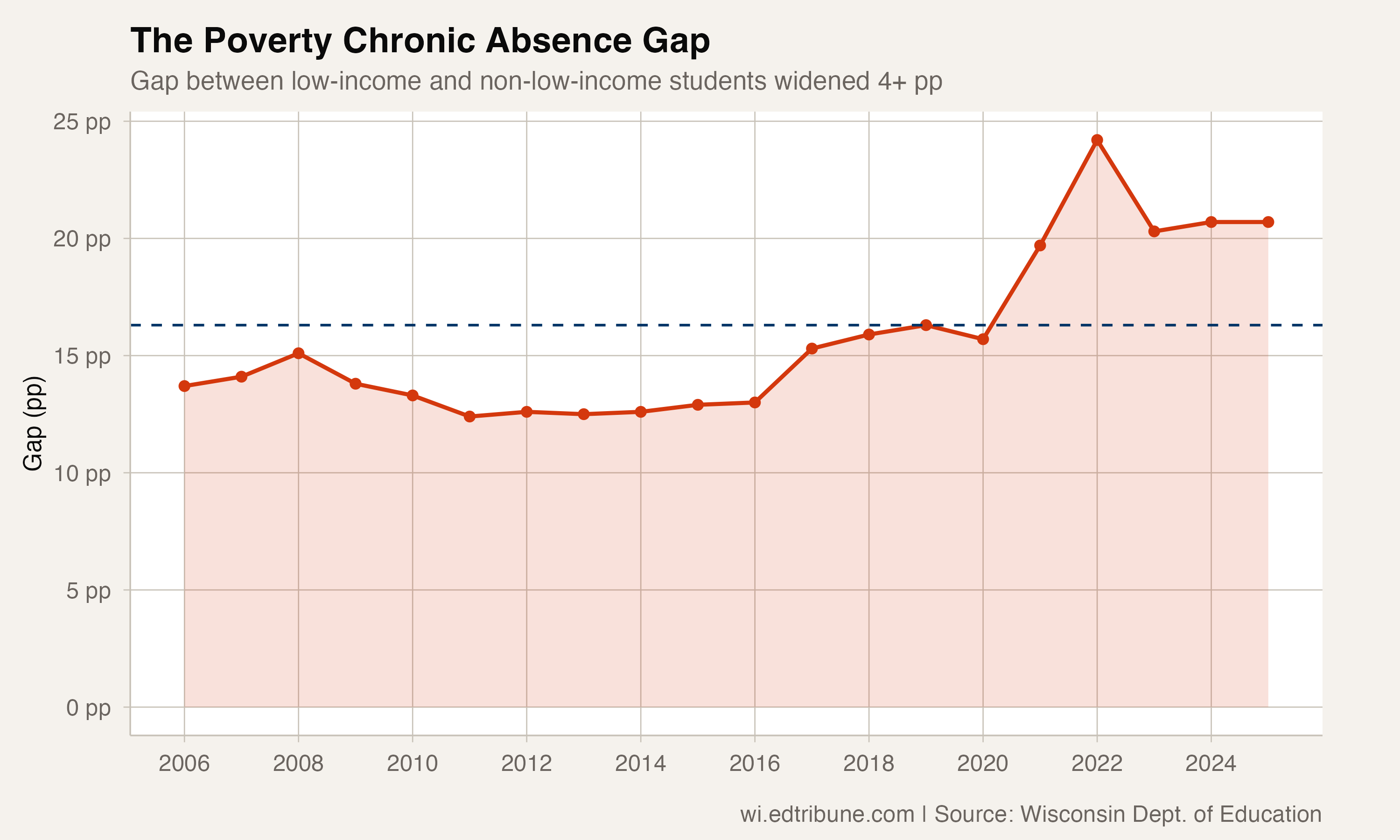
Three years after chronic absenteeism peaked, that gap has grown to 20.7 points.
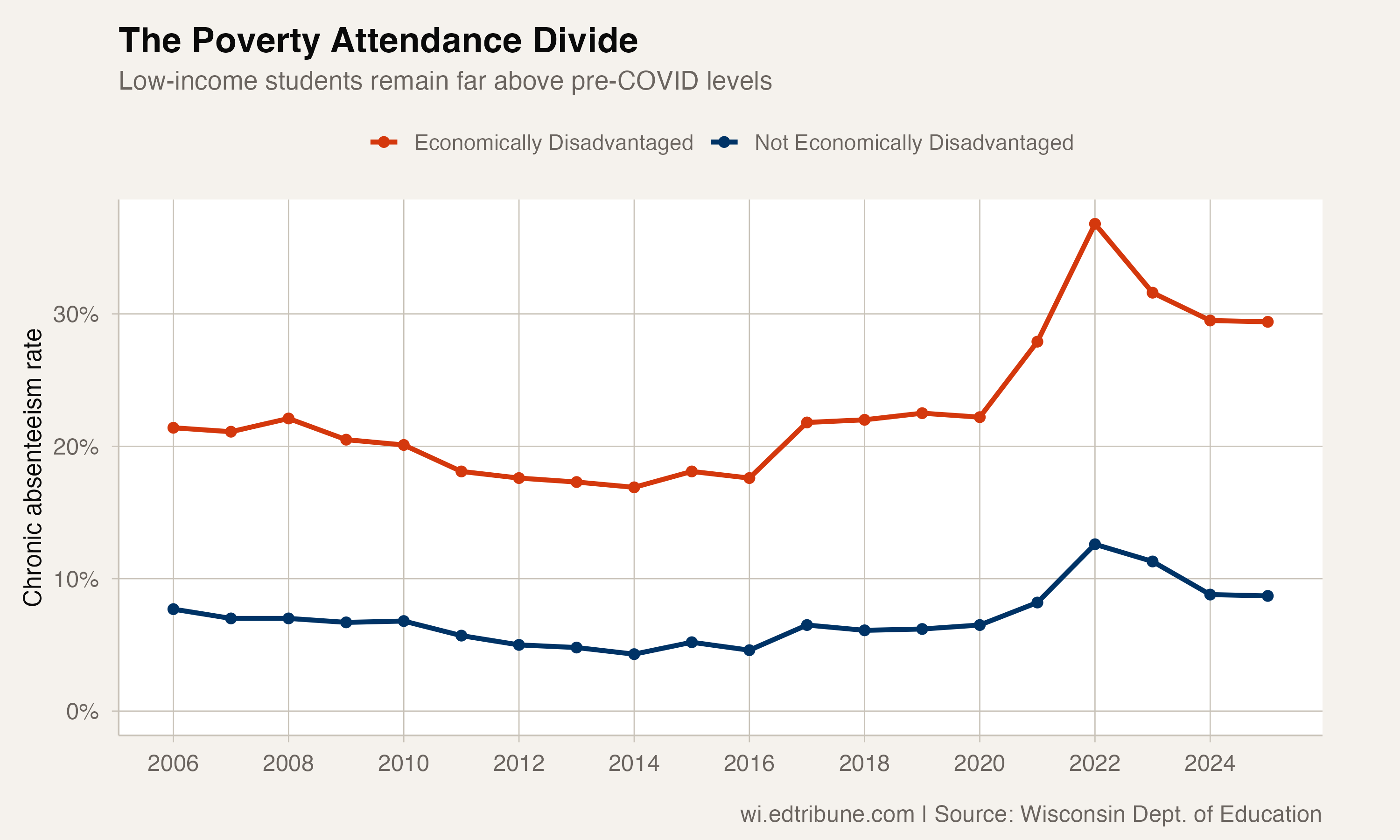
Students who are economically disadvantaged are at 29.4% in 2025, nearly one in three. Students who are not are at 8.7%, just 2.5 points above their pre-COVID rate and trending toward full recovery. The poverty attendance divide has widened by 4.4 percentage points, or 27%, since 2019.
A Two-Speed Recovery
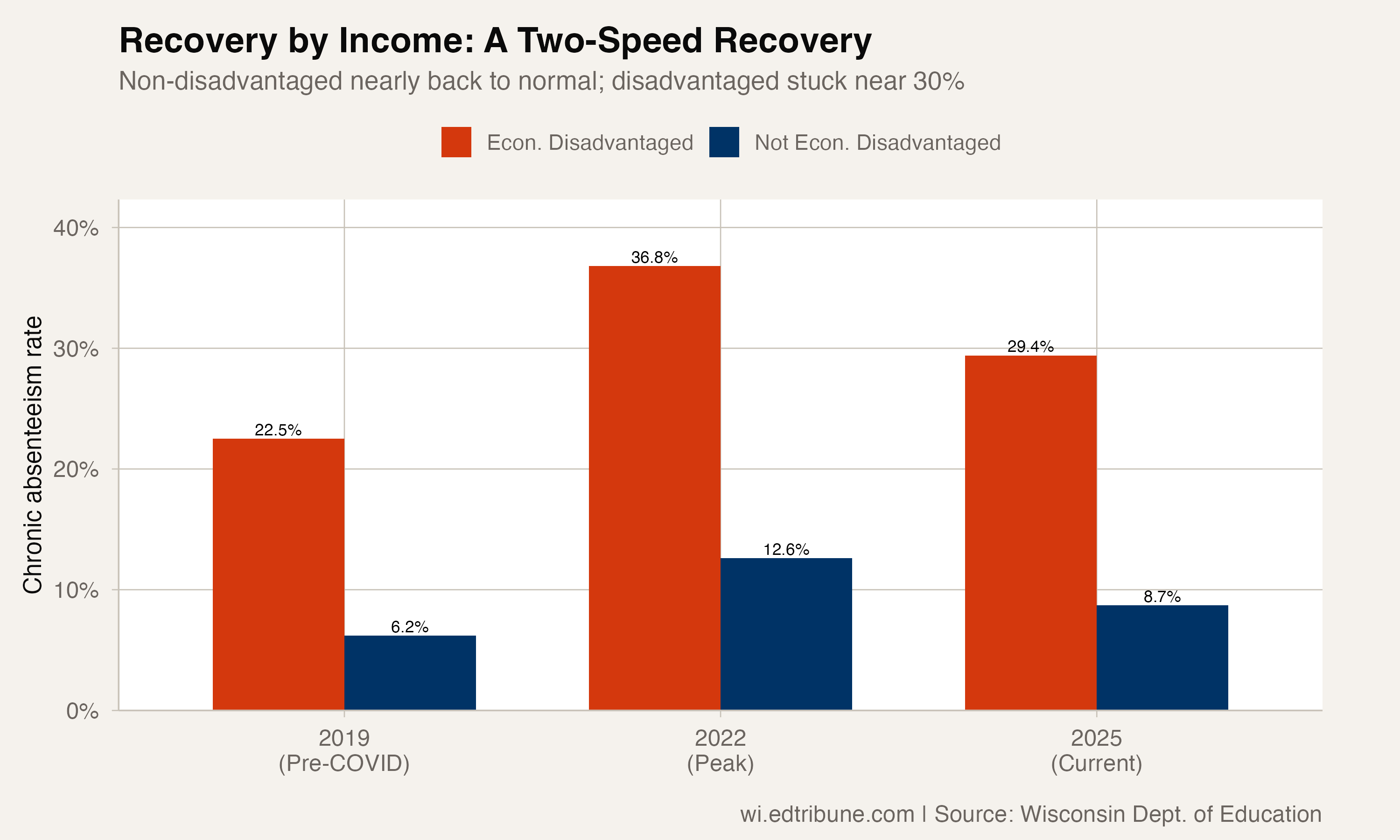
The divergence is clearest when viewed as a recovery comparison. Students who are not economically disadvantaged have recovered the majority of the way back to their pre-pandemic rate. Their peak of 12.6% in 2022 has come down to 8.7%, a recovery trajectory that suggests near-complete return to normal within another year.
Students who are economically disadvantaged peaked at 36.8% in 2022 and have improved to 29.4%. That is real progress, 7.4 percentage points of improvement. But they remain nearly 7 points above their pre-COVID rate, and the pace of recovery is slowing.
The pre-2017 average gap between these groups was 13.3 percentage points. The current gap of 20.7 points means the poverty divide in attendance has grown by more than half compared to the baseline era.
What Poverty Means for Attendance
The connection between poverty and chronic absence is not mysterious. Students from low-income families are more likely to face transportation barriers, housing instability, food insecurity, untreated health conditions, and caregiving responsibilities for younger siblings. They are more likely to attend under-resourced schools with fewer counselors and attendance staff. They are more likely to have parents working hourly jobs without the flexibility to manage school logistics.
The pandemic intensified every one of these pressures. Job losses, evictions, and the collapse of informal childcare networks disproportionately affected low-income families. When schools reopened, many of these families had experienced a fundamental disruption to the routines that made daily attendance possible.
Wisconsin uses membership-based funding rather than average daily attendance, meaning districts do not lose state aid when students are absent. This removes one financial incentive to pursue attendance improvement. It also means that students from low-income families are not doubly penalized by attendance-based funding formulas that redirect money away from the schools serving the students with the greatest needs.
The Scale of the Problem
With roughly 40% of Wisconsin's students qualifying as economically disadvantaged, a 29.4% chronic rate in this group represents a large number of students. Many of these same students score lower on state assessments and graduate at lower rates, and attendance is one of the levers districts can pull to change that.
The attendance gap is both a symptom and a cause. Students who miss school fall behind academically, which makes school feel less rewarding, which makes attendance feel less important. Breaking this cycle for the nearly one in three students who are economically disadvantaged calls for interventions that go beyond phone calls home and truancy referrals. It means addressing the material conditions that make regular attendance difficult.
The 4.4-point widening measures how much further the state has drifted from equity since 2019. Closing it means confronting a divide that was already deep before COVID arrived.
Detailed code that reproduces the analysis and figures in this article is available exclusively to EdTribune subscribers.
Discussion
Sign in to join the discussion.
Loading comments...