Wisconsin's state-level chronic absenteeism rate has recovered 55% of the way back to its pre-COVID level. That sounds like meaningful progress.
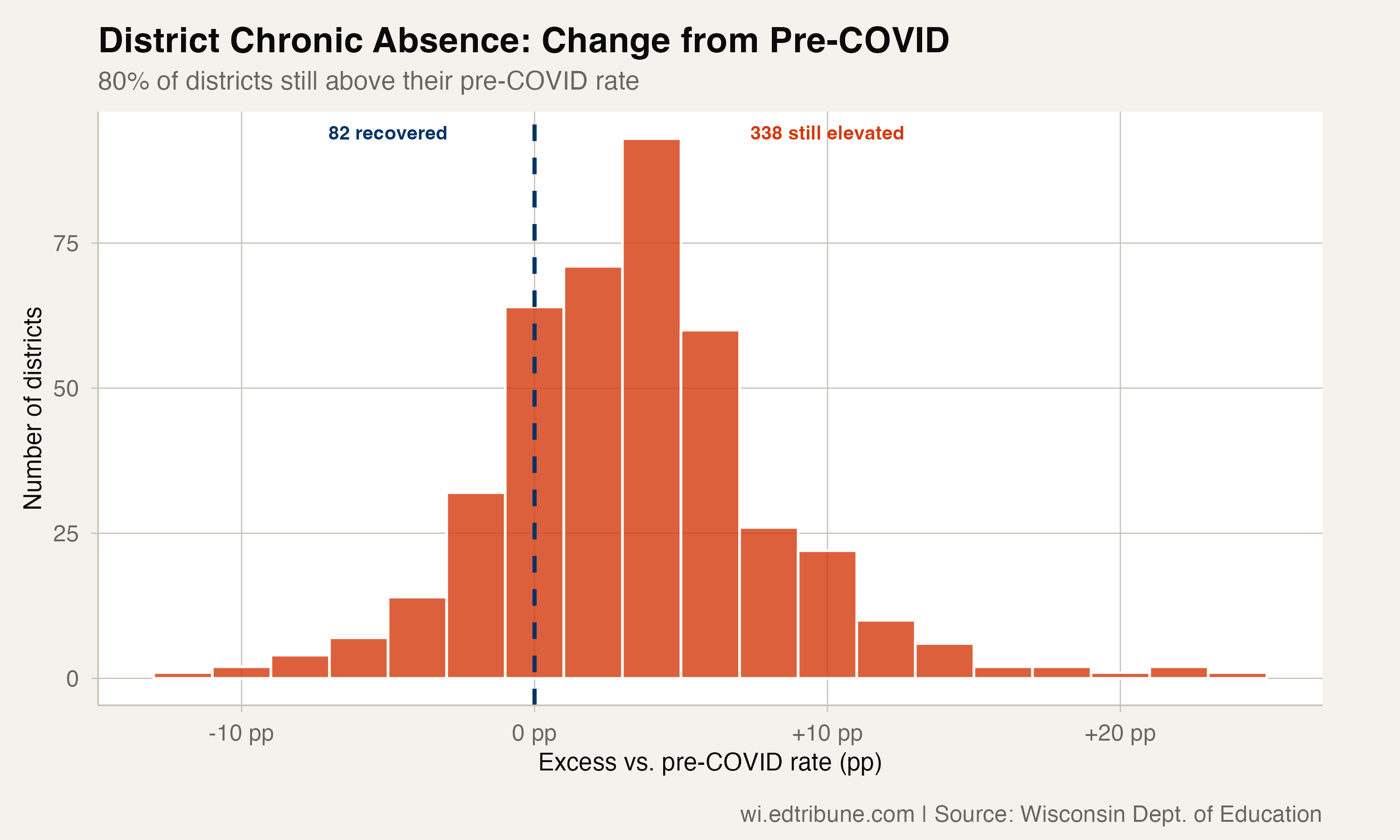
But the state-level number masks a bleaker reality at the district level. Only 83 of 421 Wisconsin school districts, 19.7%, have returned to their pre-COVID chronic absenteeism rates. The other 338 districts, more than four out of five, are still operating with elevated absence three years after the 2022 peak.
Why the State Number Lies
The disconnect between 55% state-level recovery and 80% of districts still elevated has a simple explanation: large districts that recovered are pulling the state average down.
Districts like Elmbrook↗ET (7,452 students, 3.1% chronic rate) and Hortonville↗ET (3,963 students, 2.4%) have chronic rates lower than their pre-COVID levels. These are overwhelmingly affluent suburban communities with strong parent engagement and stable enrollment. Their low rates carry significant weight in the state average.
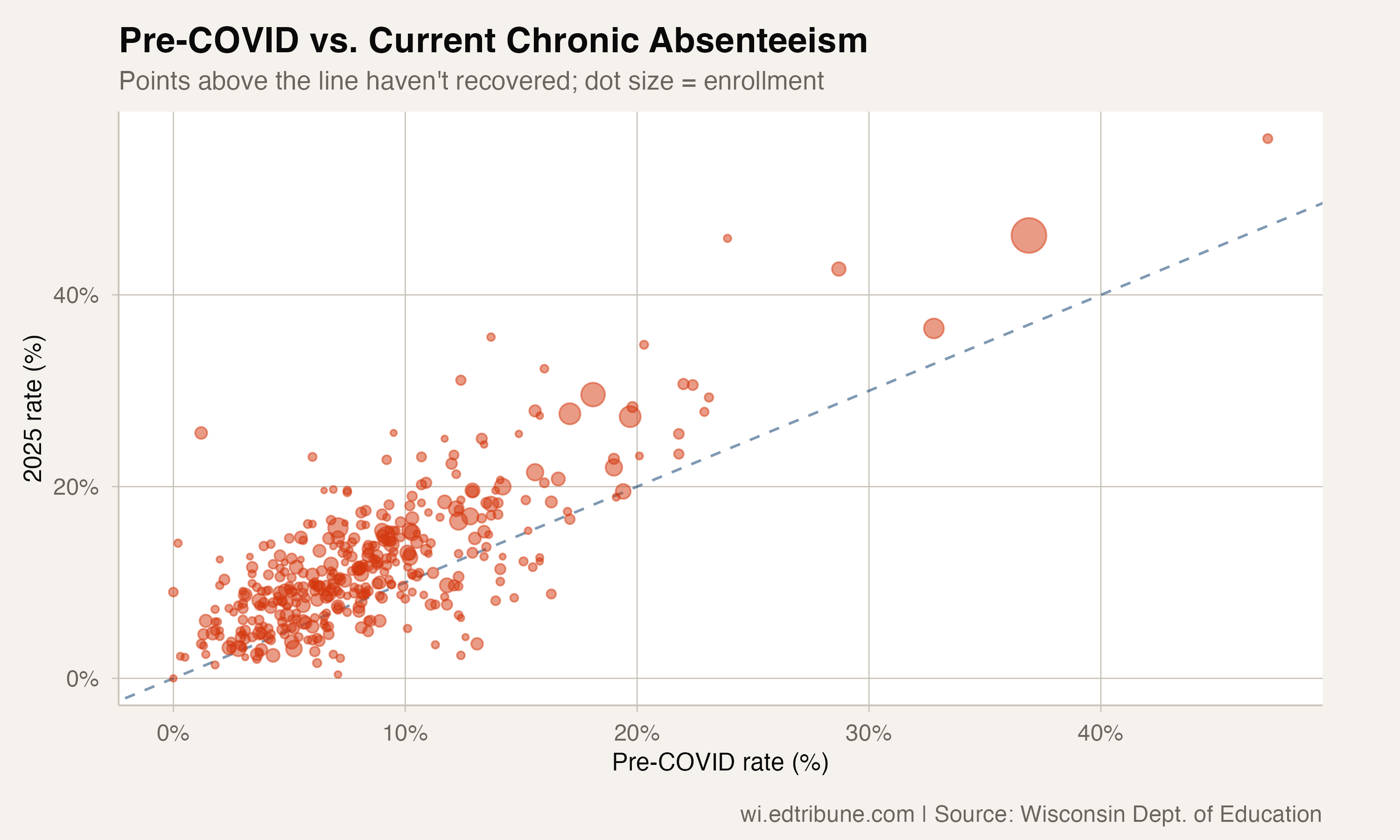
Meanwhile, hundreds of smaller districts (rural communities, small cities, tribal schools) are stuck with chronic rates 5, 10, even 15 points above where they were in 2019. Each individual district contributes little to the state average, so their struggles are invisible in aggregate.
Size Matters for Recovery
The pattern holds across district size categories. Smaller districts tend to have higher recovery rates, partly because their pre-COVID rates were lower to begin with and partly because smaller communities may have more direct connections between schools and families.
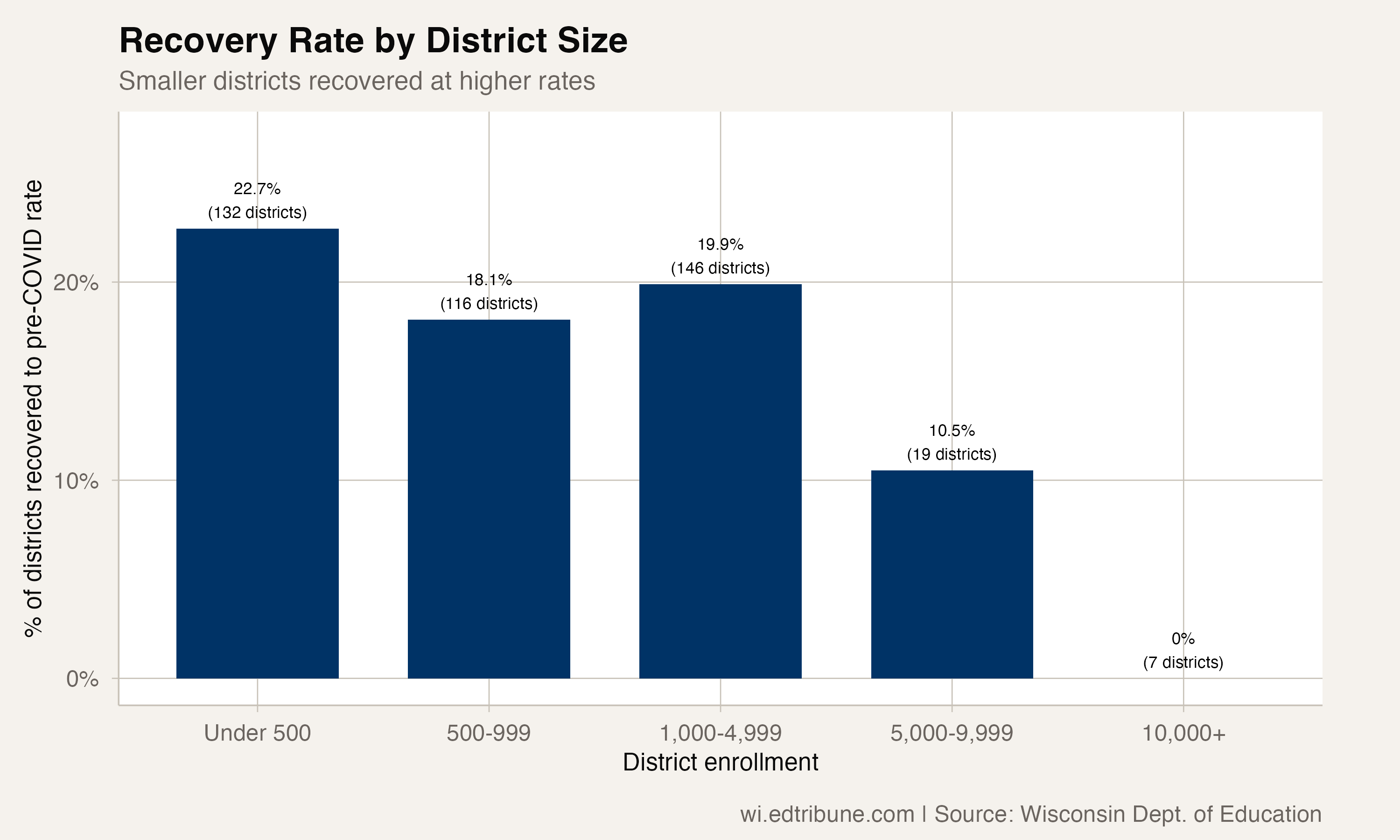
The largest districts, those enrolling 10,000 or more students, have the lowest recovery rates. This is where the most chronically absent students are concentrated, and where the structural challenges of poverty, housing instability, and transportation are most acute.
The Worst Excess
Among large districts still above pre-COVID levels, the excess is striking. Several districts with more than 1,000 students are running chronic rates 10 or more points above where they were in 2019.
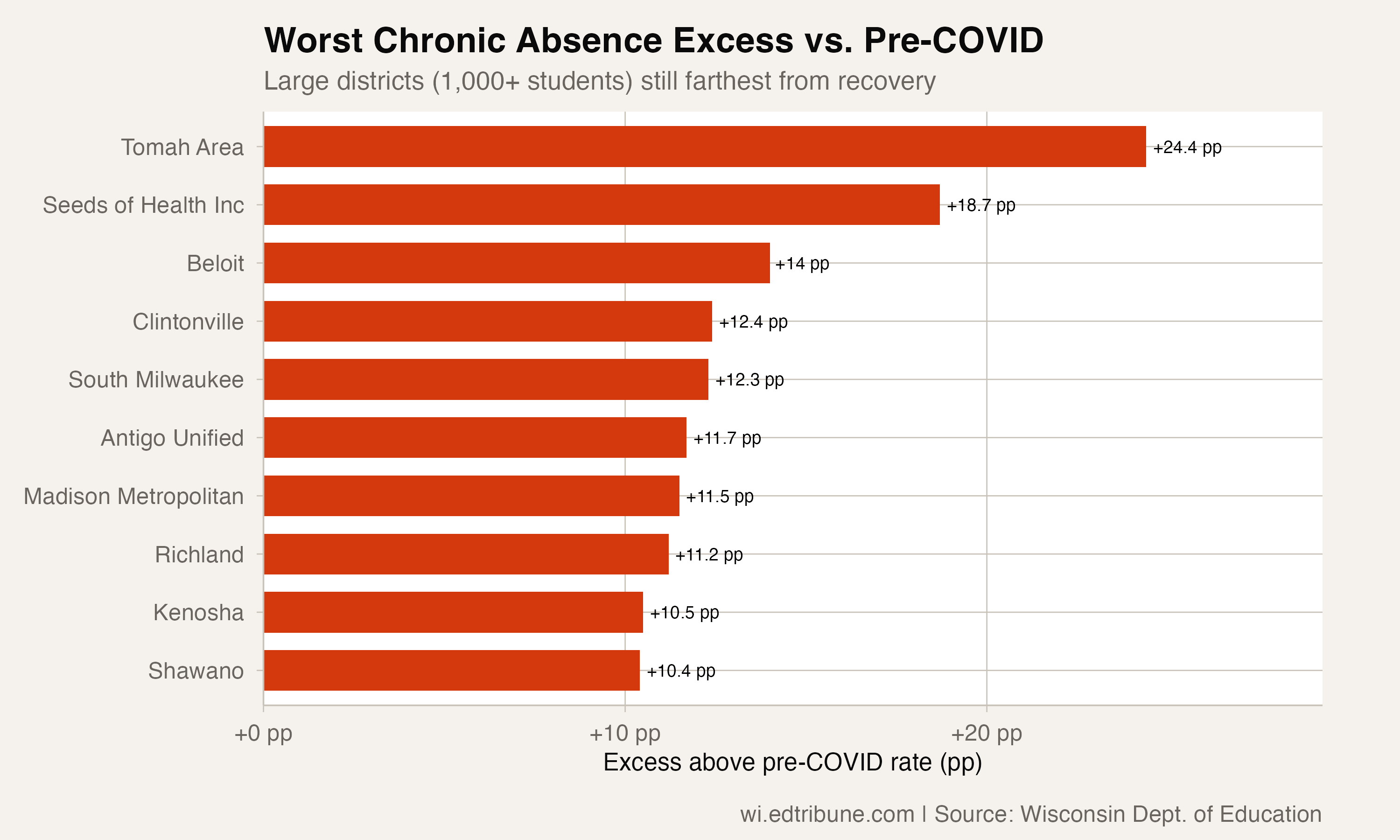
These are not districts that experienced a temporary COVID spike and are slowly recovering. These are districts where attendance has fundamentally shifted, where the pre-pandemic norm of 10-15% chronic absence has been replaced by a new normal of 25-40%.
The 80% Problem
The 80% non-recovery rate raises a question about whether full recovery is the right benchmark. If four out of five districts cannot return to pre-COVID attendance levels despite three years of effort, perhaps the pre-pandemic baseline was not as stable as it appeared. Wisconsin's rates were already drifting upward before COVID, from a 9.6% low in 2014 to 12.9% in 2019.
But even if full recovery is not realistic, the current 80% failure rate suggests that whatever interventions districts are deploying (attendance coaches, family outreach, truancy referrals, incentive programs) are not working at scale.
The state's ENGAGE program operates in 27 districts. There are 421 traditional school districts in Wisconsin. The gap between the scope of the problem and the scope of the response is significant.
The 83 districts that have recovered prove it can be done. Whether their advantages (stable housing, strong tax bases, engaged communities) can be replicated in the 338 districts still struggling is the harder question.
Detailed code that reproduces the analysis and figures in this article is available exclusively to EdTribune subscribers.
Discussion
Sign in to join the discussion.
Loading comments...