Correction: This article originally stated Black students made up 9.9% of enrollment (correct figure: 8.8%), reported the disproportionality ratio as 2.4x (correct: 2.7x), the Hispanic chronic rate as 27.9% (correct: 27.0%), and described the 2022 Black peak as exceeding 60% (actual: 58.0%).
The pandemic disrupted every student's schooling. The recovery has been anything but equal.
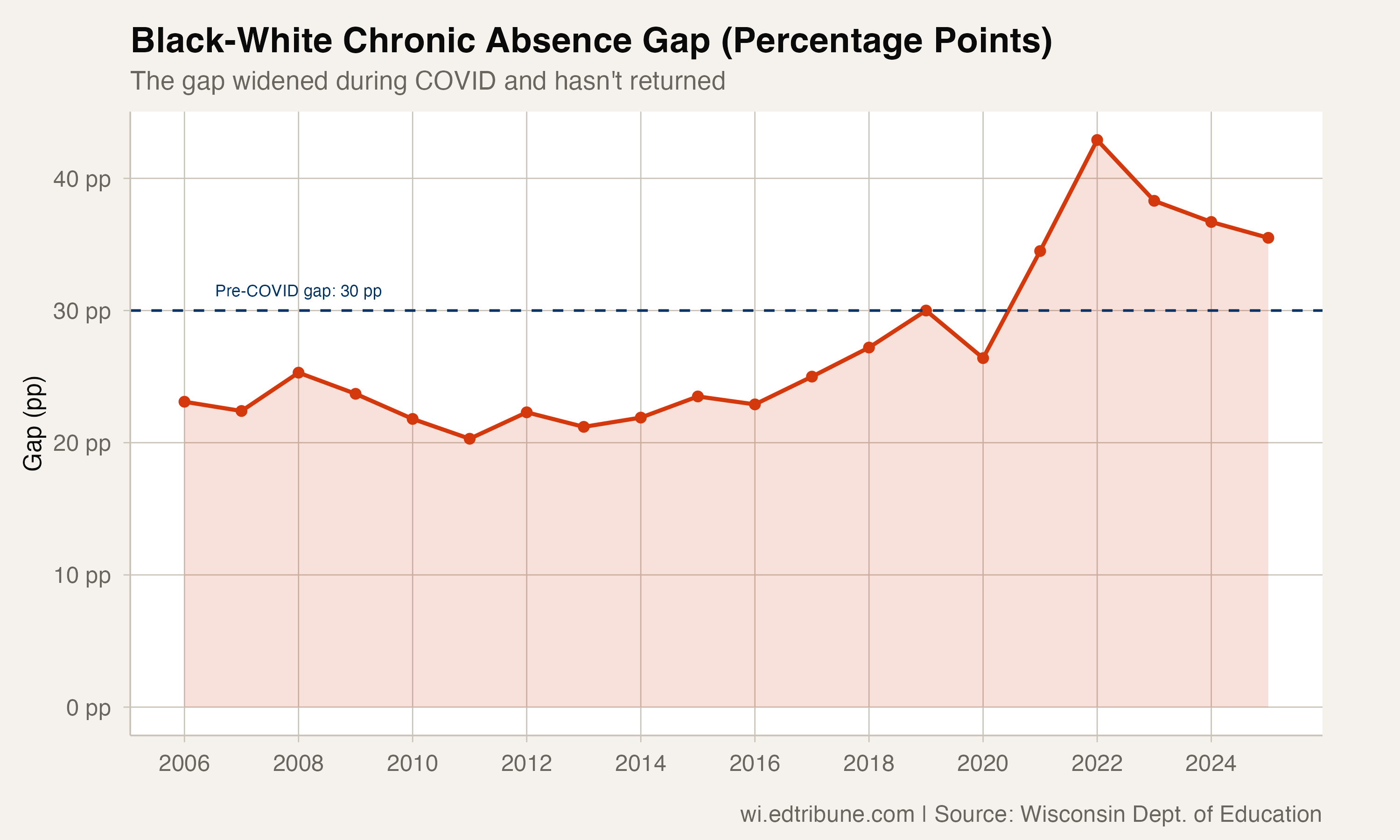
In 2019, the gap between Black and white chronic absenteeism rates in Wisconsin was 30.0 percentage points. That was enormous, but a number the state had lived with for years. Black students had a 38.2% chronic rate; white students were at 8.2%.
By 2025, that gap has expanded to 35.5 points. Black students are at 46.3%. White students are at 10.8%.
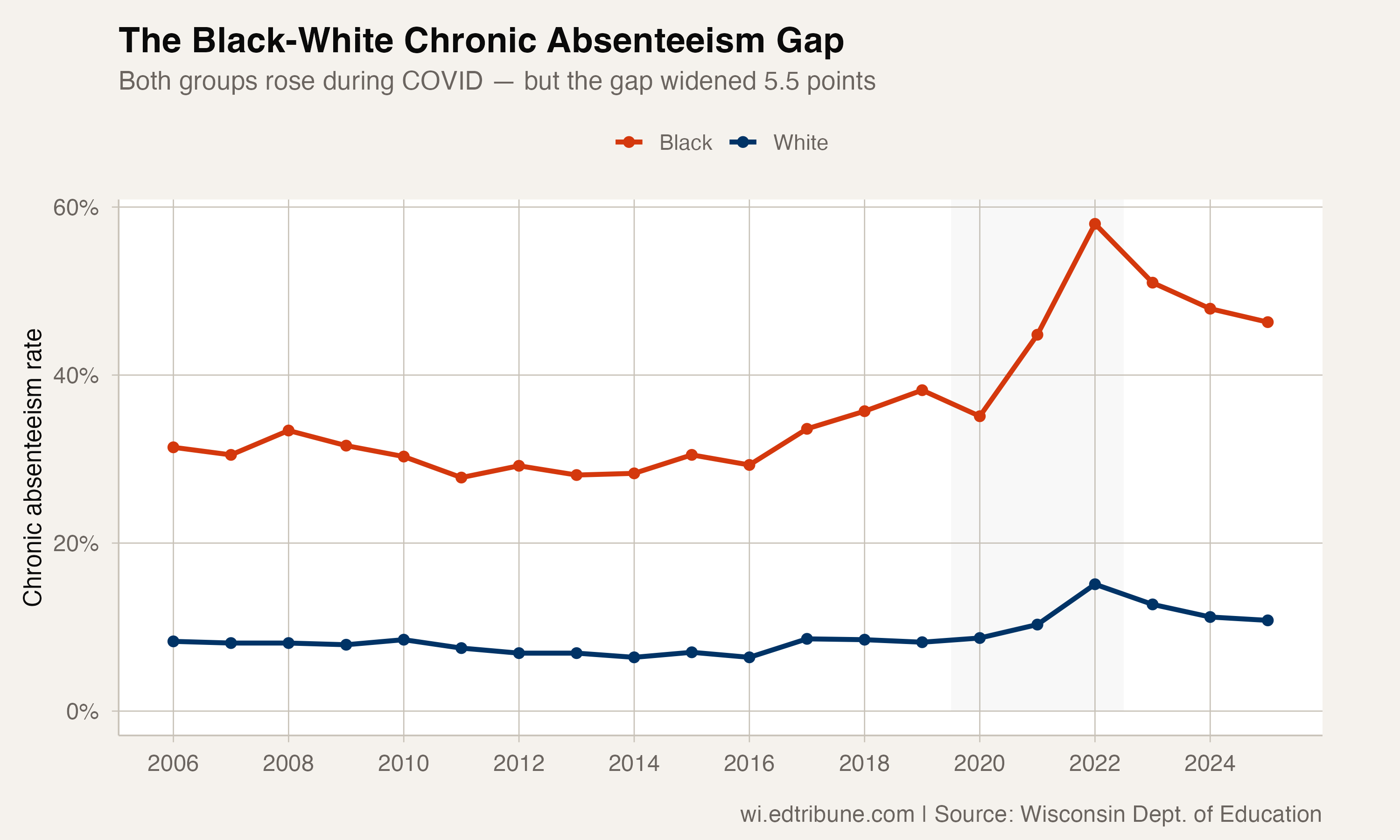
The 5.5-point widening did not happen because both groups got worse at the same rate. It happened because white students nearly recovered from the pandemic's attendance shock while Black students did not.
A Two-Speed Recovery
White students in Wisconsin have a chronic rate of 10.8%, just 2.6 points above their pre-COVID rate of 8.2%. That is close to a full recovery. If the current trajectory holds, white students could return to their pre-pandemic attendance levels within a year or two.
Black students, by contrast, remain 8.1 points above their 2019 rate. Their recovery from the 2022 peak of 58.0% has been substantial in absolute terms but has left them stuck at a level that means nearly half of all Black students in Wisconsin are missing too much school.
The Disproportionality in Numbers
The rate gap translates into a stark mismatch between who Black students are in Wisconsin's enrollment and who they are in the chronic absence numbers.
Black students make up 8.8% of Wisconsin's public school enrollment. But they account for 23.5% of all chronically absent students, a 2.7x disproportionality ratio. For every dollar, every intervention, every attendance coach deployed to address chronic absence statewide, Black students should be vastly overrepresented in who is reached. The question is whether they are.
White students, by comparison, are 65.8% of enrollment but represent a smaller share (roughly 41%) of chronically absent students.
Not Just a Black-White Story
The Black-white gap is the widest, but it is not the only one that has grown. Every racial equity gap in Wisconsin's chronic absenteeism data widened between 2019 and 2025.
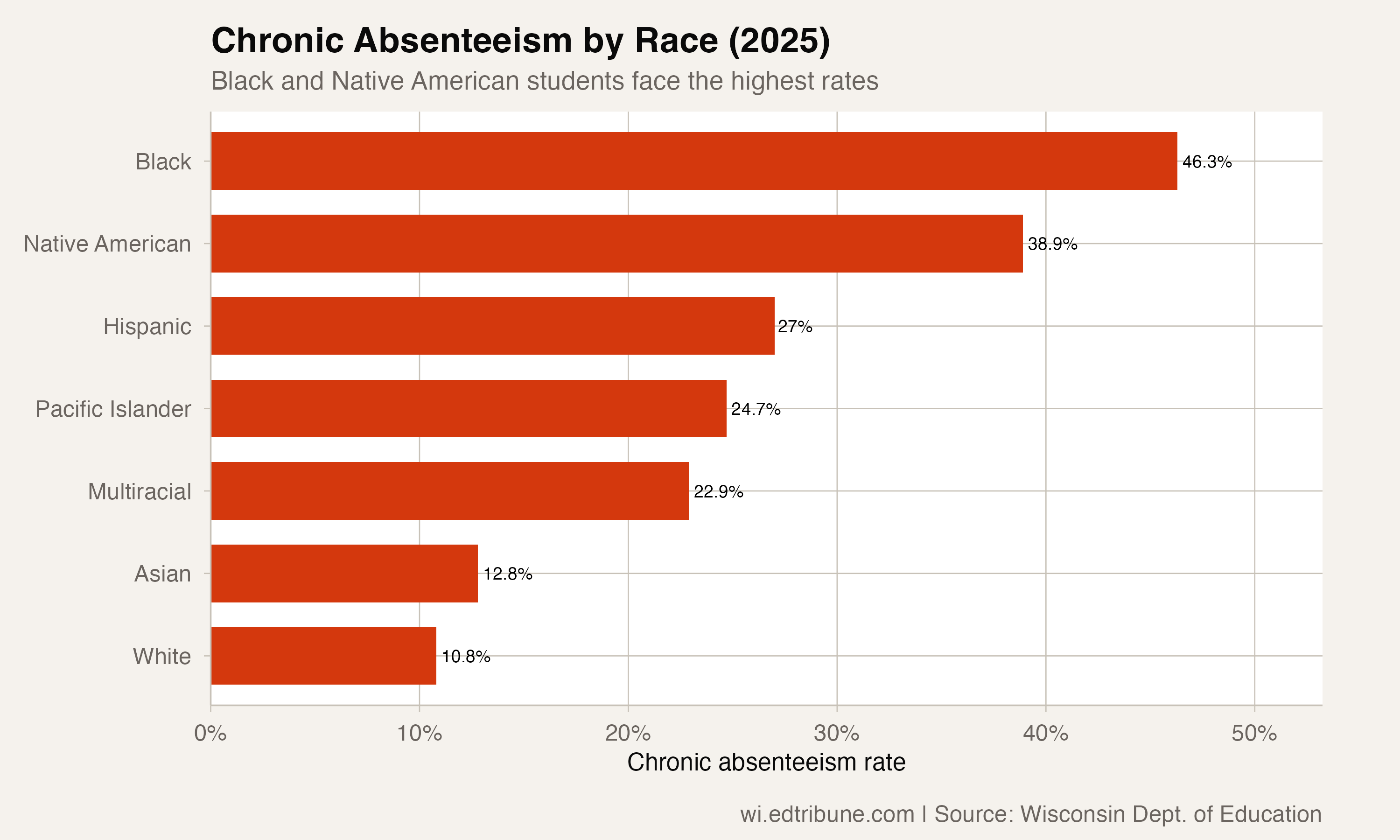
Native American students face a 38.9% chronic rate. Hispanic students are at 27.0%. Pacific Islander students, a small population in Wisconsin, also face disproportionately high rates. Asian students have the lowest rate among racial groups but have still not fully recovered to pre-COVID levels.
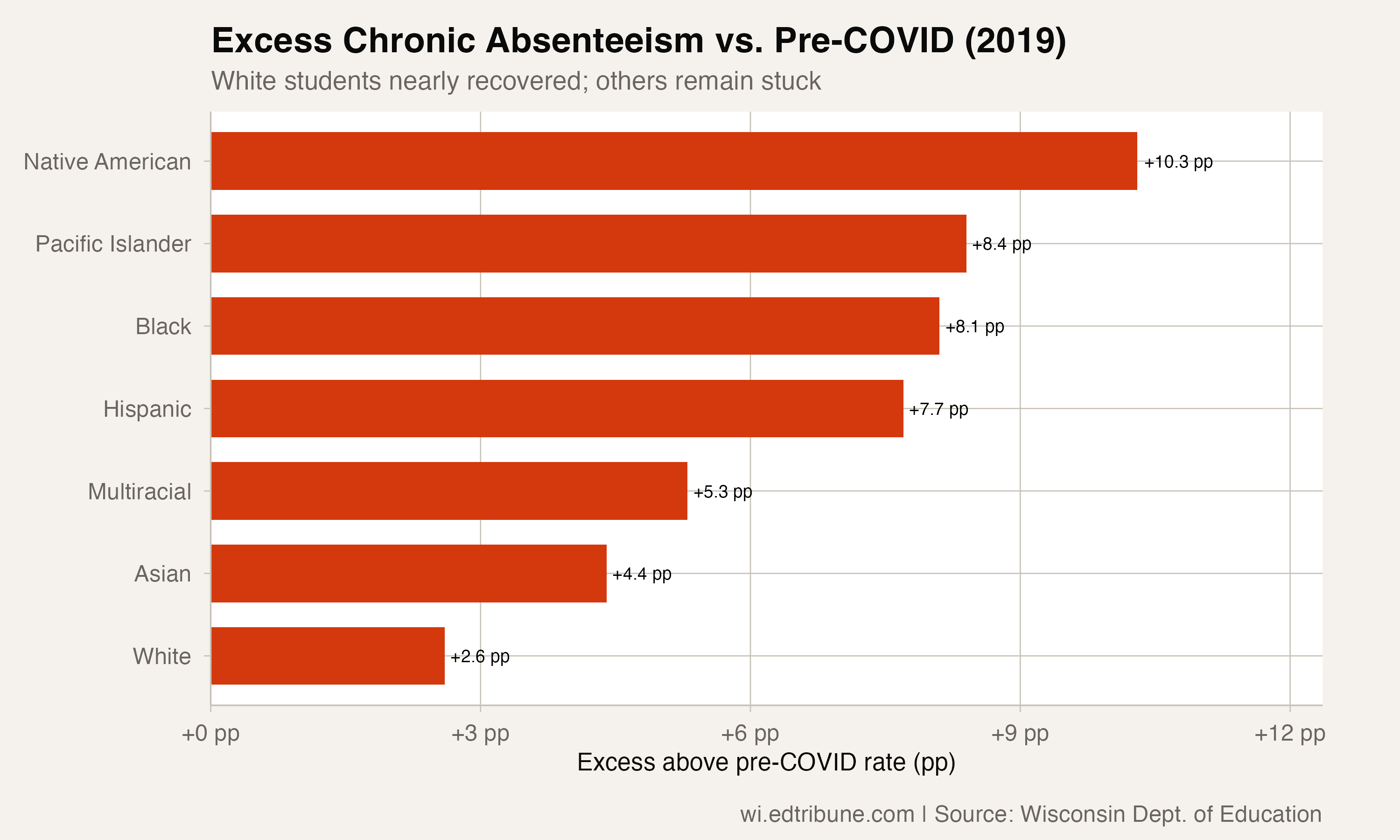
The pattern is consistent: white students recovered. Everyone else did not. The pandemic widened every gap, and three years of improvement have not been enough to narrow any of them.
What the Gap Means
A 35.5-point gap in chronic absenteeism between Black and white students is not just an attendance problem. It is a compounding disadvantage that feeds into every other educational outcome: test scores, graduation rates, college readiness, economic mobility.
Research consistently shows that chronic absence in elementary school predicts third-grade reading failure, and chronic absence in high school predicts dropout. When 46.3% of Black students are chronically absent, the downstream consequences extend far beyond the school building.
Wisconsin's ENGAGE program, which places attendance coaches in 27 districts, is one of the state's primary interventions. Whether it is reaching Black students in proportion to their need, or whether its resources are spread too thin across a 130,000-student problem, is a question the data raises but cannot answer.
The 5.5-point widening does not mean Wisconsin lacks good intentions on equity. It means good intentions have not been enough.
Detailed code that reproduces the analysis and figures in this article is available exclusively to EdTribune subscribers.
Discussion
Sign in to join the discussion.
Loading comments...