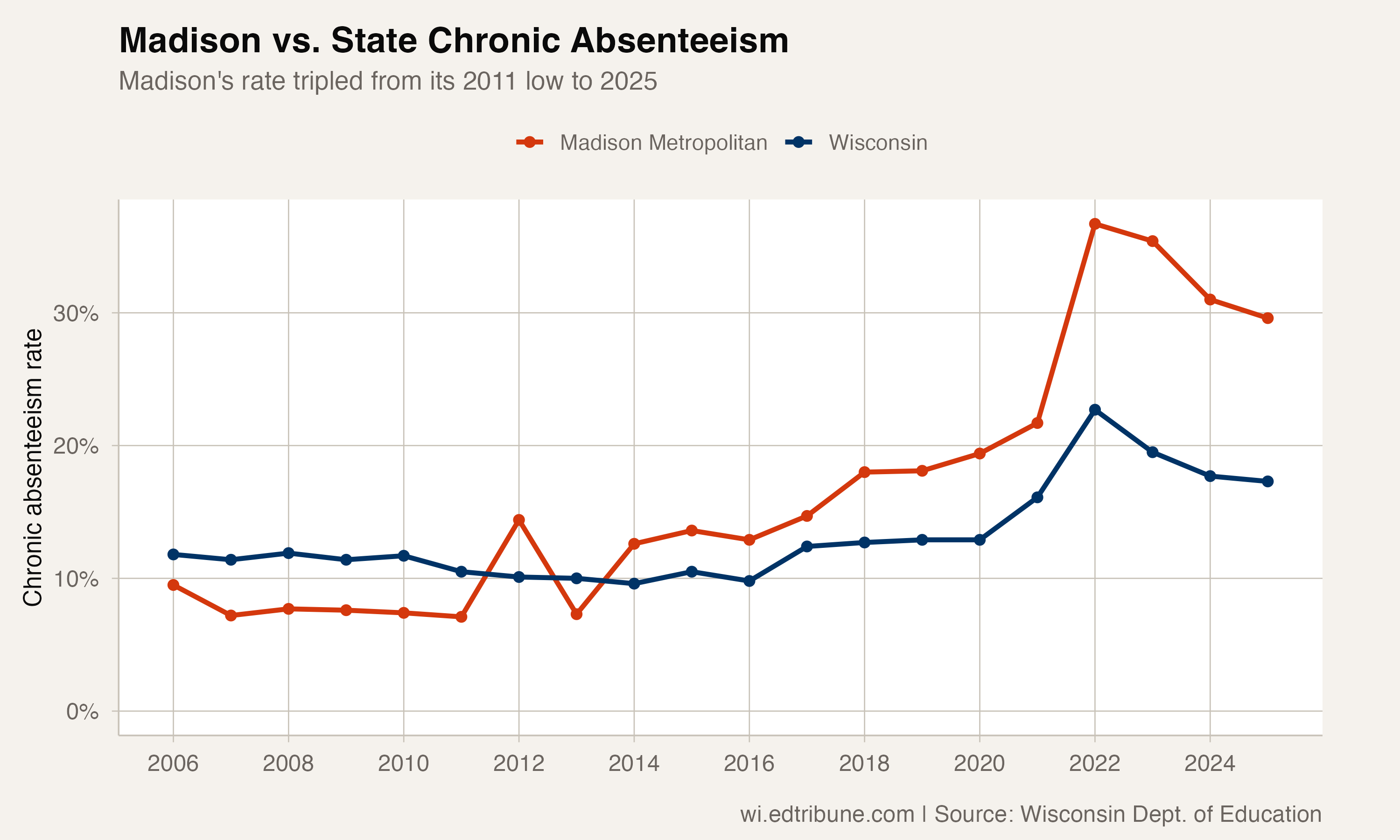
Madison Metropolitan↗ET, Wisconsin's second-largest school district and the seat of state government, had a chronic absenteeism rate of 7.1% in 2011. By 2025, it is 29.6%.
That is not a pandemic story. It is a decades-long transformation of a capital-city school district from one where chronic absence was a fringe problem to one where nearly a third of students are missing too much school.
The Pre-COVID Rise
The most important thing about Madison's attendance trajectory is that it was climbing long before COVID. The rate went from 9.5% in 2006 to 7.1% in 2011, then reversed: 10.3% in 2014, 14.8% in 2017, 18.1% in 2019.
By the time the pandemic hit, Madison's chronic rate had already more than doubled from its low point. COVID pushed it to 36.7% in 2022, but the pandemic was an accelerant to a fire that was already burning.
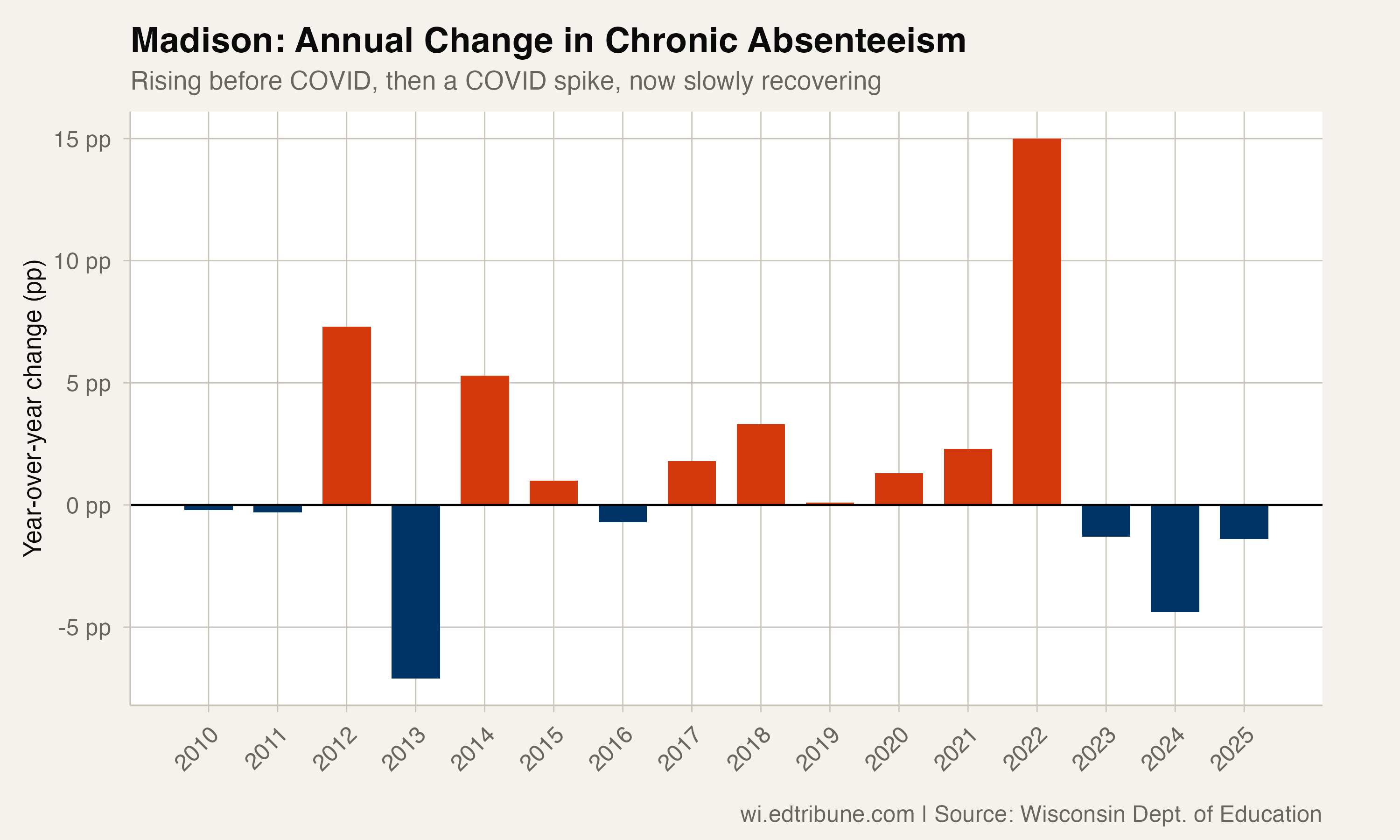
This pre-COVID trend distinguishes Madison from districts like Milwaukee, where chronic absence was always high, or Racine, where the pandemic represented a clear inflection point. Madison's trajectory suggests structural forces within the district (demographic shifts, changing family norms, mental health pressures, or growing income inequality in Dane County) that have been driving absence upward for more than a decade.
Inside the 29.6%
Within Madison, the disparities are stark.
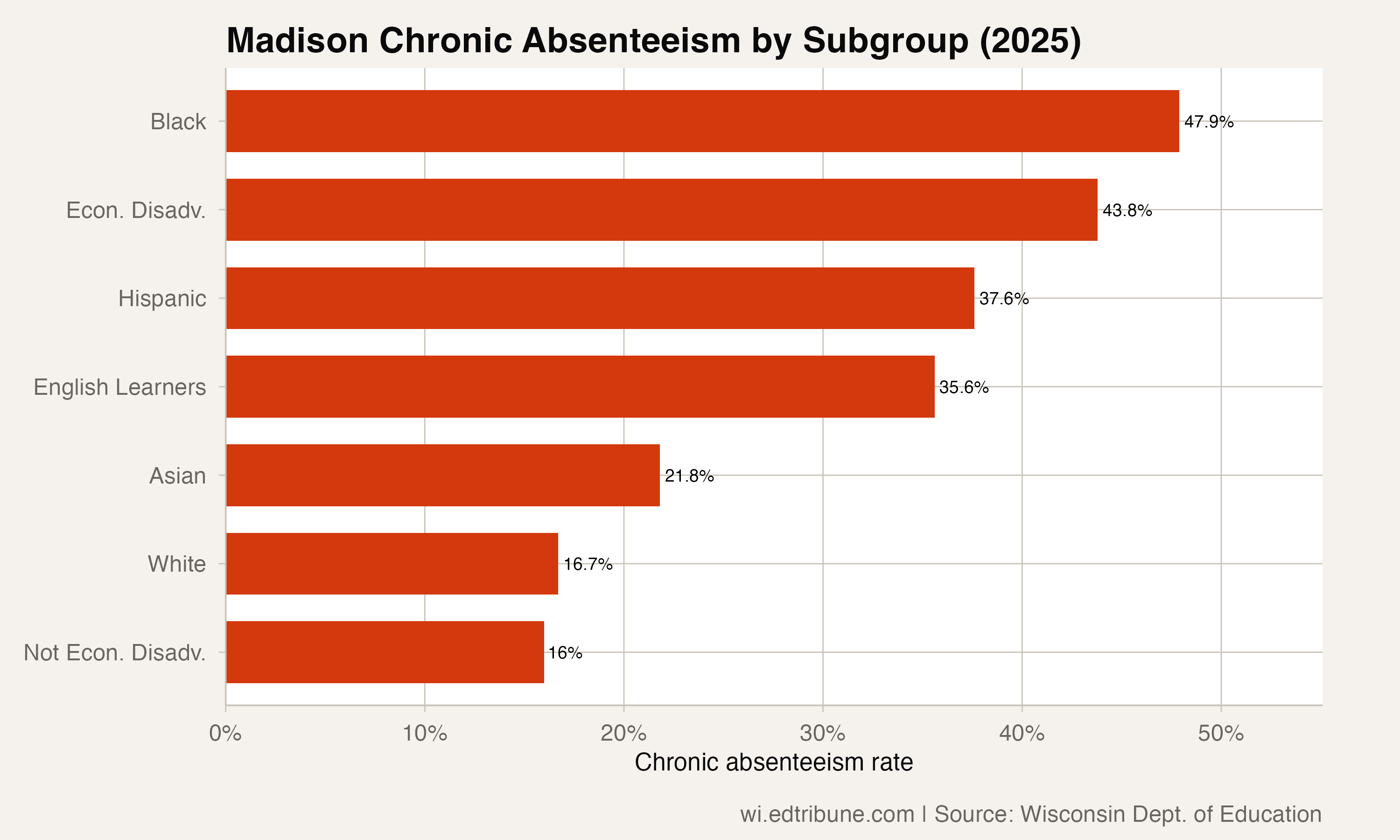
The subgroup data reveals that Madison's 29.6% overall rate is an average across vastly different experiences. Some student populations face rates approaching or exceeding 50%, while others are far below the district average. The district's growing diversity (Madison has become increasingly multiracial and multilingual over the past decade) means that the chronic absence burden falls disproportionately on students of color and English learners.
What 23,480 Students Means
Madison enrolls 23,480 students in 2025. At a 29.6% chronic rate, roughly 6,950 students are chronically absent, more than the total enrollment of most Wisconsin school districts.
This matters for the state-level picture. Madison is the second-largest contributor to Wisconsin's chronic absence total, behind only Milwaukee. Together, Milwaukee and Madison account for more than a quarter of all chronically absent students statewide. Any state strategy that does not move the needle in these two districts is a strategy that cannot succeed.
Madison's challenge is in some ways harder than Milwaukee's. Milwaukee has been dealing with high chronic absence for years and has built infrastructure, however insufficient, to address it. Madison is a district that remembers when its chronic rate was 7%. The institutional muscle for attendance intervention is less developed, even as the problem has grown to rival Milwaukee's.
The Capital City Paradox
Madison sits at the center of one of Wisconsin's most economically prosperous regions. Dane County has low unemployment, high educational attainment, and a robust public sector anchored by the University of Wisconsin and state government. It is not the kind of community typically associated with a 30% chronic absence rate.
But Madison also has one of the widest achievement gaps in the nation between white students and students of color. The chronic absence data mirrors that pattern: the district's overall rate is pulled up by severe absence among Black, Hispanic, and low-income students even as some subgroups maintain rates far below the state average.
Madison's tripling is a warning that attendance crises do not require urban decline. They can grow in prosperous communities where the gap between the haves and have-nots is wide enough.
Detailed code that reproduces the analysis and figures in this article is available exclusively to EdTribune subscribers.
Discussion
Sign in to join the discussion.
Loading comments...