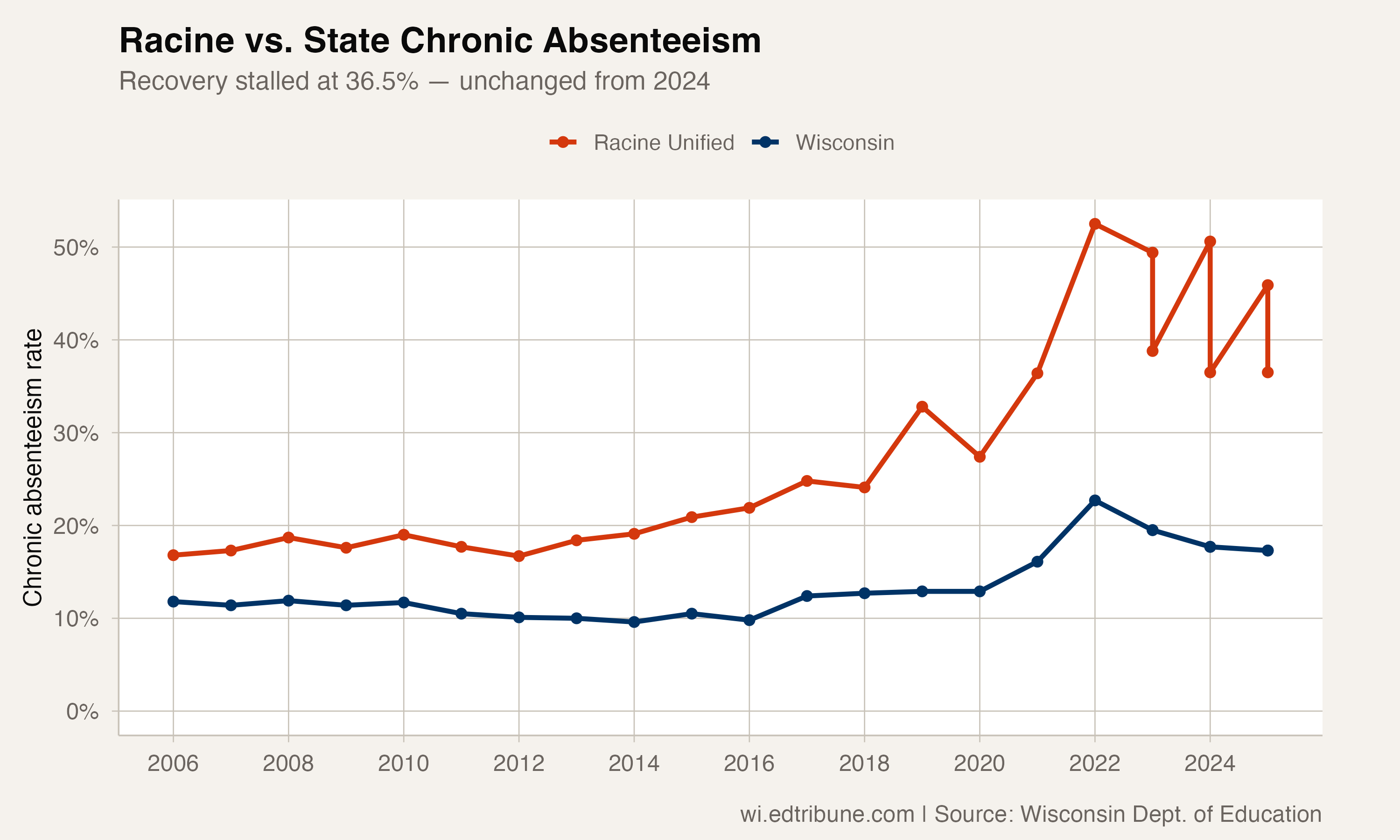
Racine Unified↗ET showed promising signs of attendance recovery in 2023 and 2024. After its chronic absenteeism rate spiked to 52.5% in 2022, more than half of all students missing too much school, the rate dropped to 38.8% in 2023 and 36.5% in 2024.
Then it stopped. In 2025, Racine's chronic rate is exactly 36.5%. Flat. Unchanged. While the state improved by another 0.4 points, Racine's recovery stalled.
More Than One in Three
The 36.5% rate means 5,277 of Racine's 14,464 students were chronically absent in 2024-25. That is more than one in three students missing more than 10% of school days, a rate that makes regular attendance the exception for a significant portion of the student body.
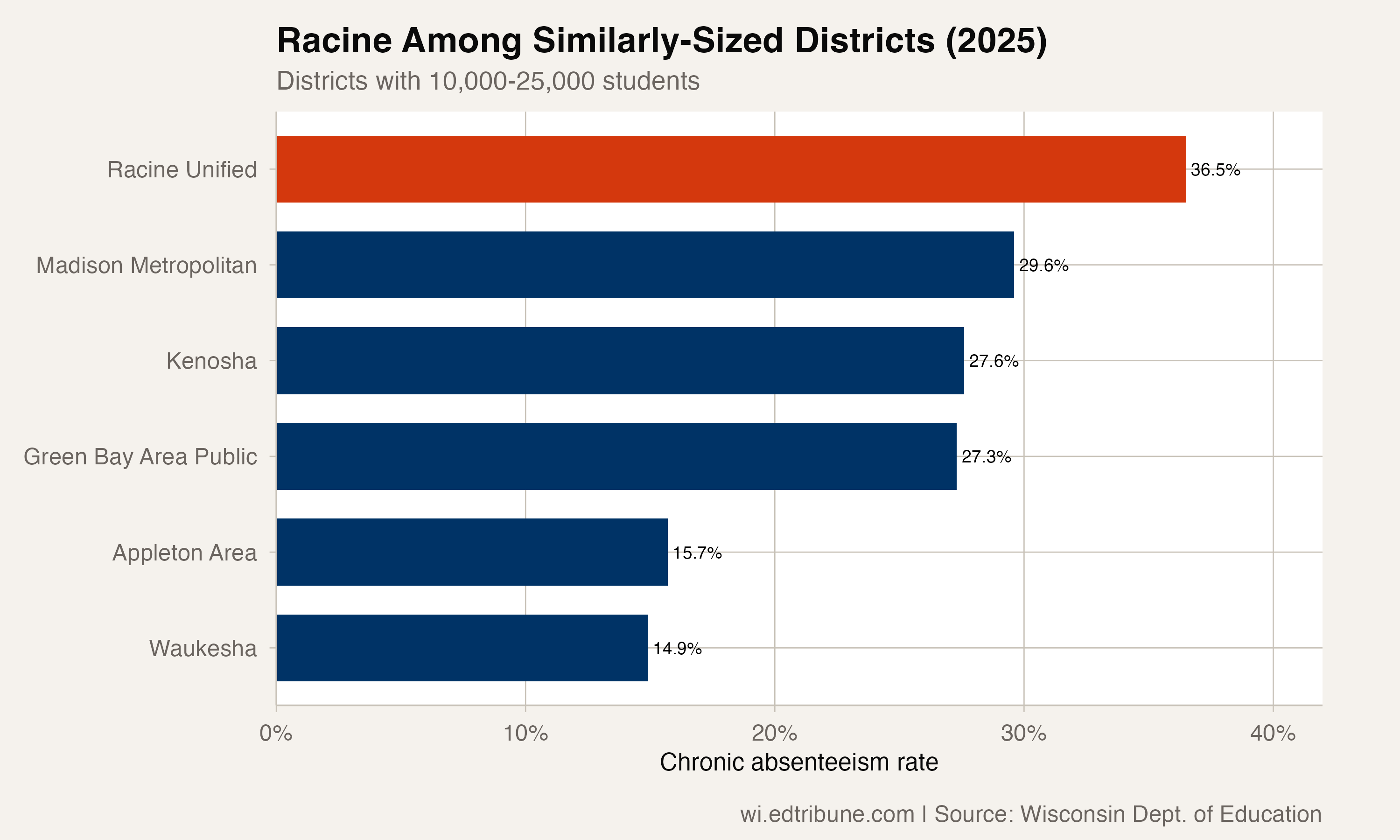
Racine is Wisconsin's fifth-largest district, and its chronic rate is more than double the statewide 17.3%. Among similarly sized districts (10,000-25,000 students), Racine's rate stands out.
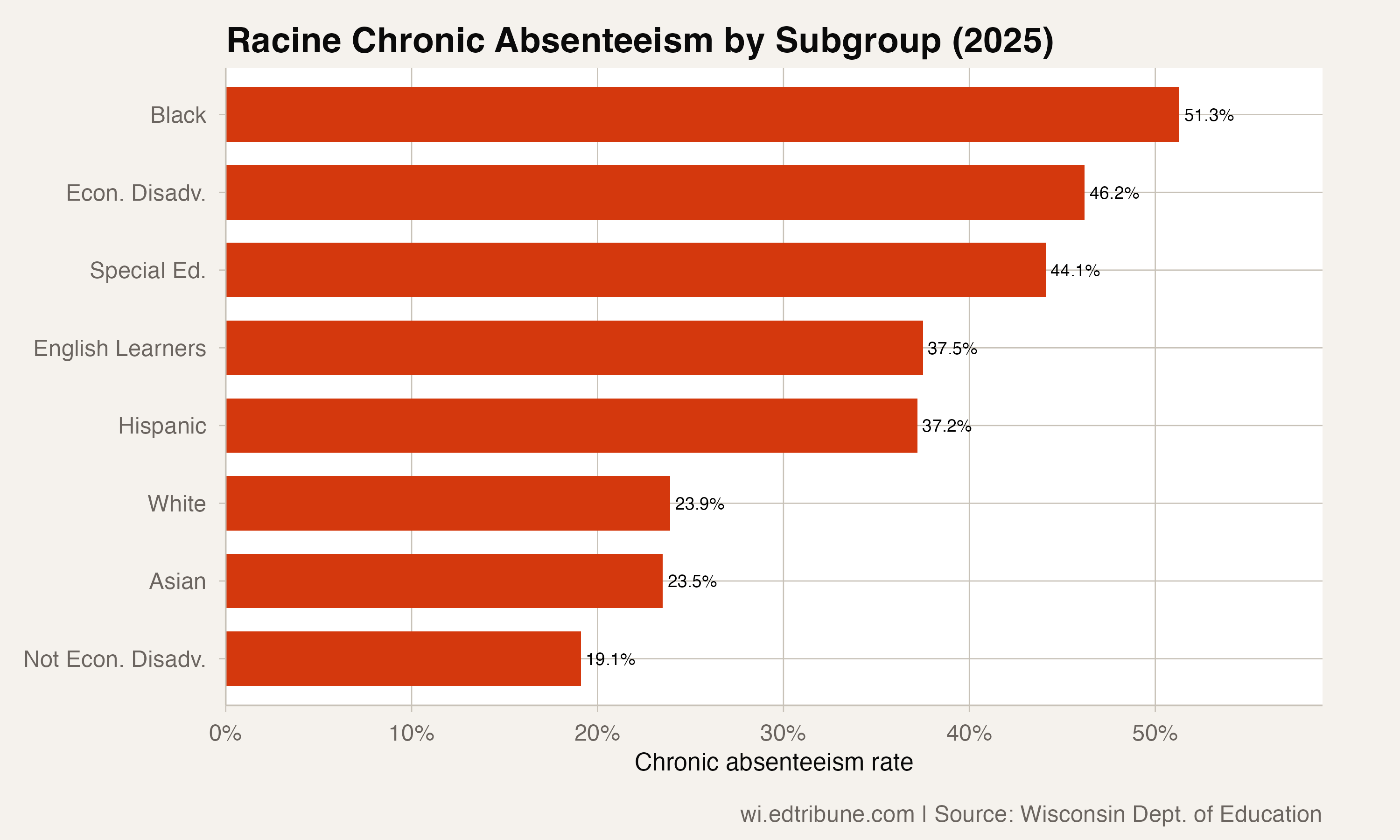
The subgroup data reveals that the crisis is not evenly distributed within the district.
Fewer Students, Attending Less Often
Racine's attendance crisis unfolds against a backdrop of enrollment decline. The district enrolled 19,616 students in 2011. By 2025, that number has fallen to 14,464, a loss of more than 5,000 students over 14 years. The district is simultaneously shrinking and losing attendance ground.
This creates a compounding fiscal problem. Fewer students mean less state aid under Wisconsin's membership-based funding formula. Higher chronic absence, while not directly reducing state aid in the same way it would under an ADA formula, correlates with lower academic performance on the state report cards that influence public perception, open enrollment choices, and community support.
Racine is one of the plaintiff districts in the school funding lawsuit filed by Green Bay, Beloit, Eau Claire, and others, arguing that state funding has not kept pace with inflation since 2009. The suit frames attendance challenges as partly a resource problem: districts that cannot afford sufficient counselors, attendance specialists, and family engagement staff cannot mount effective interventions.
The Plateau Question
The stall at 36.5% raises the question of whether Racine has reached a floor, a chronic rate that current strategies cannot push below. The initial recovery from 52.5% to 36.5% may have captured the students who were temporarily detached during the pandemic. The remaining 36.5% may represent a population with deeper, more structural barriers to attendance.
If that is the case, moving the number lower will require different interventions: addressing housing instability, transportation, mental health, and the perception among some families that regular attendance is not essential. These are problems that a single school district, especially one with a shrinking enrollment base and strained finances, may not be equipped to solve alone.
The stall at 36.5% is a signal. The district's funding lawsuit argues it cannot do this alone. The data supports that argument.
Detailed code that reproduces the analysis and figures in this article is available exclusively to EdTribune subscribers.
Discussion
Sign in to join the discussion.
Loading comments...