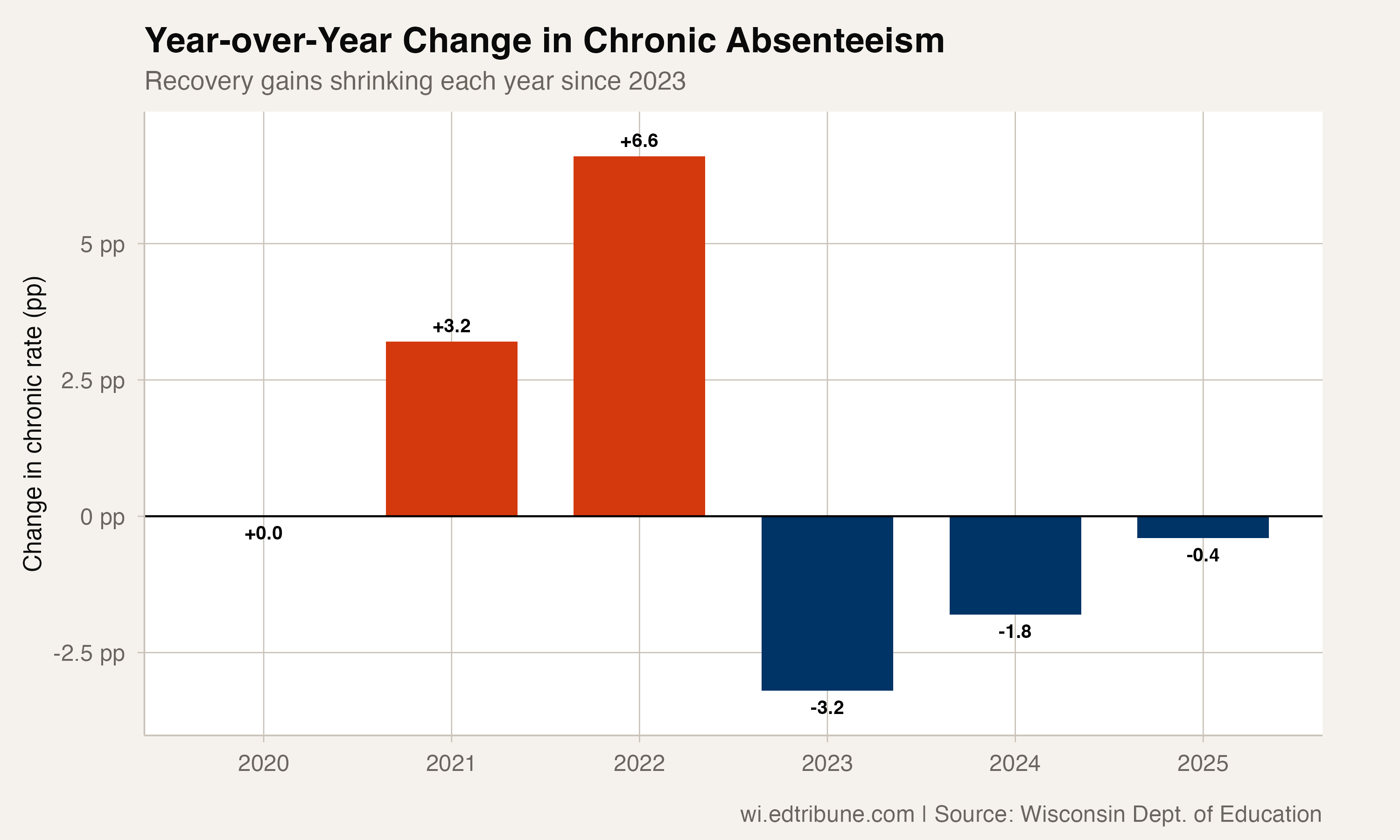
Wisconsin's battle against chronic absenteeism made real progress in 2023, when the state cut its chronic rate by 3.2 percentage points in a single year -- the kind of improvement that suggested the pandemic's grip on student attendance might finally be loosening.
Then the gains started shrinking. In 2024, the improvement dropped to 1.8 points. In 2025, it was just 0.4 points.
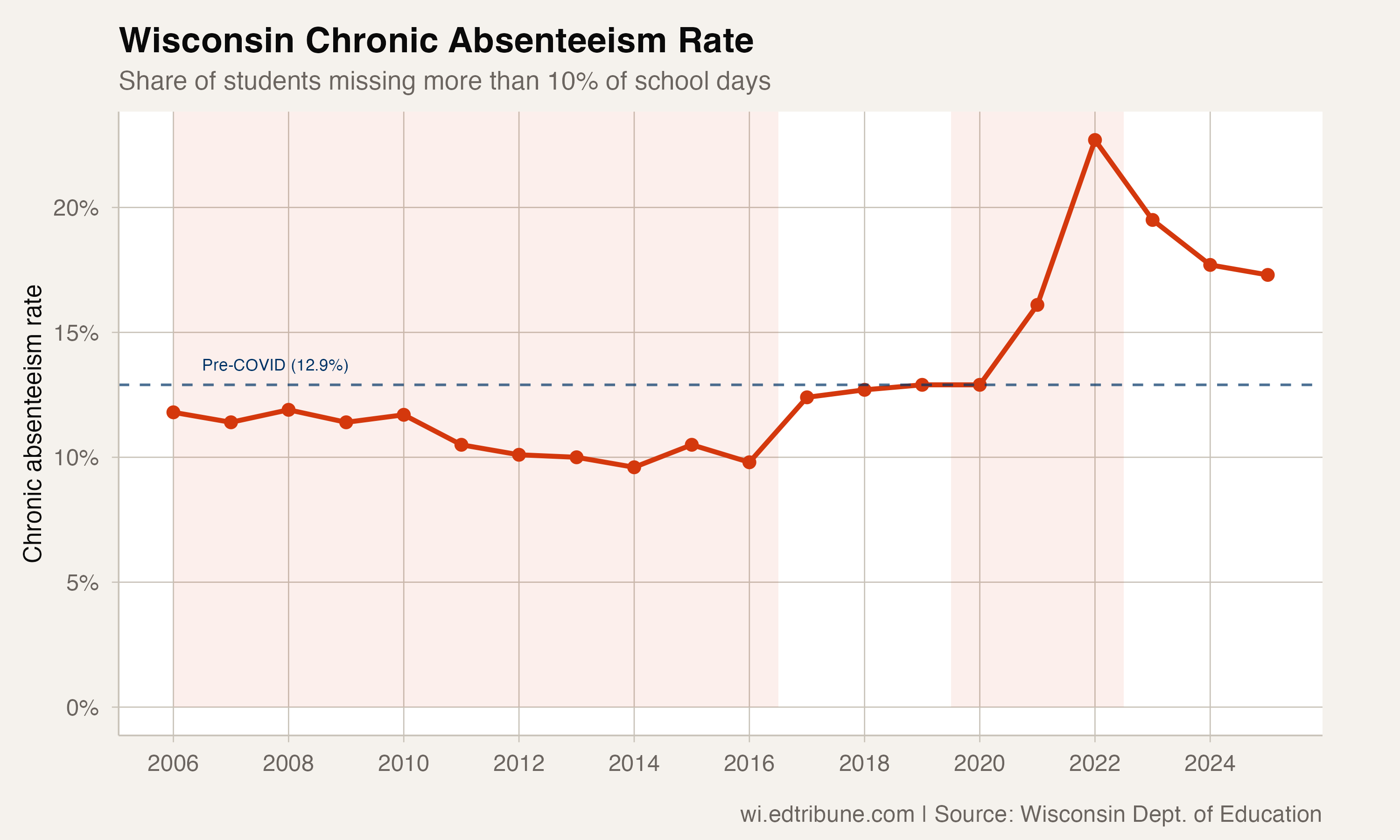
The state's chronic absenteeism rate now sits at 17.3%, meaning 130,131 students, roughly one in six, missed more than 10% of school days during the 2024-25 school year. That is 5.4 points below the 2022 peak of 22.7%, but still 4.4 points above the pre-COVID rate of 12.9% in 2019. And it is a far cry from the 9.6-11.9% range that Wisconsin maintained from 2006 to 2016, before a structural shift pushed rates higher even before the pandemic arrived.
The Decelerating Recovery
The pattern is unmistakable: each year's improvement is smaller than the last.
- 2023: -3.2 percentage points (from 22.7% to 19.5%)
- 2024: -1.8 percentage points (from 19.5% to 17.7%)
- 2025: -0.4 percentage points (from 17.7% to 17.3%)
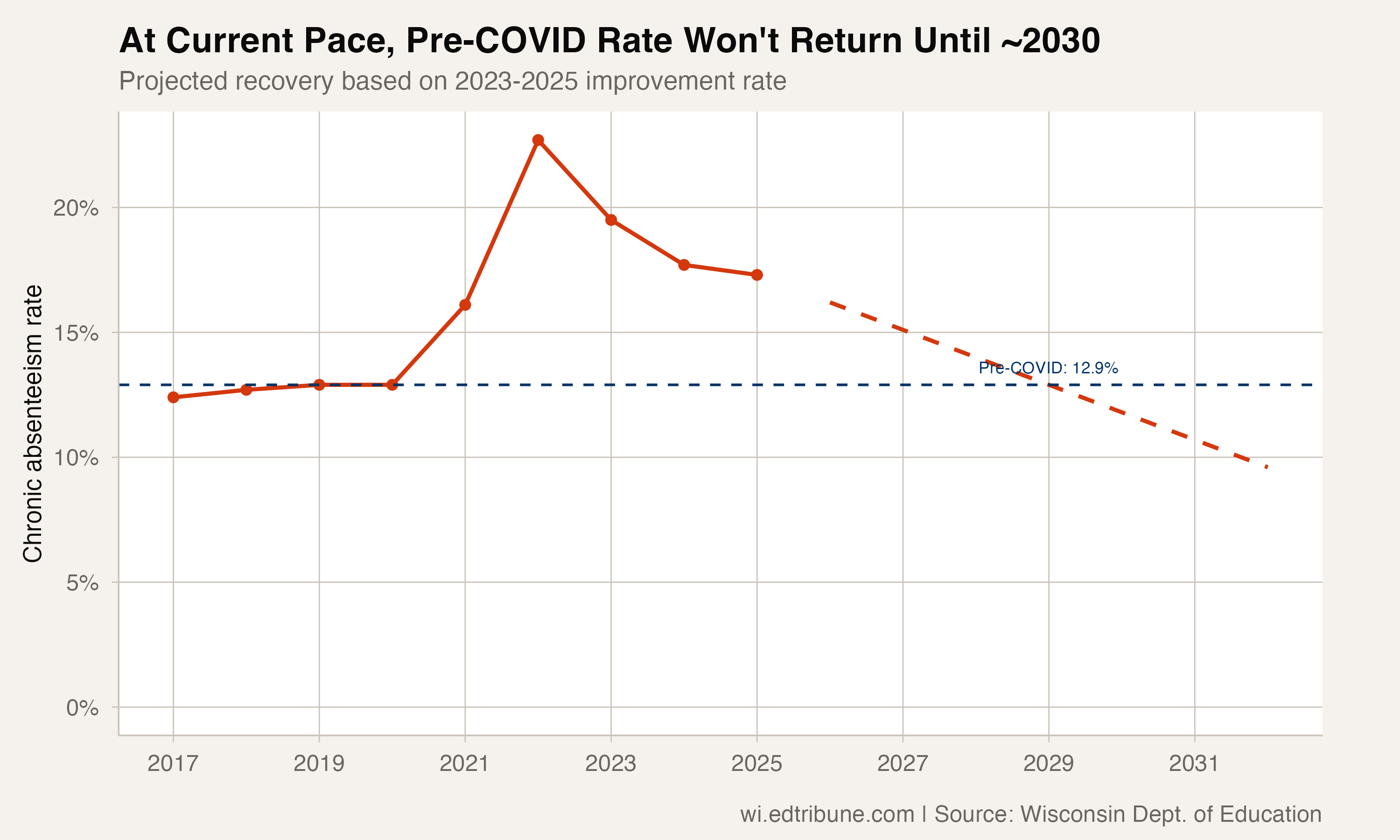
At the current pace of improvement, averaging 1.8 percentage points per year over the last three years, a simple projection would put Wisconsin back at its pre-COVID rate of 12.9% by 2028. But that average is misleading, because it is dominated by the early gains. At the most recent year's pace of just 0.4 points, reaching 12.9% would take until the mid-2030s. Reaching the pre-2017 baseline of 9.6% would take even longer.
If the improvement continues to shrink (from 3.2 to 1.8 to 0.4), the state could be approaching a plateau, a rate that current interventions simply cannot push lower.
52,000 More Than the Low Point
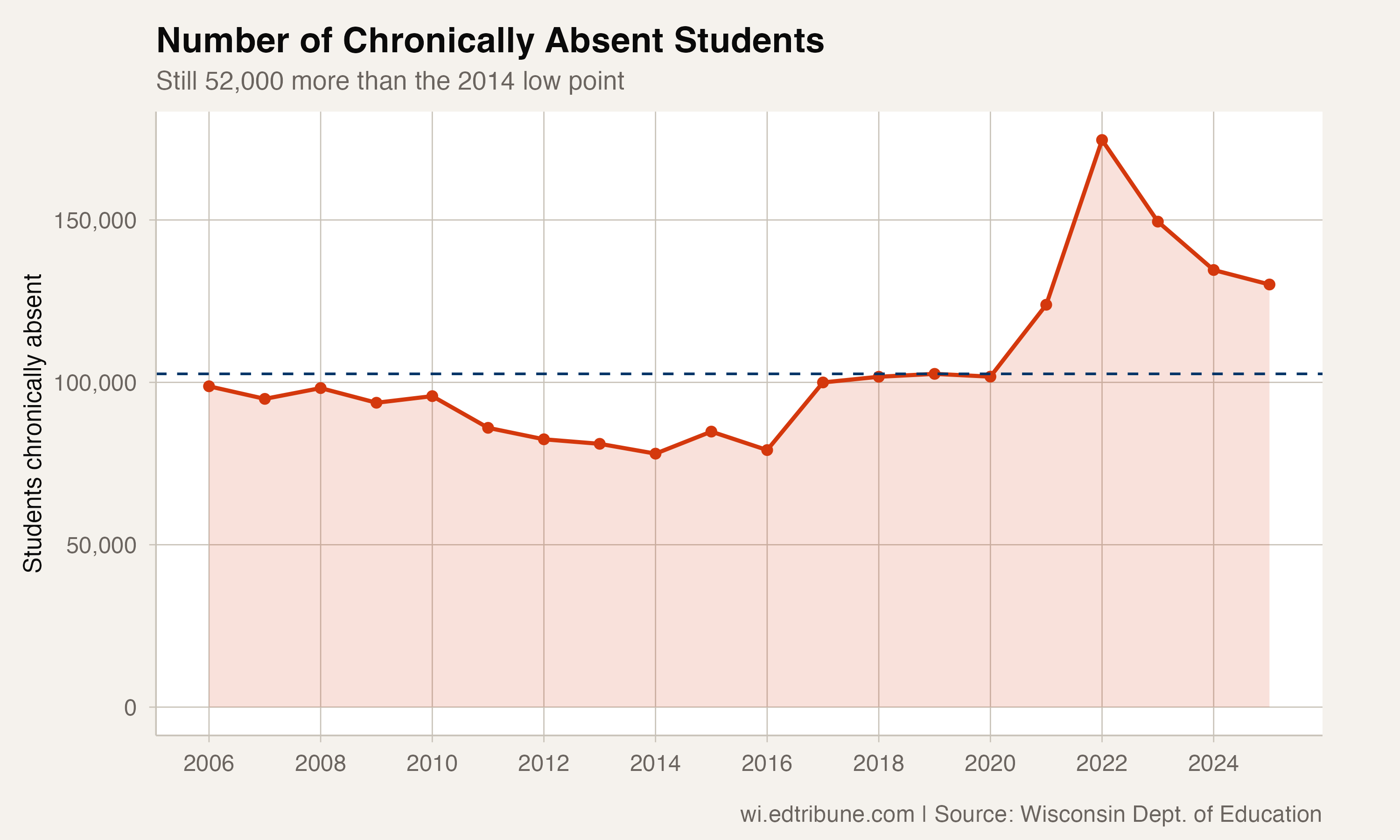
The raw numbers tell a story that percentages can obscure. In 2014, Wisconsin had 78,043 chronically absent students, the lowest point in the dataset. By 2019, that number had already climbed to 102,611, reflecting the pre-COVID drift upward. In the latest data, 130,131 students were chronically absent, 52,088 more than the 2014 low and 27,520 more than the last pre-pandemic year.
Those 130,131 students are not evenly distributed across the state. Milwaukee alone accounts for 28,355 of them, more than one in five of all chronically absent students statewide. The state's five largest districts by absence count hold 38% of all chronically absent students, even though they enroll a much smaller share of total students.
What the Wall Means
The decelerating recovery is consistent with a pattern observed nationally. The initial post-pandemic improvement likely captured students who were temporarily disengaged: families whose attendance habits were disrupted by remote learning, quarantines, or pandemic anxiety but who were ready to return to regular attendance once conditions normalized.
The students who remain chronically absent may represent a structurally harder population to reach: families dealing with housing instability, mental health challenges, transportation barriers, or a fundamental shift in how they view the necessity of daily attendance.
Wisconsin's ENGAGE program, a partnership between the Department of Public Instruction and Graduation Alliance funded by federal COVID relief dollars, has placed attendance coaches in 27 districts including Milwaukee. Governor Tony Evers proposed $6 million in the 2025-27 budget to sustain the program. The state legislature also passed a truancy bill package, including $2 million in truancy reduction grants.
Whether those investments are sufficient to break through the current plateau remains an open question. Wisconsin uses membership-based funding rather than average daily attendance, meaning chronic absenteeism does not directly reduce state aid the way it does in states like California or Texas. That removes one financial incentive for districts to aggressively pursue attendance improvement, though the academic consequences of missed school days are the same regardless of funding formula.
The Pre-2017 Question
There is a deeper question embedded in the data. Wisconsin's chronic absenteeism rate was not stable before COVID hit. After holding between 9.6% and 11.9% for a decade, the rate jumped to 12.4% in 2017 and kept climbing to 12.9% by 2019.
Something changed before the pandemic, and that something has never been identified or reversed. Even if Wisconsin manages to push its rate back below 13%, it would still be operating in an era of elevated absence compared to the early 2010s.
The 0.4-point improvement in 2025 is not failure. It is still improvement. But it is the clearest signal yet that the easy gains are over, and that returning to anything resembling pre-pandemic attendance norms will require something different from what has worked so far.
Detailed code that reproduces the analysis and figures in this article is available exclusively to EdTribune subscribers.
Discussion
Sign in to join the discussion.
Loading comments...