Correction (September 30, 2026): Our July correction added Medford Area Public as a second large district whose chronic absenteeism rose more than 4 points in 2025. That comparison does not hold up. Medford's online school, Rural Virtual Academy, which enrolls more than a third of its students, reported zero chronically absent students from 2022 through 2024 and 183 in 2025, so most of Medford's jump from 8.0% to 14.7% reflects that school beginning to record absences. Across Medford's other schools the rate rose 1.5 points. Among districts with 2,500 or more students whose schools account for their rate in both years, Beloit's increase is the only one above 4 points. This version also corrects Beloit's enrollment decline since 2006 to 33.4% (it was reported as 33.5%) and replaces the closing claim that Beloit's reversal was the sharpest in the state; several small districts rose more. An earlier correction (July 23, 2026) noted that Milwaukee, a traditional district, has a higher chronic rate than Beloit.
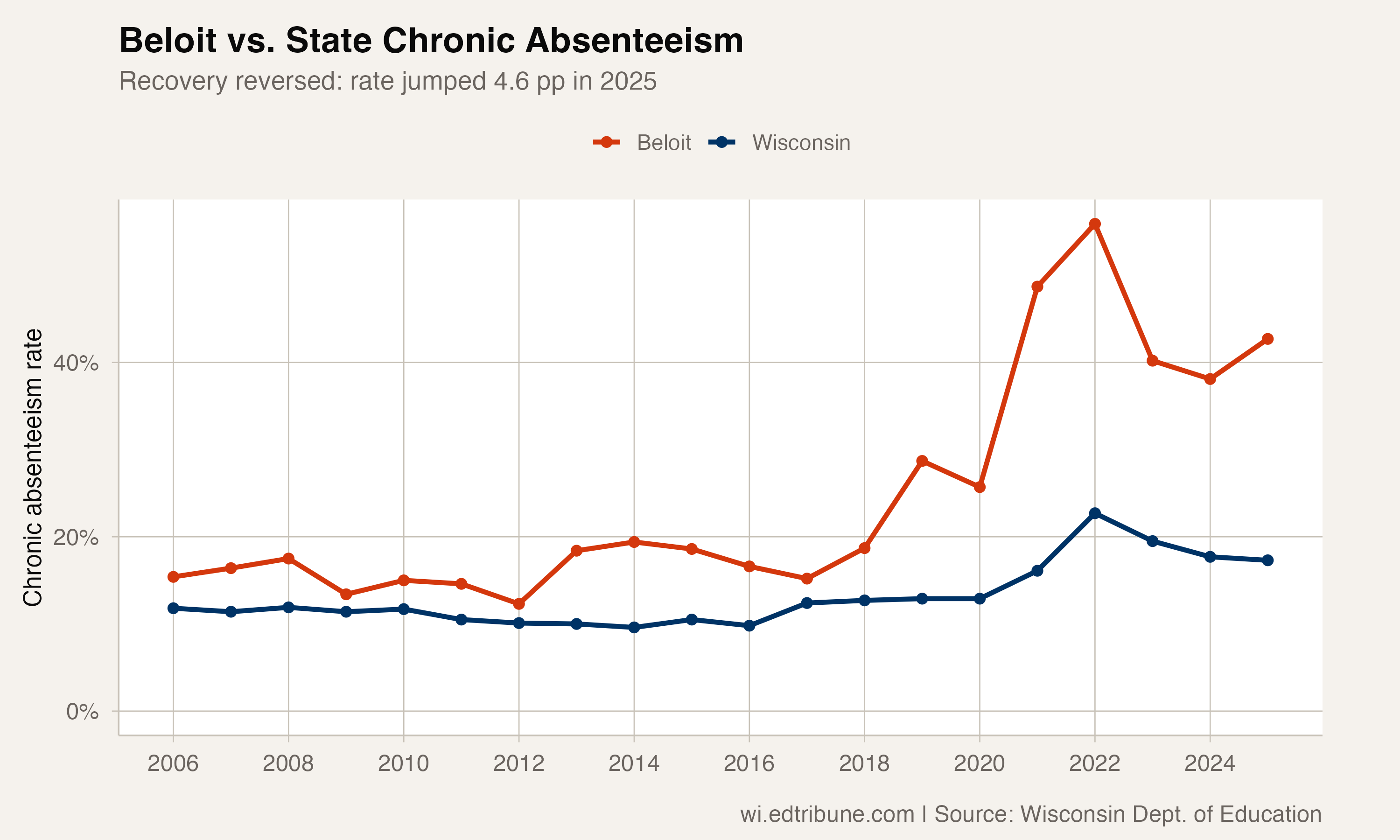
Beloit↗ET was heading in the right direction. After a devastating 55.9% chronic absenteeism rate in 2022 (meaning more students were chronically absent than not), the district clawed its way back. The rate fell to 40.2% in 2023 and 38.1% in 2024. Two consecutive years of improvement.
Then 2025 happened. Beloit's chronic rate jumped to 42.7%, a 4.6 percentage-point reversal that erased more than a year of progress. While the state improved by 0.4 points, Beloit went the other direction.
A Reversal Few Large Districts Matched
Among Wisconsin districts with 2,500 or more students, Beloit's was the only rate to rise by more than 4 percentage points in 2025 once online-school reporting is taken into account. One other large district, Medford Area Public, posted a bigger published increase, from 8.0% to 14.7%. But Medford's Rural Virtual Academy, with 1,162 of its students, recorded no chronically absent students at all from 2022 through 2024, then 183 in 2025. Most of Medford's jump is that school starting to count absences. Across Medford's other schools, the rate went from 12.6% to 14.1%.
At 42.7%, Beloit also has the second-highest chronic rate of any Wisconsin district with 2,500 or more students, behind only Milwaukee at 46.2%.
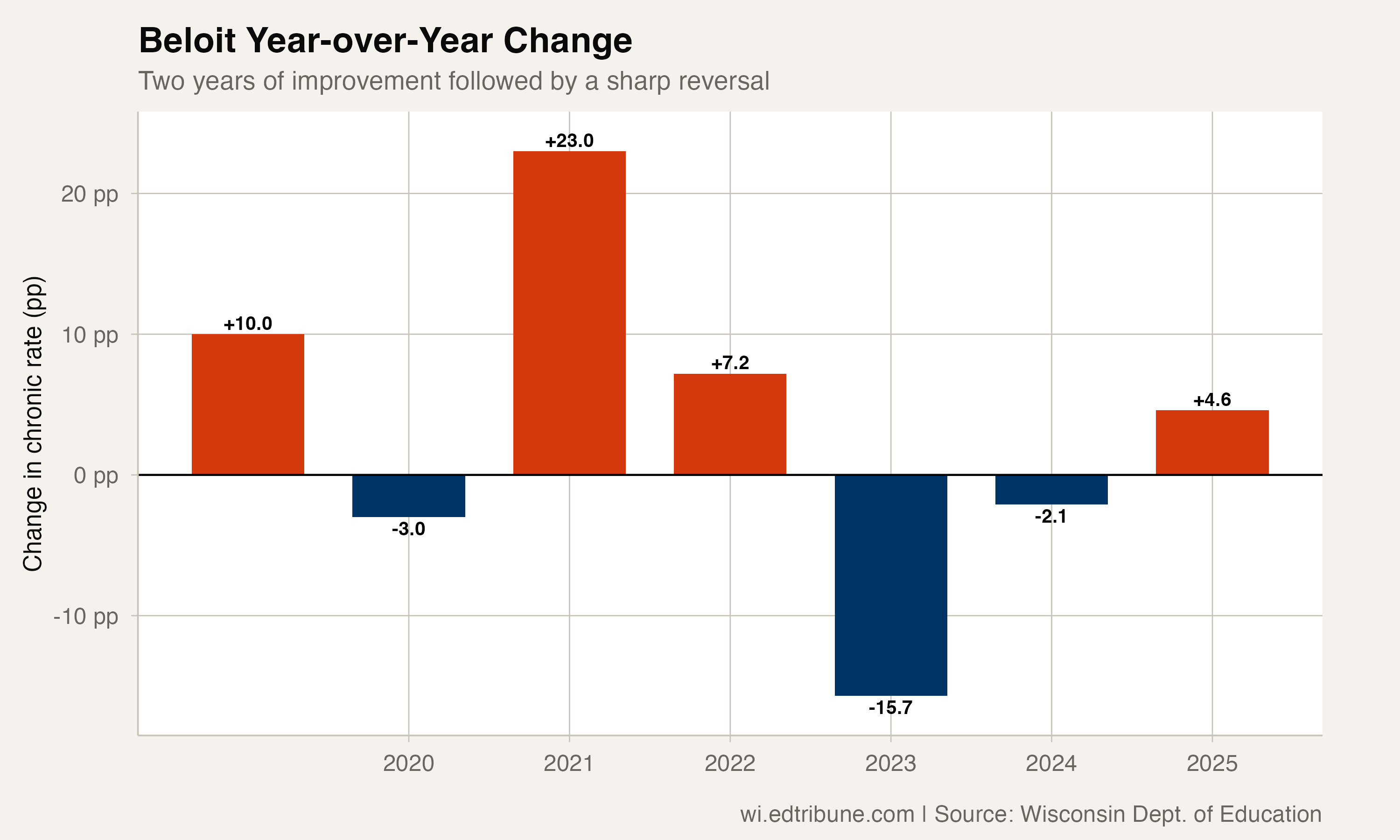
The reversal brings Beloit's rate back above the 40% threshold, a level that means two out of every five students are missing more than 10% of school days. In raw numbers, 1,933 of the district's 4,529 students were chronically absent.
A Shrinking District Getting Worse
Beloit's attendance crisis is compounded by a two-decade enrollment decline. In 2006, the district enrolled 6,800 students. By 2025, that number had fallen to 4,529, a 33.4% loss.
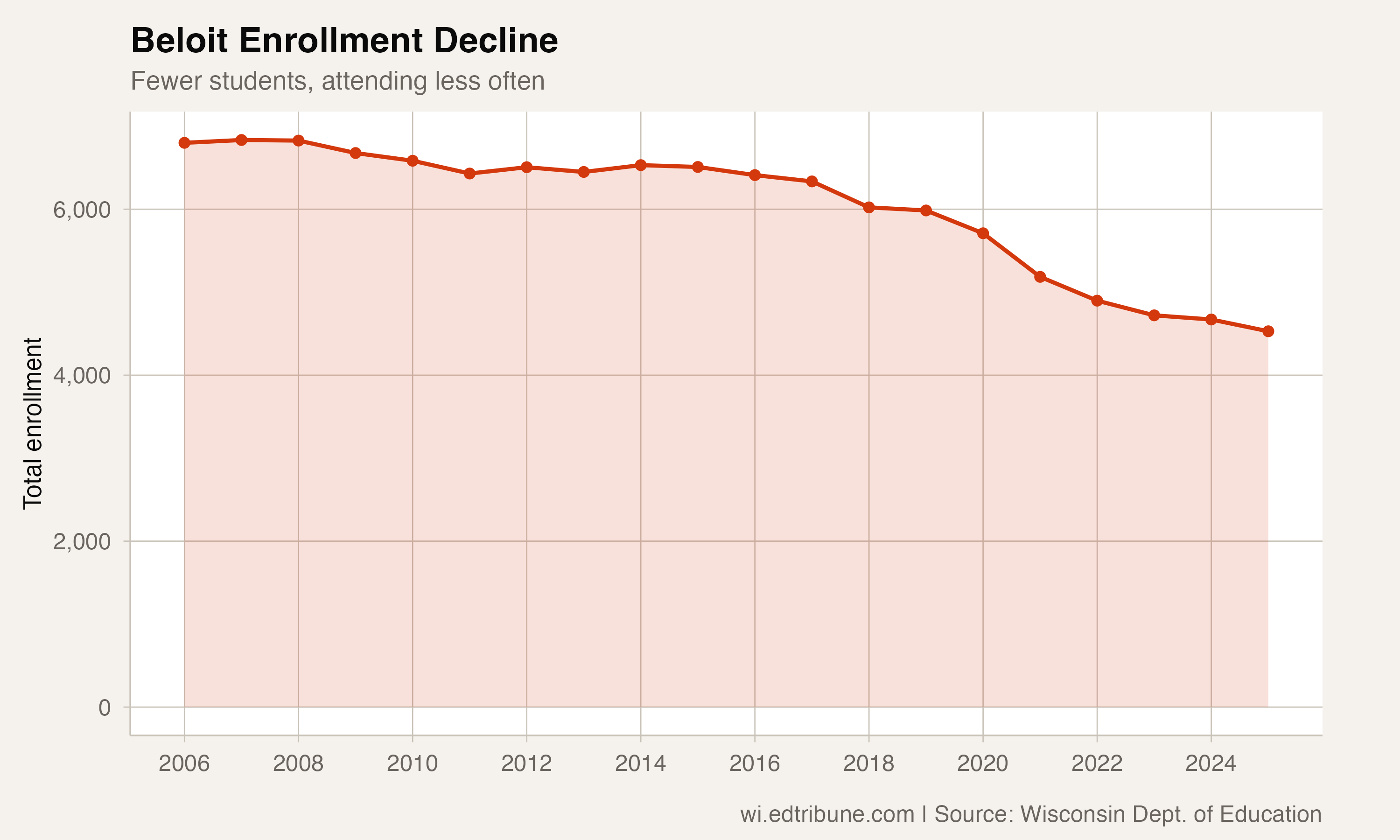
The simultaneous shrinking and attendance deterioration create a vicious cycle. Fewer students mean less funding, which means fewer resources for attendance interventions, which means worse attendance, which contributes to further enrollment losses as families who can leave do leave.
Beloit is one of the plaintiff districts in the school funding lawsuit, alongside Green Bay, Eau Claire, and others. The district's argument, that inadequate state funding has left it unable to address the root causes of chronic absenteeism, is underscored by data showing a district in free fall on both enrollment and attendance.
What Caused the Reversal?
The data cannot explain why Beloit reversed course. Possible factors include:
Staffing turnover could have disrupted attendance intervention programs that were working in 2023 and 2024. Small districts are particularly vulnerable to the loss of a single attendance coordinator or family liaison.
Community instability (housing displacement, economic disruption, or family crises concentrated in a small population) can produce swings in chronic rates that would be averaged out in a larger district.
A cohort effect is possible: if a particularly high-absence group of students entered the school system or a particularly low-absence group graduated, the overall rate could shift.
Whatever the cause, the 4.6-point reversal is a reminder that attendance recovery is not linear. Districts can make progress for two or three years and then lose it in one. Without sustained, stable investment in the conditions that make attendance possible (reliable transportation, stable housing, accessible mental health care, engaged families), improvement remains fragile.
Among the state's larger districts, Beloit's reversal stands alone. Whether it becomes a trend or an aberration will depend on what happens next.
Detailed code that reproduces the analysis and figures in this article is available exclusively to EdTribune subscribers.
Discussion
Sign in to join the discussion.
Loading comments...