In a state where four out of five districts have not returned to their pre-pandemic attendance levels, Elmbrook↗ET has gone the other way.
The Waukesha County district reported a 3.1% chronic absenteeism rate in 2025, the most recent school year in Wisconsin's published data. The statewide rate that year was 17.3%. Elmbrook enrolls 7,452 students, so this is not a small district where a handful of families can move the percentage.
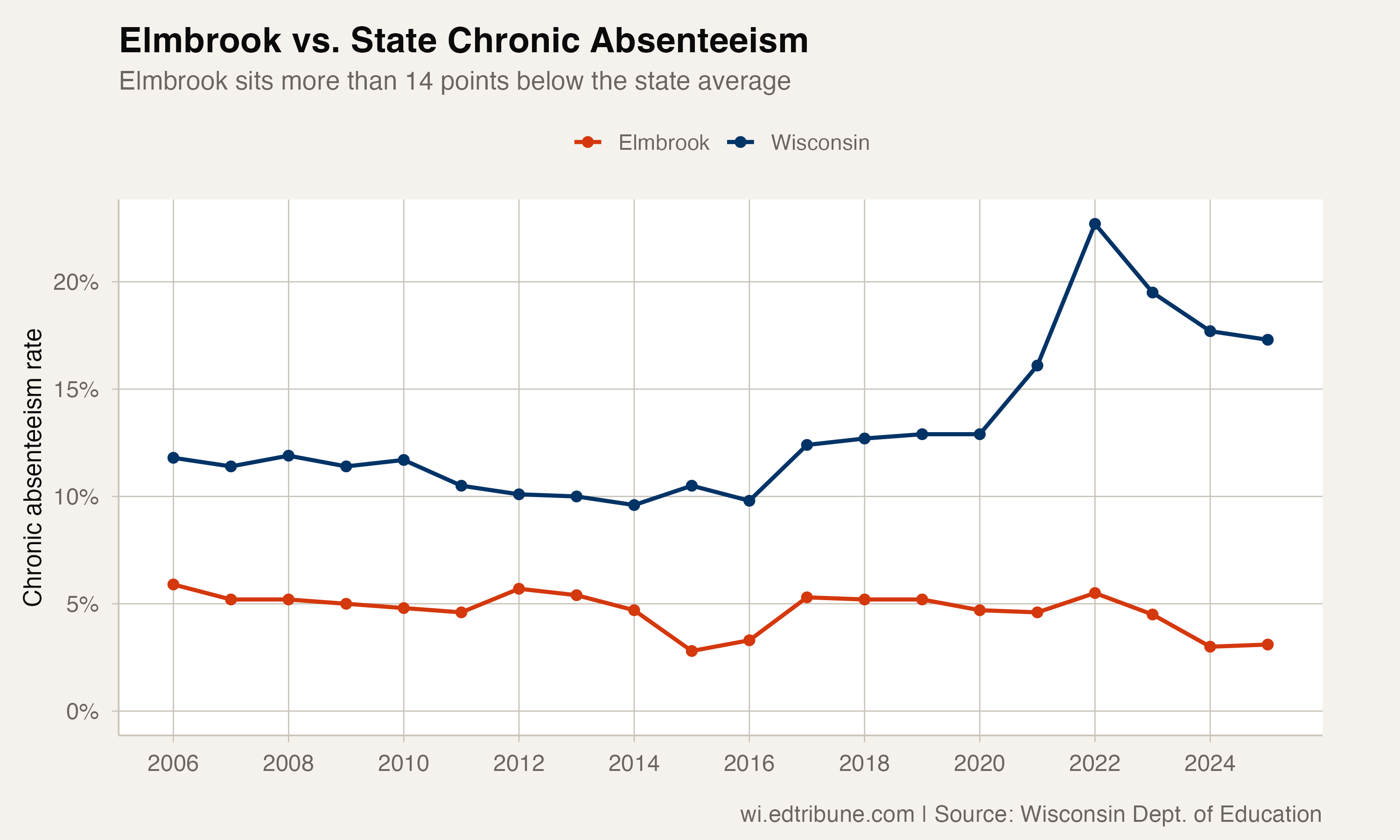
What makes the figure unusual is the direction of travel. Elmbrook's 2025 rate sits 2.1 points below its own 2019 level of 5.2%, meaning the district did not simply recover from the pandemic, it ended up better than where it started. Statewide, chronic absenteeism moved the opposite way over the same six years, from 12.9% in 2019 to 17.3% in 2025, an increase of 4.4 points.
Across Wisconsin, 423 districts reported a rate in both 2019 and 2025. Of those, 83 are at or below their 2019 level. The other 340 are not.
How the district weathered COVID
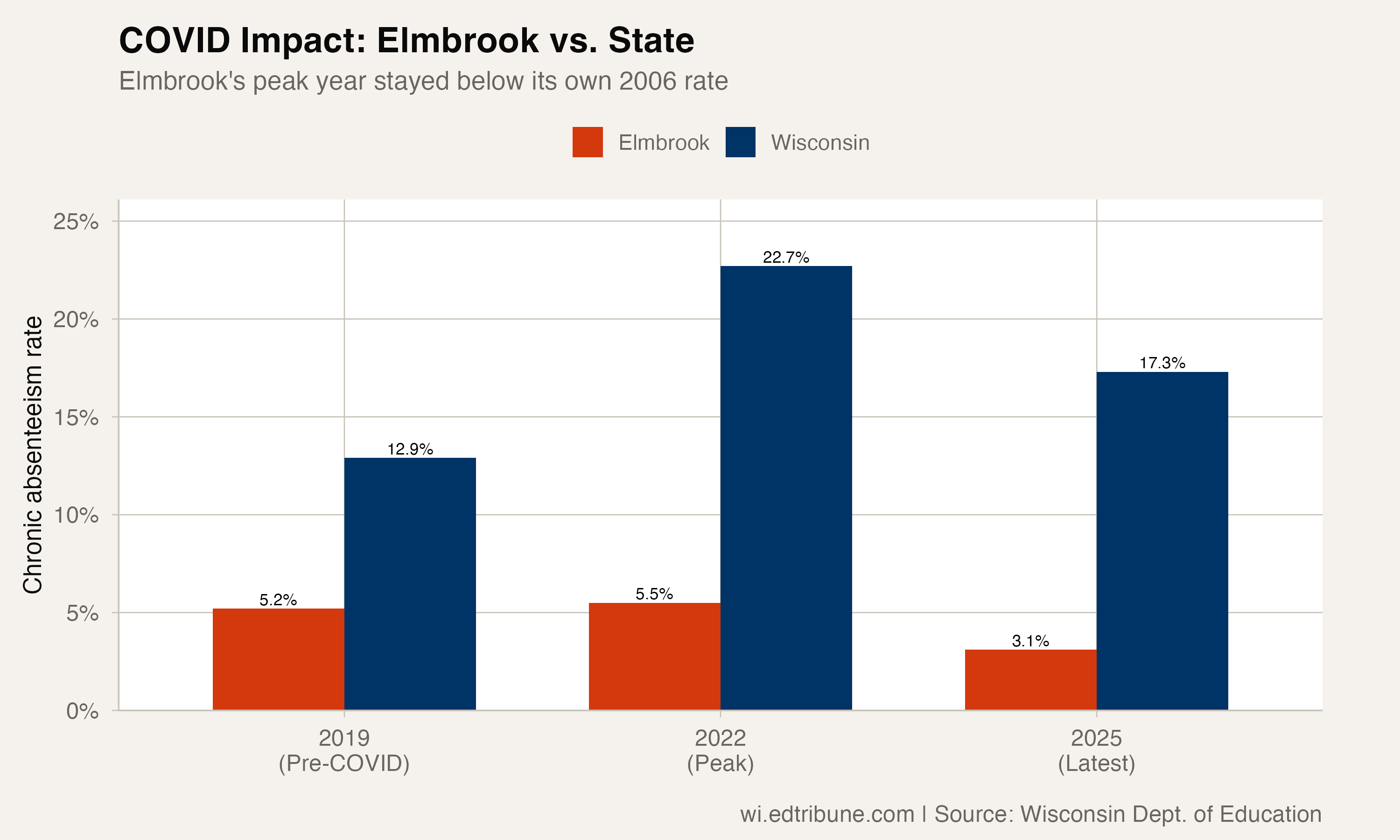
The most striking feature of Elmbrook's record is how little the pandemic shows up in it. In 2022, the worst year on record statewide, Elmbrook reached 5.5% while Wisconsin as a whole reached 22.7%, a gap of 17.2 points in a single year. Elmbrook's pandemic-era high was lower than its own 2006 rate of 5.9%, so the district never got as bad during COVID as it had been twenty years earlier.
Chris Thompson, Elmbrook's chief strategy officer, said the district treats attendance as an early-warning system rather than a lagging measure. "We have built and refined proactive data monitoring and early warning systems. Rather than waiting for a student to fall into the 'chronically absent' category, our systems flag early shifts in individual attendance patterns," Thompson said. "This allows our staff to step in immediately, identify the root cause of the absences, and partner directly with the family to resolve the issue before a student drops too far behind."
Among the state's lowest
Ranked against other large districts, those enrolling 3,000 or more students, Elmbrook has the third-lowest chronic absence rate in the state. Hortonville Area reported 2.4% and Slinger 2.5%. Below Elmbrook sit New Berlin at 3.2% and Mukwonago at 3.8%.
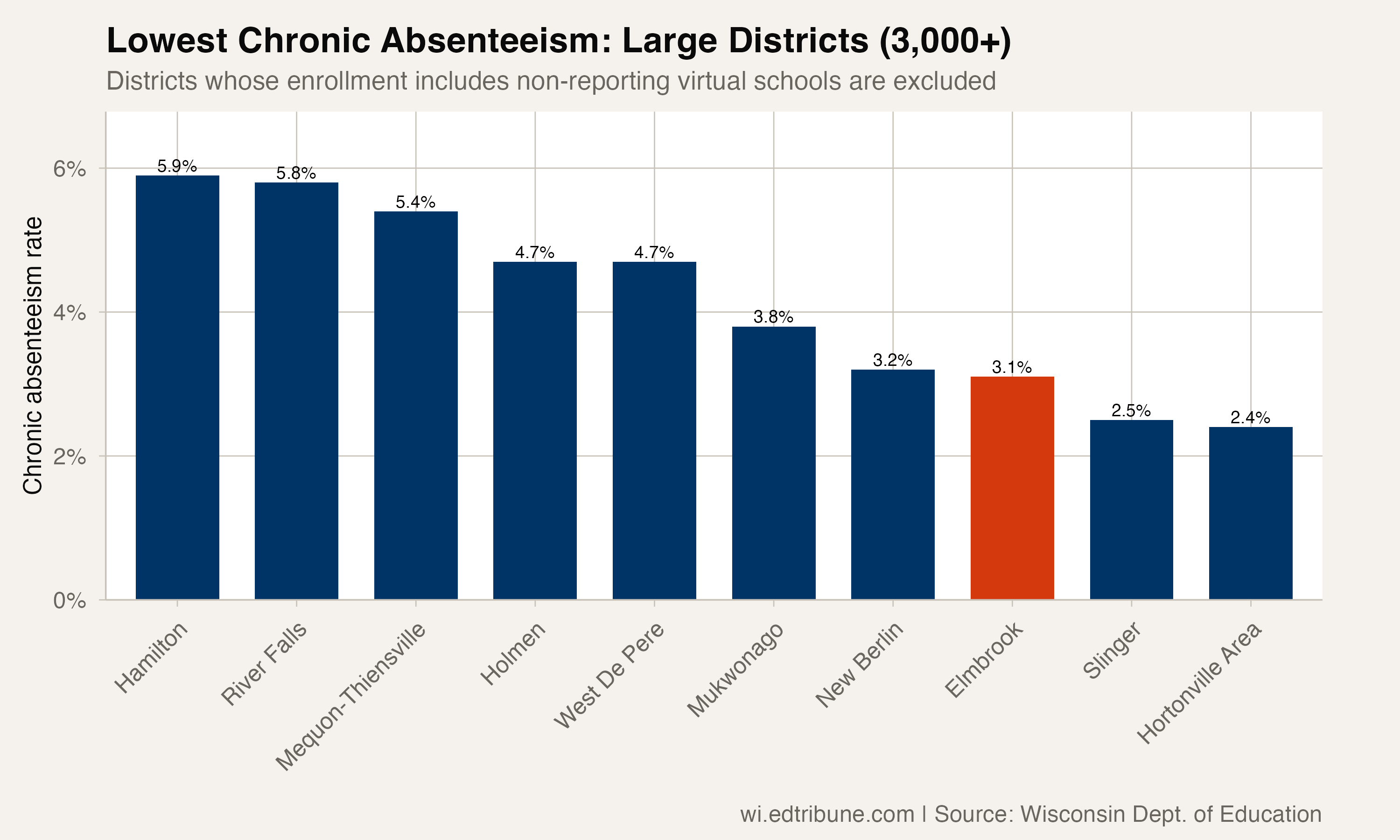
Two large districts are left out of that ranking. In each, a substantial share of enrollment sits in virtual schools that record no chronic absences at all, which pulls the district's published rate down without any student attending more often. A rate built that way is not comparable to one drawn from schools that report the measure, so those districts are excluded rather than ranked. It is worth saying plainly that this is a feature of how the statistic is assembled, not a judgment about the districts involved.
The transferability question
The obvious question is whether Elmbrook's results are replicable. The honest answer is: probably not in their entirety. Elmbrook is a community with structural advantages, including high home ownership, lower poverty than most of the state, and a property tax base that supports substantial school programming.
But dismissing the result as simply demographics would be a mistake, and Thompson made that argument himself. "It would be an oversimplification to look at our 3.1% rate and attribute it solely to our community's demographics, just as it would be an oversimplification to think our exact playbook can be copied blindly by every district," he said.
Within the universe of well-resourced suburban districts there is real variation. Not every affluent district in Wisconsin is near 3%. Something about how this particular district communicates with families, watches for early warning signs, and intervenes when students begin missing school is doing work that demographics alone do not explain.
As Thompson put it, "The structural realities differ, but the human element of active intervention and relationship-building is something we can all learn from."
The challenge for Wisconsin's education leadership is to identify which of those practices travel. If none of them do, then the 83 districts now at or below their pre-pandemic rate are a fortunate minority rather than a model for the 340 that are not.
Chronic absenteeism records come from the Wisconsin Department of Public Instruction's WISEdash.
Detailed code that reproduces the analysis and figures in this article is available exclusively to EdTribune subscribers.
Discussion
Sign in to join the discussion.
Loading comments...