Not one of Wisconsin's 10 largest school districts has recovered the students it lost during the pandemic. Not Milwaukee↗ET, not Madison↗ET, not Kenosha↗ET. Zero for 10. Statewide, only 116 of 420 districts, 27.6%, have climbed back to their pre-pandemic enrollment levels. The other 304 are still below where they stood in 2019-20, and most are still falling.
The total damage since 2019: 52,952 students gone, a 6.2% contraction. The pandemic itself accounted for 28,898 of those losses. The four years since have added another 24,054. COVID did not cause Wisconsin's enrollment crisis. It was already losing students before the pandemic. But it doubled the speed of the decline, and five years later, no reversal has materialized.
The trend line that broke
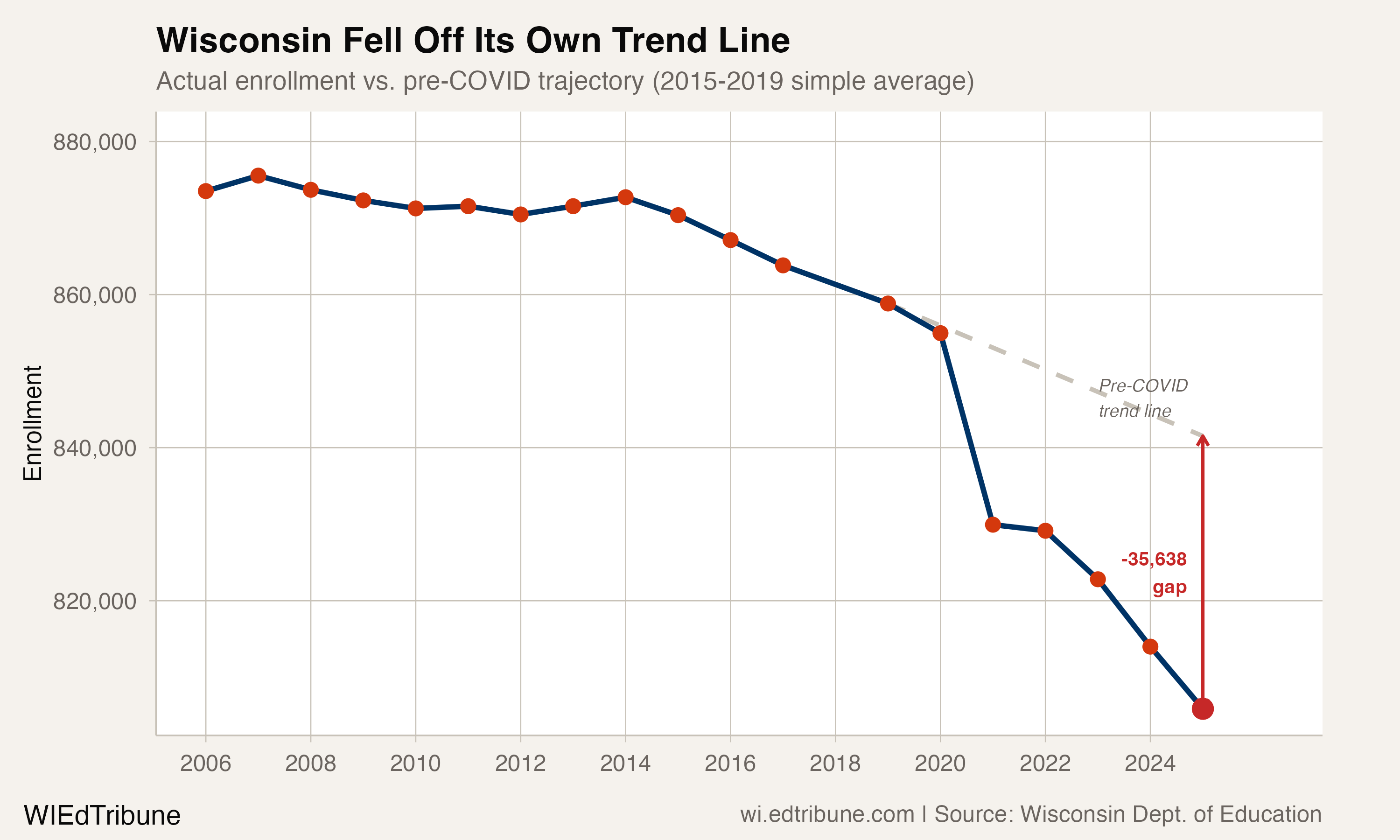
Before the pandemic, Wisconsin was losing students at a rate of about 2,886 per year, the simple average between 2014-15 and 2018-19. The trendline was downward but consistent. Had that pace continued, the state would have expected about 841,500 students in 2024-25.
Instead, enrollment stands at 805,881, a gap of roughly 35,600 students below the pre-pandemic trajectory. The post-COVID rate of decline, roughly 6,014 students per year from 2021 to 2025, is running more than twice the pre-pandemic pace.
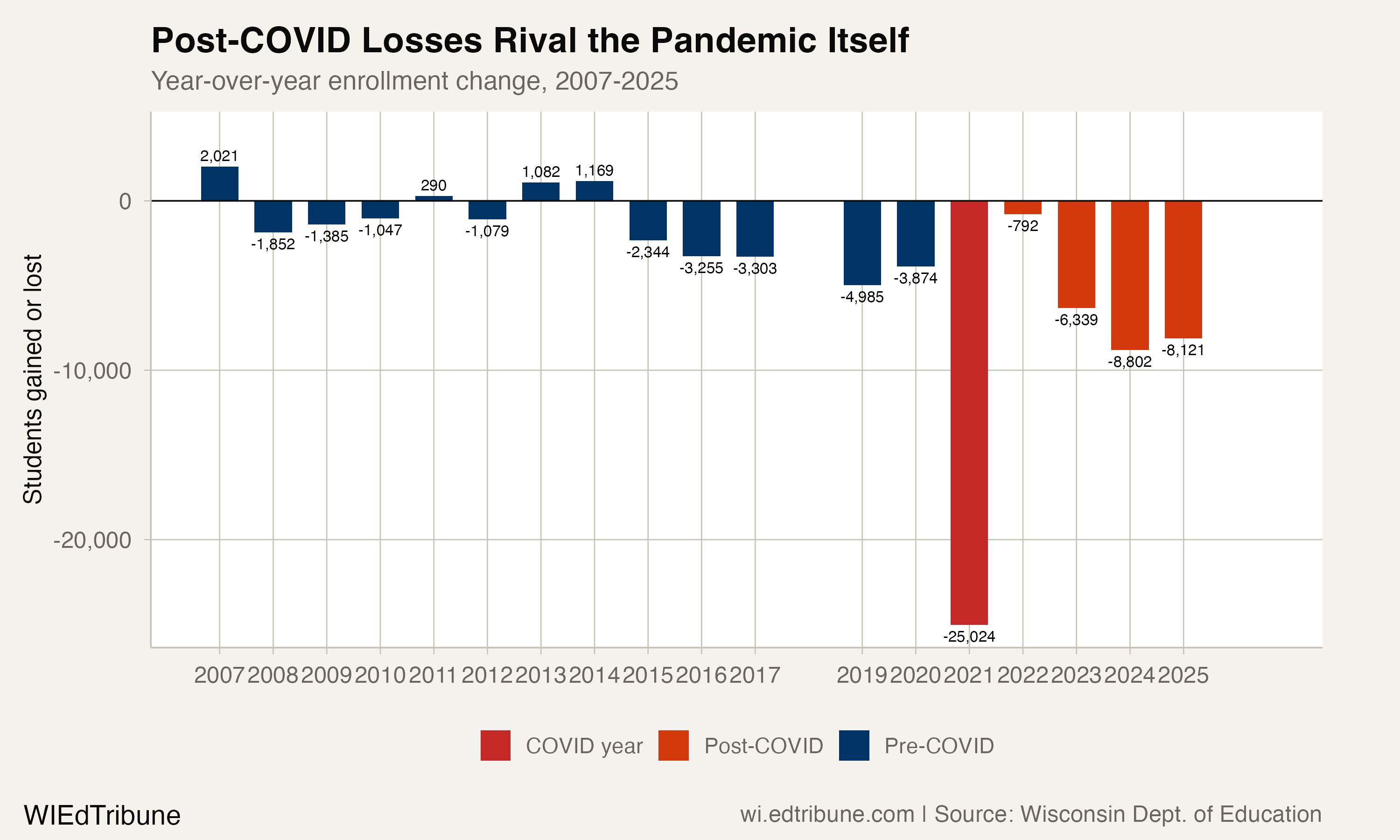
The single worst year was 2020-21, when enrollment cratered by 25,024 students in one year, a 2.9% drop. That was the year of hybrid schedules, quarantines, and families who pulled their children out entirely. What followed was supposed to be recovery. The 2021-22 year lost only 792, which looked like stabilization. Then losses accelerated: 6,339 in 2022-23, 8,802 in 2023-24, and 8,121 in 2024-25.
Where the students went
The 10 districts with the largest absolute losses since 2019 account for a disproportionate share of the state's decline. Milwaukee↗ET alone lost 9,832 students, 13.0% of its 2019 enrollment, and accounts for 18.6% of the entire statewide loss. Kenosha↗ET lost 2,918 (13.7%), Racine↗ET lost 2,081 (11.7%), and Green Bay↗ET lost 2,012 (9.9%).
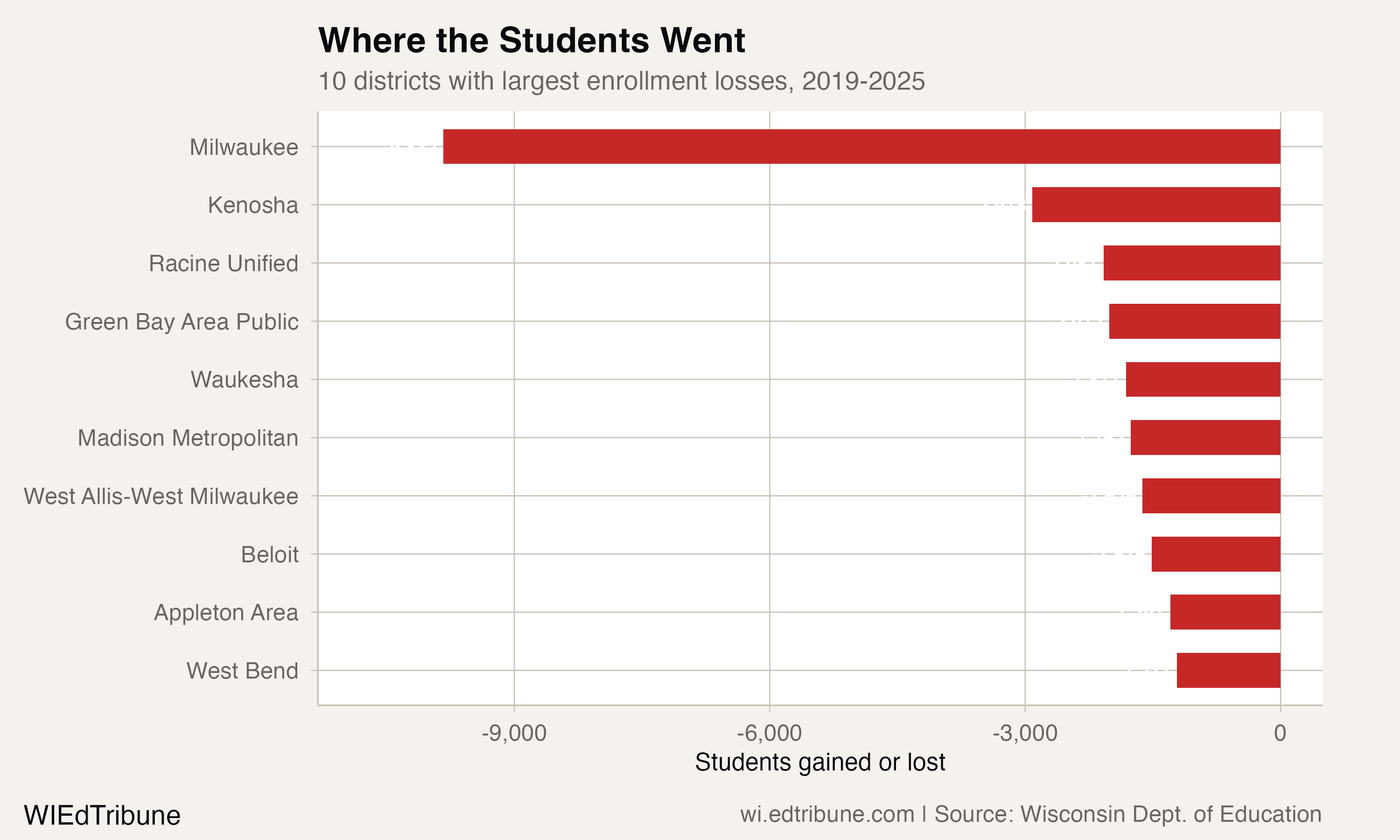
Waukesha↗ET lost 1,817 students (14.3%), the steepest percentage decline among the top 10 losers. West Allis-West Milwaukee↗ET shed 19.7% of its enrollment. Beloit↗ET lost 23.4%, nearly one in four students.
Kenosha's superintendent, Jeff Weiss, traces his district's losses to a force that predates the pandemic and has outlasted it. "Districts have been experiencing enrollment declines for many years, and COVID accelerated that trend," Weiss said in a written statement. "However, the primary factor continues to be the declining birth rate. In our area, births peaked in 2008, the current senior class, and have steadily decreased each year since." He said current projections indicate the trend is likely to continue for the next several years.
The districts that did recover tend to be small or host virtual schools. McFarland↗ET, which gained 1,474 students since 2019, hosts the Wisconsin Virtual Academy (WIVA), drawing students from across the state. Grantsburg↗ET hosts iForward, another statewide virtual school. Strip out the three largest virtual-host districts and the recovery rate drops to 27.1%. Elmbrook↗ET, which gained 511 students (7.0%), and Sun Prairie↗ET, which gained 75, are the only two among the state's 20 largest districts to show any recovery at all.
Size determined fate
The relationship between district size and COVID recovery is nearly linear.
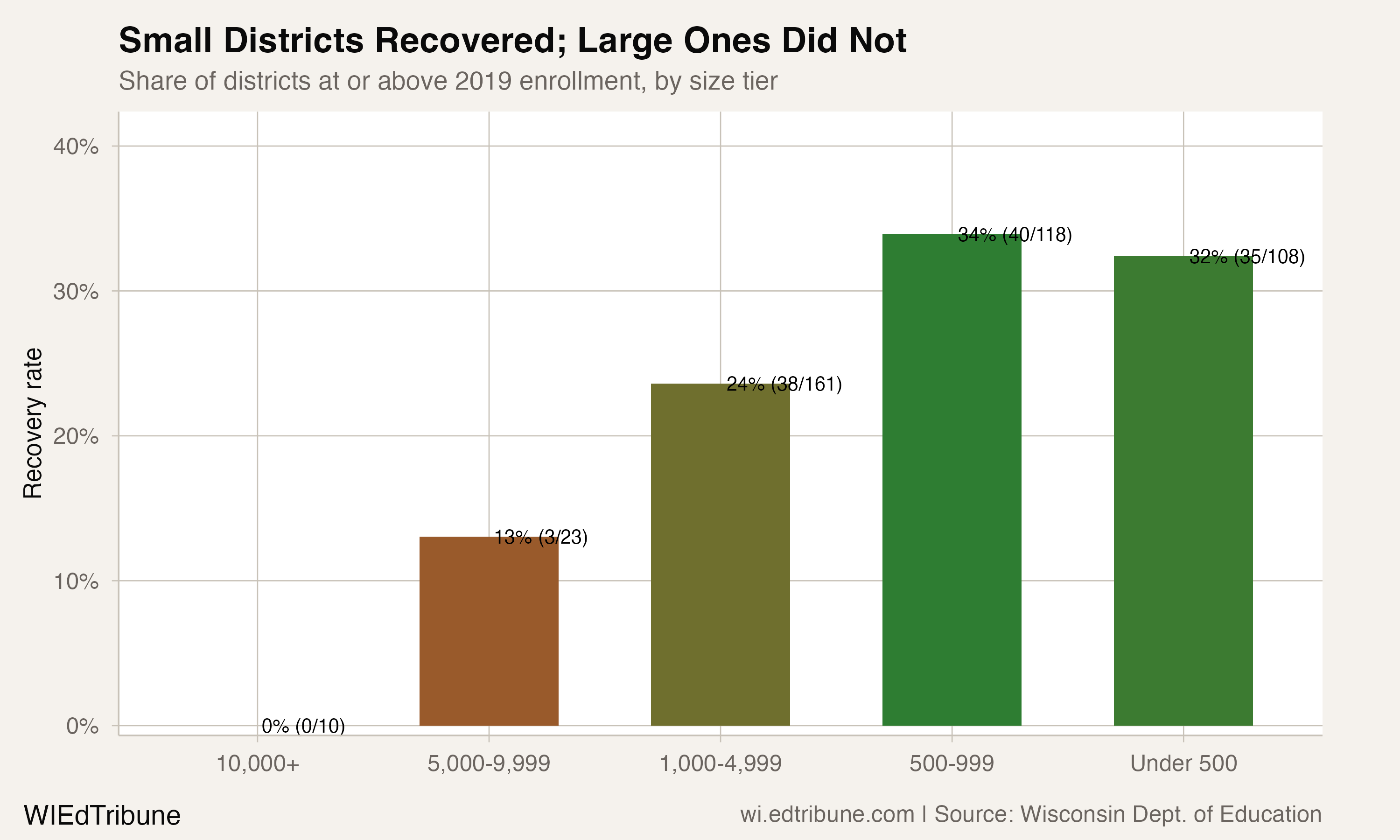
Among districts with 10,000 or more students in 2019, the recovery rate is 0%. None of the 10 districts in that tier have reached their pre-pandemic enrollment. Among mid-size districts (5,000 to 9,999), only 13% recovered. The rate climbs to 24% for districts between 1,000 and 4,999, and to roughly a third for the smallest districts.
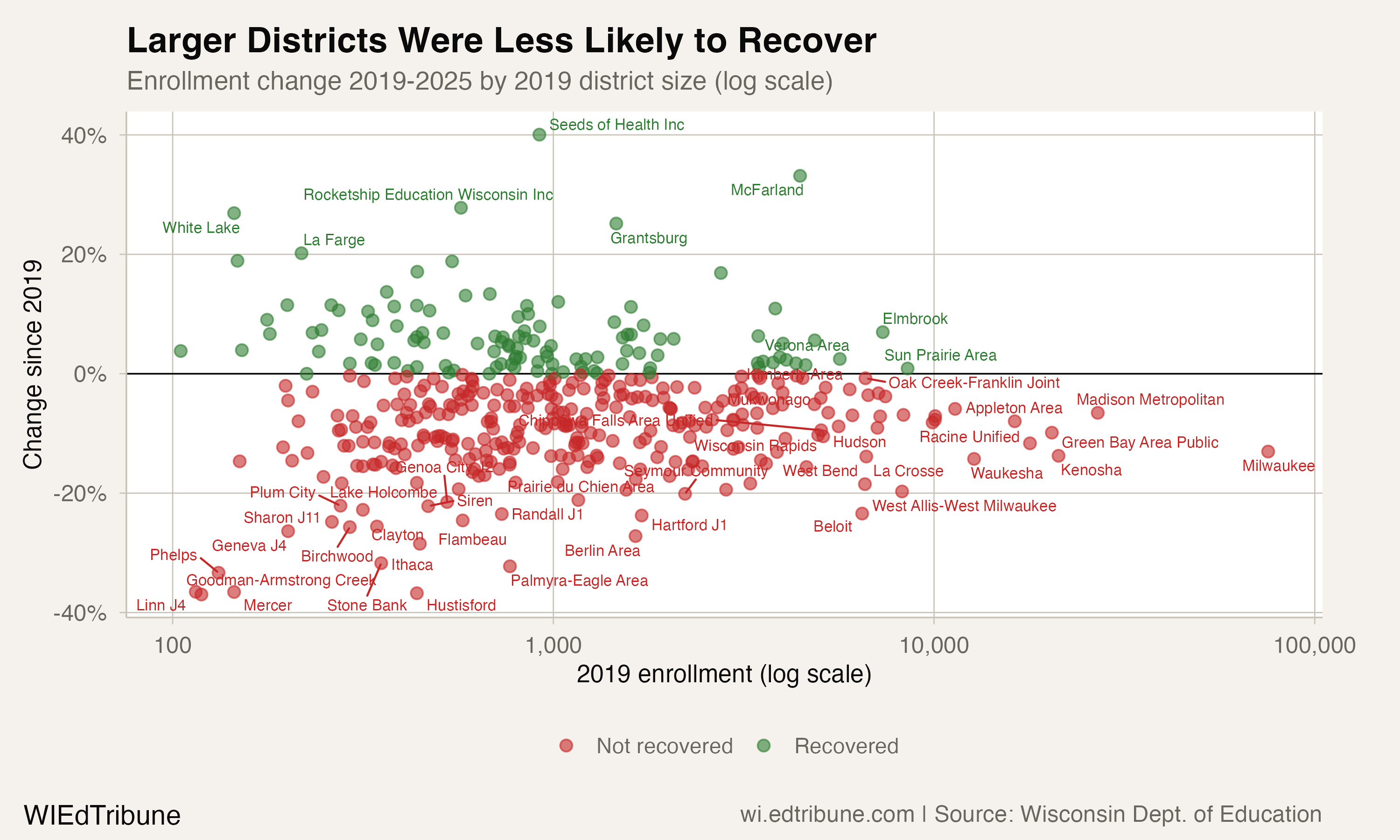
The scatter of individual districts makes the pattern visible. Nearly every green dot (recovered) sits on the left side of the chart, below 2,000 students. The right side, where the large urban and suburban districts sit, is almost entirely red. A few small districts with losses exceeding 30% anchor the bottom of the chart, but they represent handfuls of students. The mass losses are concentrated in the upper-right quadrant: big districts losing 5% to 15% of their students.
This is partly arithmetic. A district of 300 students needs only a handful of new families to cross back above its 2019 mark. A district of 75,000 needs a demographic reversal that has not occurred anywhere in Wisconsin. But it also reflects the structural forces pushing students out of larger districts: open enrollment transfers, voucher programs, and the concentration of homeschool growth in metro areas.
The spending paradox
Wisconsin received $1.49 billion in federal ESSER pandemic relief funds across three rounds. The money was intended as one-time emergency support for learning recovery, ventilation upgrades, and mental health services. According to a December 2025 analysis by the Institute for Reforming Government, 41% of those funds went instead to permanent salaries, propping up staffing levels even as enrollment fell.
The result: Wisconsin's public schools in 2024-25 employed more staff than at any point in state history while educating the fewest students since 1991-92. The state added 2,702 non-teaching staff from 2020 to 2025 even as enrollment dropped by 49,078. In 1992, with comparable enrollment, Wisconsin had roughly 7,800 fewer teachers and 20,000 fewer other staff.
Whether this staffing expansion was reckless or necessary depends on whom you ask. Smaller class sizes and more counselors are genuine recovery investments. But ESSER funds expired in September 2024, and districts that used them for permanent positions now face a fiscal cliff. Chippewa Falls, which previously bucked the statewide trend by growing, passed a three-year operational referendum to cover a $2.5 million annual shortfall in 2024. Its superintendent told Civic Media the state's per-student increase of $325 was "less than half of what we lost when federal dollars ran out."
53% of districts lost students both times
Of 420 districts with data for all three benchmark years, 223 (53.1%) lost students during the pandemic (2019-2021) and then continued losing after it (2021-2025). These "double-loss" districts represent the core of Wisconsin's enrollment crisis: places where the pandemic accelerated a decline that never reversed.
Another 45 districts actually gained students during COVID, likely through virtual enrollment or rural in-migration, but then gave those gains back. Only 116 are at or above their 2019 level today.
The net math is blunt. Non-recovered districts have collectively shed 64,836 students since 2019. Recovered districts have gained a total of 8,913. The gains do not come close to offsetting the losses.
The open enrollment drain
Wisconsin's inter-district open enrollment program, which allows students to attend any public school in the state regardless of residence, moved 75,126 students between districts in 2024-25, 9.5% of total enrollment. The transfer payment follows each student: $8,618 for general education, $13,470 for special education. The program creates clear winners and losers, and the losing districts are disproportionately the same ones that lost students during COVID.
Open enrollment does not create new students. It redistributes existing ones, shifting revenue from sending districts to receiving ones. For a district like Appleton↗ET, which lost 1,297 students since 2019, open enrollment outflows compound the demographic losses, draining both students and the funding that follows them. The Appleton superintendent has warned that without a referendum, the district faces $13 million in cuts.
Wisconsin's four voucher programs add another layer. More than 60,000 students now attend private schools using public vouchers through the Milwaukee Parental Choice Program, the Wisconsin Parental Choice Program, the Racine Parental Choice Program, and the Special Needs Scholarship Program. Voucher enrollment in Milwaukee has risen roughly 90% since 2006. These students are not counted in public school enrollment figures, meaning they deepen the statistical nonrecovery even if they remain in the same city.
What recovery would require
Five years after the worst enrollment loss in modern Wisconsin history, the state is roughly 35,600 students below where its own pre-pandemic trend line suggested it would be. The trend line itself was already declining. Wisconsin will not recover from COVID's enrollment impact. The 116 districts that clawed back above their 2019 levels are mostly small, and many of them host virtual schools that inflate their numbers. The large districts, where the majority of Wisconsin's children attend school, are still sinking.
Chippewa Falls passed a three-year operational referendum in 2024 to cover a $2.5 million annual shortfall, and its superintendent said the state's per-student increase of $325 was "less than half of what we lost when federal dollars ran out." That arithmetic applies across the 304 districts still below their 2019 mark, where federal pandemic aid that paid for permanent positions has now run out and enrollment continues to slide.
Detailed code that reproduces the analysis and figures in this article is available exclusively to EdTribune subscribers.
Discussion
Sign in to join the discussion.
Loading comments...