More than half the students in Abbotsford↗ET are classified as English learners. In Arcadia↗ET, the figure is 44%. These are not urban school districts absorbing waves of international arrivals. They are small towns in rural western Wisconsin, surrounded by dairy farms and meatpacking plants, where the workforce that keeps the agricultural economy running has brought children who speak Spanish, Hmong, and dozens of other languages into classrooms built for a monolingual student body.
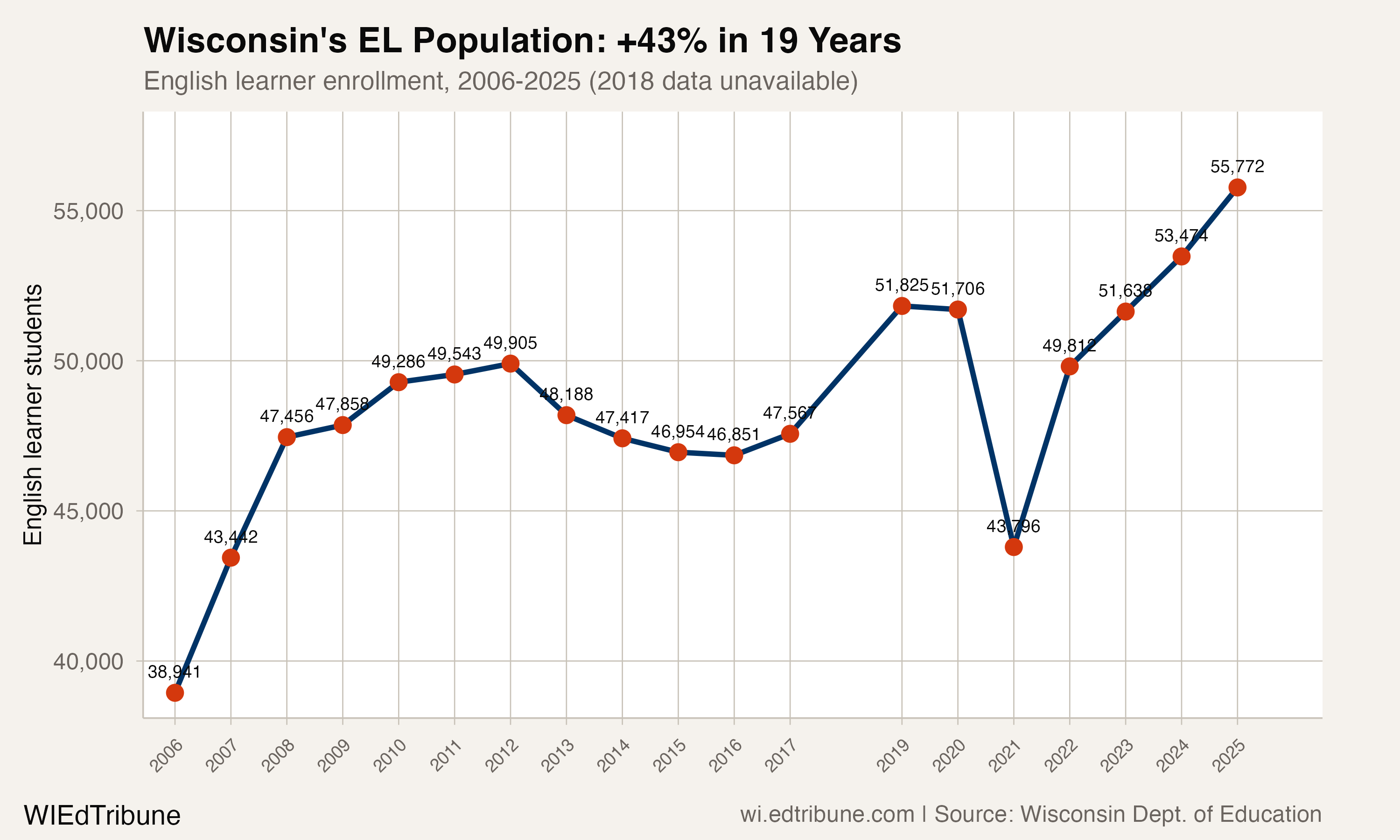
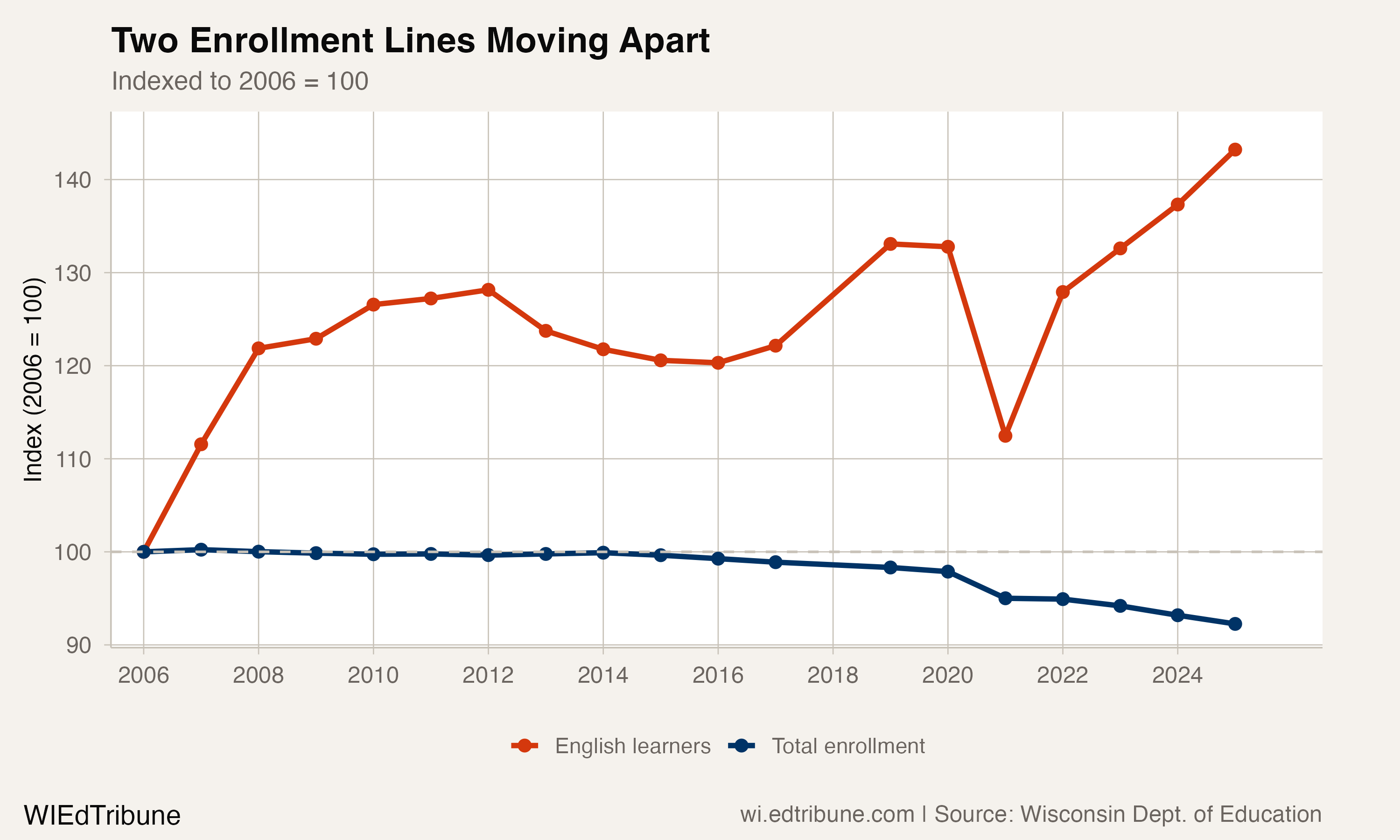
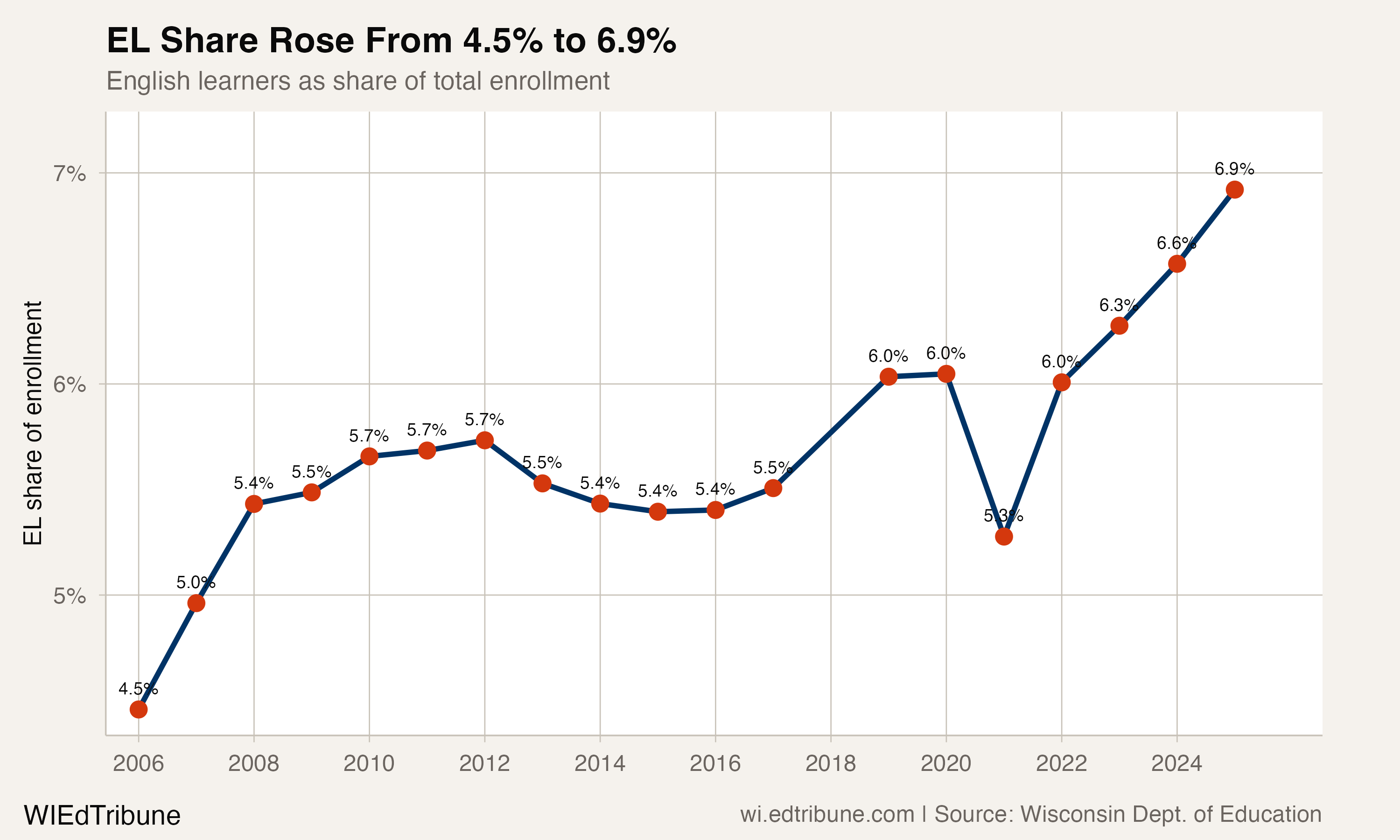
Wisconsin now enrolls 55,772 English learners, up 43.2% from 38,941 in 2005-06. Over the same period, total enrollment fell 7.7%, from 873,521 to 805,881. One in every 14 students in the state is classified as an English learner, up from one in 22 two decades ago. The growth has not slowed. It has accelerated: the state added 5,960 students who are English learners in the last three years alone, a 12.0% increase since 2021-22.
The structural mismatch
The divergence between these two lines carries fiscal weight. Wisconsin lost 67,640 students since 2005-06, shrinking the base that generates per-pupil revenue. English learner enrollment grew by 16,831 over the same span. Had EL enrollment held flat, the state's total decline would have been 84,471 rather than 67,640. The students who prevented an even steeper decline are precisely the students whose instructional programs carry higher per-pupil costs: bilingual and ESL staffing, translated materials, family liaisons, and federally mandated annual proficiency assessments.
Wisconsin's bilingual-bicultural (BLBC) aid program reimburses districts for a portion of their EL program costs, but only 58 districts received state BLBC aid in 2024-25, serving 25,427 students. That is roughly 45% of the state's EL population. The remaining 30,000-plus English learners attend districts that either fall below the statutory concentration threshold for aid eligibility or lack bilingual programs entirely.
Three phases of growth
The 19-year trend is not a single story. It breaks into distinct eras with different dynamics.
Phase one (2006-2012): Rapid expansion. EL enrollment surged from 38,941 to 49,905, adding nearly 11,000 students in six years. This period coincided with peak Hispanic immigration into Wisconsin's dairy and meatpacking regions. Clark County, where Abbotsford is located, saw its Hispanic population grow 219% between 2000 and 2010. Abbotsford's EL share climbed from 13.7% to 29.1%.
Phase two (2013-2017): Plateau and mild retreat. EL enrollment dipped to 46,851 by 2015-16 before stabilizing. Identification rates may have tightened during this period, though statewide methodology did not formally change. Districts like Sheboygan Area↗ET and Wausau↗ET began reporting fewer students classified as English learners even as their immigrant communities remained.
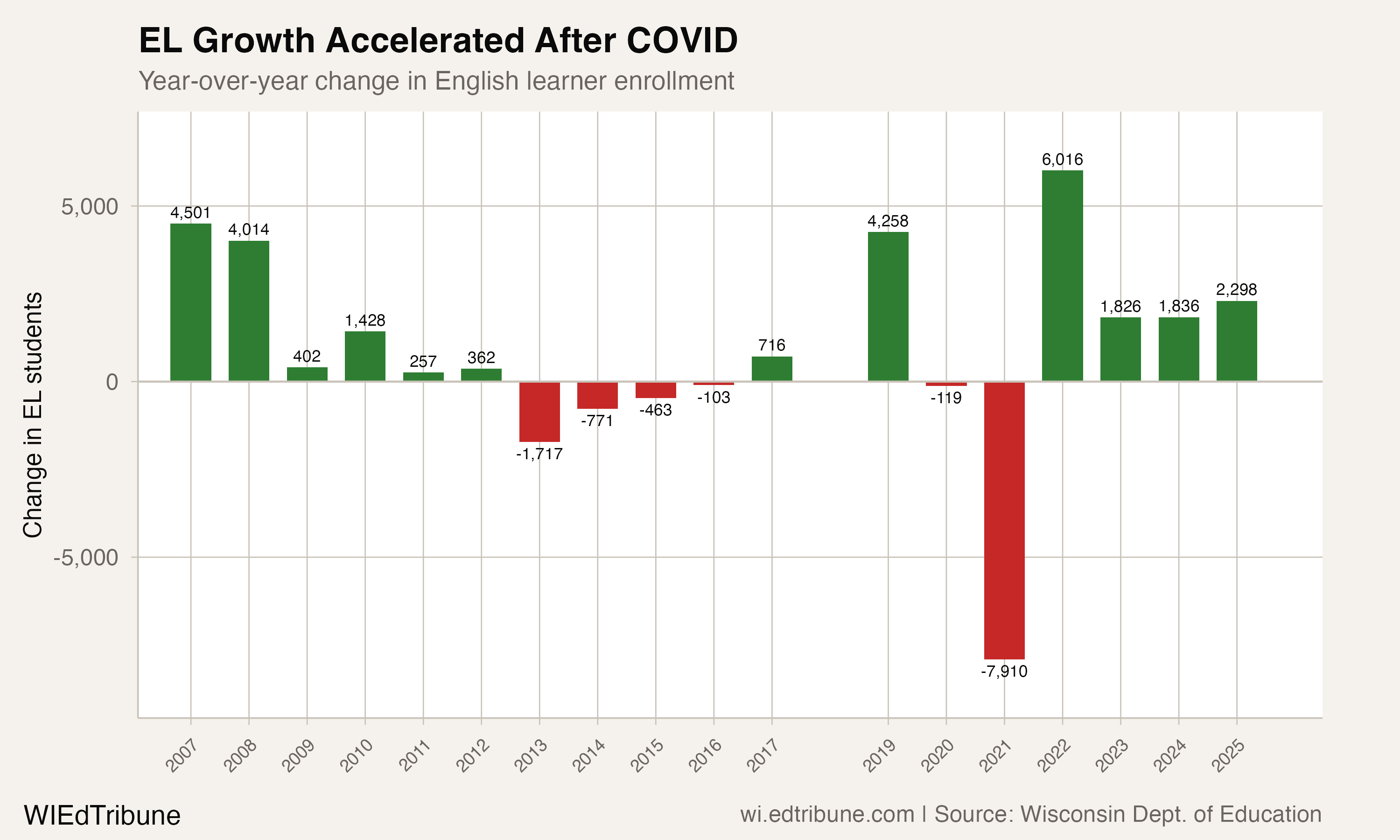
Phase three (2019-2025): Post-plateau acceleration. EL enrollment broke above 50,000 for the first time in 2018-19, crashed to 43,796 during the pandemic year of 2020-21, then rebounded to a record 55,772 by 2024-25. The COVID dip of 7,910 students was not a real population decline; it reflected disrupted identification and enrollment processes. The rebound exceeded pre-pandemic levels by 4,066 students, suggesting both re-identification of existing students and genuine new arrivals.
The geography of language
The districts with the highest EL concentrations tell distinctly different stories about how language diversity reaches Wisconsin classrooms.
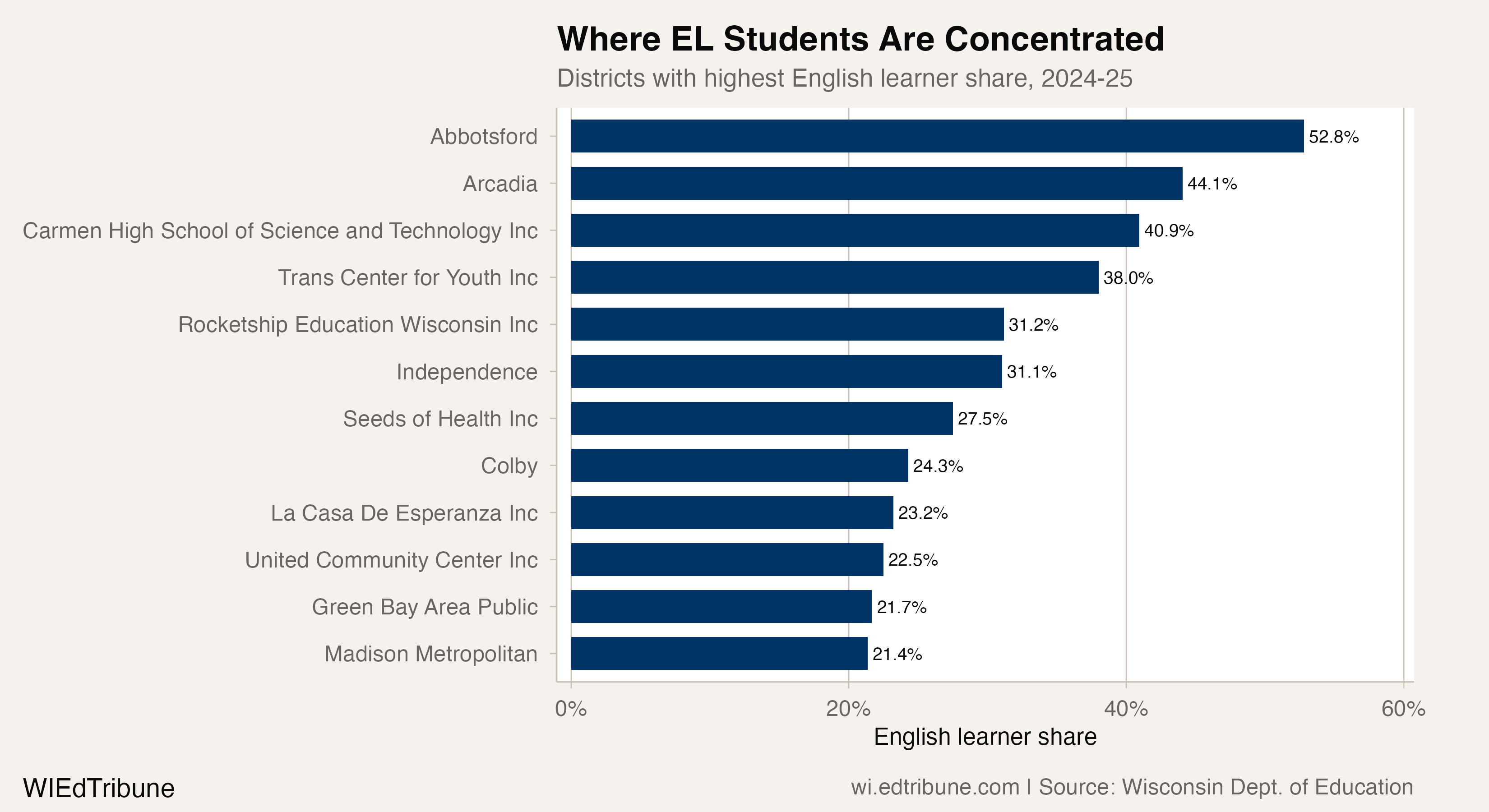
Dairy country. Abbotsford's EL share has quadrupled since 2005-06, from 13.7% to 52.8%. The district enrolled 422 English learners out of 799 total students in 2024-25, making it the most EL-intensive traditional district in Wisconsin. An estimated 70% of labor on Wisconsin dairy farms is performed by immigrant workers, according to a 2023 UW-Madison School for Workers survey, many from Mexico and Central America. Abbotsford sits in Clark County, which ranks first statewide in dairy operations. Colby↗ET, 15 miles east, has reached 24.3% EL. Independence↗ET, in neighboring Trempealeau County, is at 31.1%.
Meatpacking towns. Arcadia's transformation is anchored by two employers: the Ashley Furniture headquarters and a Pilgrim's Pride chicken processing plant. The district's EL share rose from 6.9% in 2005-06 to 44.1% in 2024-25. Arcadia's total enrollment grew from 995 to 1,303 over the same period. Without its EL population, the district would have shrunk.
Urban convergence. Milwaukee↗ET enrolls 11,498 English learners, 17.5% of its student body, nearly doubling its EL count from 5,846 in 2005-06. Madison Metropolitan↗ET serves 5,375 students classified as English learners (21.4%), and Green Bay Area Public↗ET serves 3,983 (21.7%). Green Bay's EL population reflects Hmong, Hispanic, and Somali communities converging in a single district. The Wisconsin DPI identifies over 140 languages spoken by students statewide, with Spanish the most common and Hmong the second.
Milwaukee's quiet transformation
Milwaukee's English learner trajectory deserves separate attention. The district's EL enrollment nearly doubled from 5,846 (6.4% of enrollment) in 2005-06 to 11,498 (17.5%) in 2024-25. This happened while Milwaukee lost 26,219 total students over the same period. The EL share nearly tripled not because of modest growth but because EL enrollment grew 96.7% against a backdrop of total enrollment falling 28.6%.
Milwaukee now has more English learners than 440 of Wisconsin's 446 districts have total students.
Hmong communities: a split trajectory
The traditional Hmong settlement areas show an unexpected pattern. While statewide EL numbers surged, several historically Hmong-concentrated districts saw their EL counts fall. Wausau's EL enrollment dropped 56.3%, from 1,666 to 728. Sheboygan Area fell 25.3%, from 2,174 to 1,624. These declines likely reflect generational transition: children of long-established Hmong families are increasingly English-proficient at school entry, removing them from EL classification even as the community's cultural presence endures.
Appleton Area↗ET moved in the opposite direction, growing from 1,209 to 1,637 students classified as English learners (a 35.4% increase), suggesting newer arrivals or different community dynamics than Wausau and Sheboygan.
The funding question
The gap between Wisconsin's EL enrollment and the state's capacity to fund EL instruction is a structural problem, not a temporary shortfall. The BLBC aid program's design means a district needs a sufficient concentration of students speaking a single language to qualify. Rural districts with small numbers of students who are English learners from diverse language backgrounds receive no state bilingual aid regardless of the instructional burden those students create.
The number of districts serving at least one English learner grew from 300 in 2005-06 to 384 in 2024-25, an increase of 84 districts. The number serving EL populations above 10% of enrollment grew from 14 to 36. Wisconsin's EL footprint is both deepening in established communities and spreading into districts that have never needed bilingual capacity.
"There are lots and lots of bilingual, bicultural people in the state of Wisconsin. We just don't create incentives or pathways for them to become certified as bilingual teachers." -- Mariana Pacheco, UW-Madison School of Education, via UW-Madison
DPI's 2025-27 budget request included a proposed English learner categorical aid separate from the existing BLBC program, designed to reach districts that fall below the concentration threshold. The proposal would have provided a minimum of $10,000 to districts with one to 20 EL students and $500 per additional student, but DPI's Act 15 summary says the Joint Finance Committee removed it from consideration.
Immigration enforcement and what comes next
Wisconsin's EL enrollment growth coincides with a period of intensifying federal immigration enforcement. The Wisconsin DPI sent districts guidance in January 2025 reaffirming that students have the right to enroll in public schools regardless of citizenship status. Whether enforcement actions affect enrollment patterns in dairy and meatpacking communities, where immigrant labor is concentrated, is a question the 2025-26 data will begin to answer.
The more durable question is staffing. Wisconsin reports bilingual education as a teacher shortage area. A district like Abbotsford, where a majority of students need English instruction, cannot function without bilingual staff. The pipeline for those educators is thin, the competition for them is national, and the communities that need them most are small towns where housing and salary compete poorly against urban districts.
Wisconsin added 16,831 English learners in 19 years. It did not add 16,831 bilingual teachers. That arithmetic is the story.
Detailed code that reproduces the analysis and figures in this article is available exclusively to EdTribune subscribers.
Discussion
Sign in to join the discussion.
Loading comments...