In a single school year, Wisconsin's charter sector gained more ground than it had in the previous five years combined. Between 2019 and 2021, charter schools added 7,570 students -- a 17.5% increase -- while traditional public schools lost 36,468. Charter share jumped a full percentage point, from 5.0% to 6.1%, and has held at 6.0% every year since.
Nearly 90% of that surge came from virtual schools, which doubled enrollment during the pandemic. Four years later, the traditional sector has not recovered those students. The charter sector has not given them back.
A sector that plateaued, then surged

Wisconsin's charter sector grew rapidly from 2006 to 2014, climbing from 27,553 students (3.2% of public enrollment) to 45,069 (5.2%). Then growth stalled. From 2014 to 2019, charter enrollment actually declined slightly, falling to 43,291, as new school openings slowed and several Milwaukee-based charters contracted.
COVID changed that. In 2020-21, charter enrollment jumped to 50,861, the sector's all-time high. The gain of 6,158 students in a single year was the largest in the dataset, eclipsing even the 5,821-student jump in 2008 when Wisconsin was still scaling up its charter authorization framework.
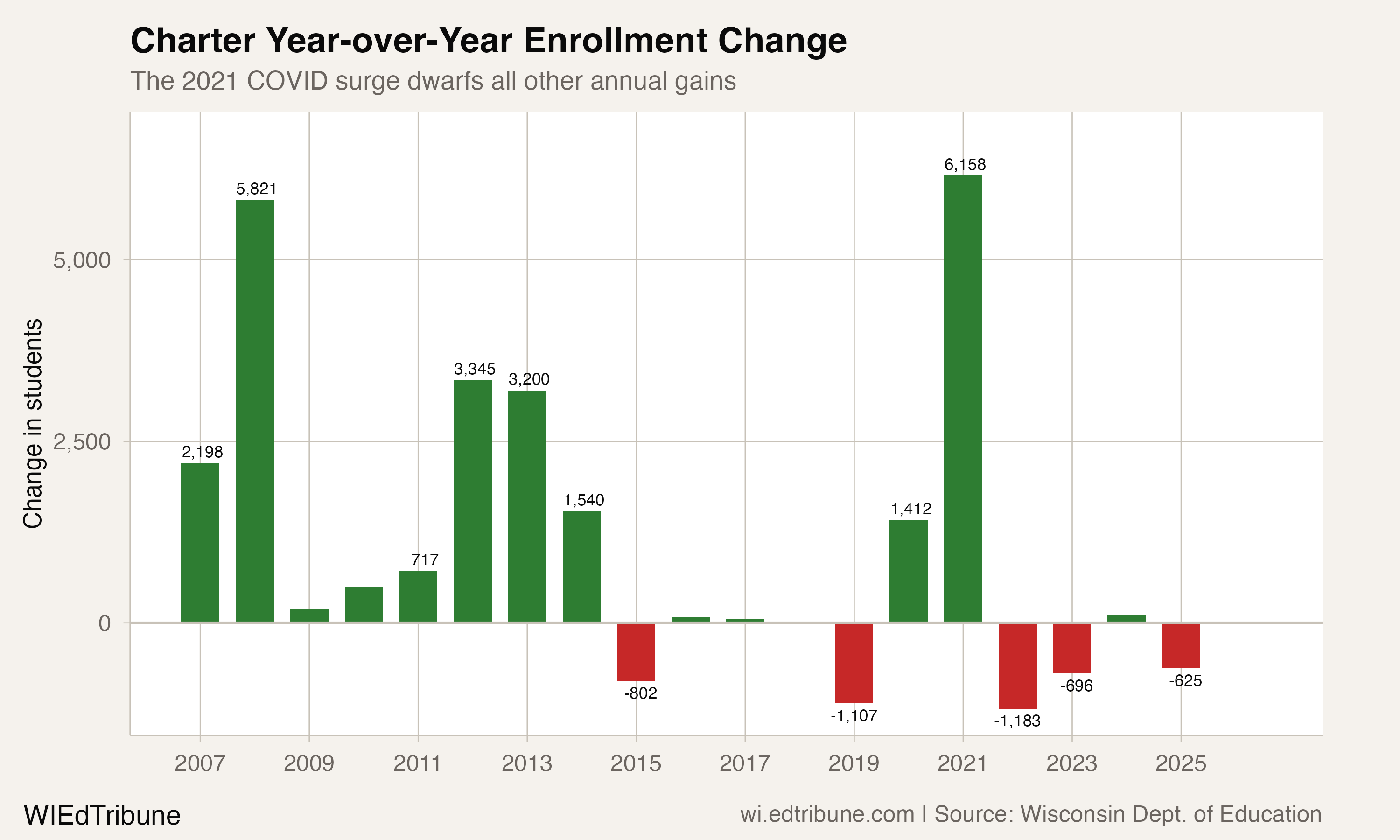
Since 2021, charter enrollment has settled around 48,500 to 49,700. The sector has given back about 2,400 students from its pandemic peak but remains 5,182 students above its pre-COVID level, a 12.0% net gain over six years. Traditional schools, by contrast, fell from 815,542 to 757,408 over the same period, a loss of 58,134 students (7.1%).
Virtual schools drove the entire surge
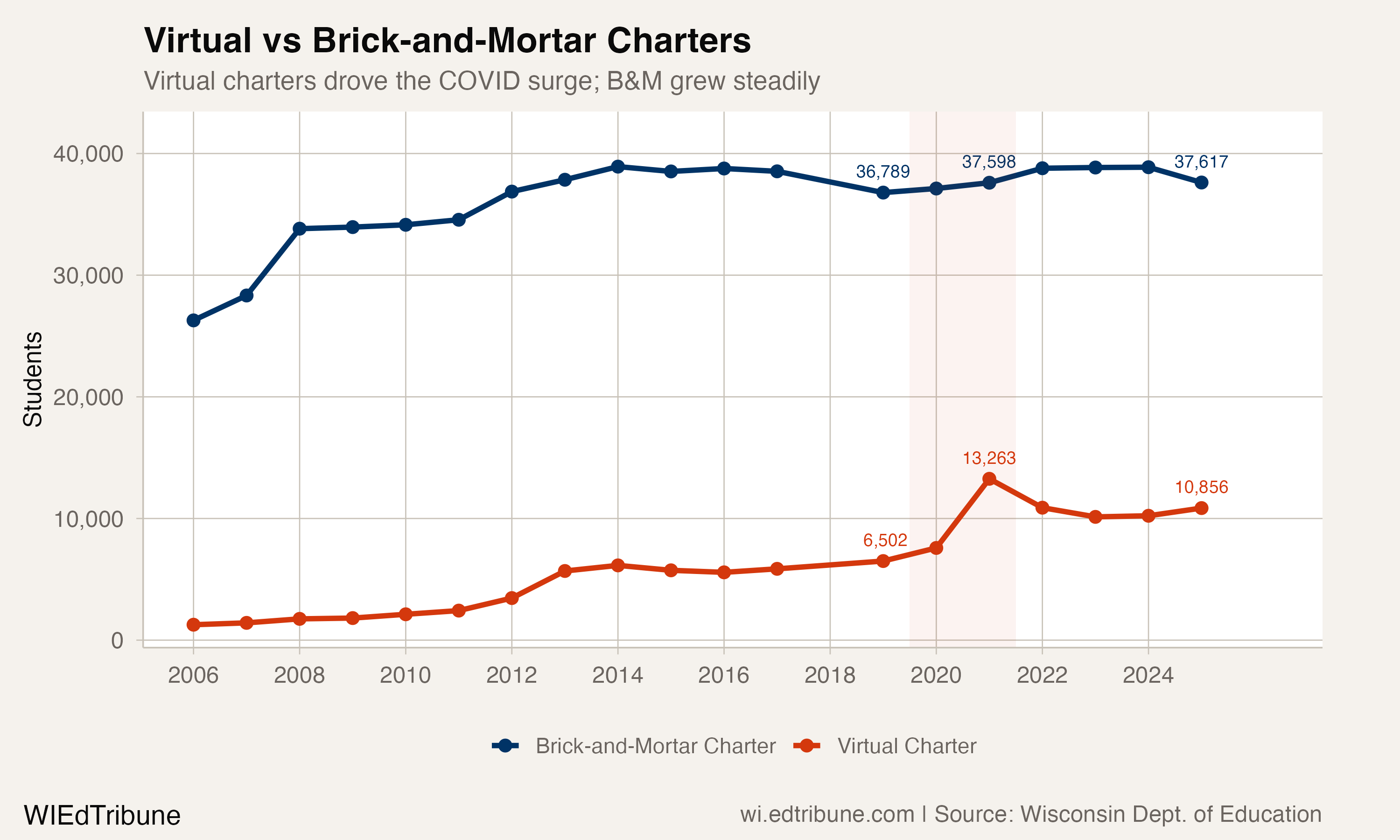
The mechanism is not subtle. Virtual charter enrollment doubled from 6,502 students in 2019 to 13,263 in 2021, a gain of 6,761 students. Brick-and-mortar charter enrollment during the same period rose just 809 students, from 36,789 to 37,598. Virtual schools accounted for 89% of the total charter surge.
The largest beneficiaries were established virtual operators. Wisconsin Virtual Academy (WIVA), administered through the McFarland↗ET School District and operated by K12 Inc., gained 1,756 students across its K-8 and high school campuses. Wisconsin Connections Academy in Appleton↗ET gained 676. ARISE Virtual Academy in Janesville↗ET gained 633 students, growing from 101 to 734. iForward, based in Grantsburg↗ET, added 391. Even smaller virtual operators saw enrollment triple or quadruple.
"The enrollment of Wisconsin's virtual charter schools nearly doubled to more than 16,000 students in the 2020-21 school year, according to state Department of Public Instruction figures." -- Capital Times, Dec. 2024
The pandemic rationale is straightforward: families who wanted an alternative to in-person instruction during COVID turned to existing virtual charters rather than navigating improvised remote learning from their home district. Virtual charters had the infrastructure, the curriculum platforms, and the enrollment capacity to absorb thousands of families in a single semester. Traditional districts offering emergency remote instruction were competing with schools built for online delivery.
The share plateau at 6%
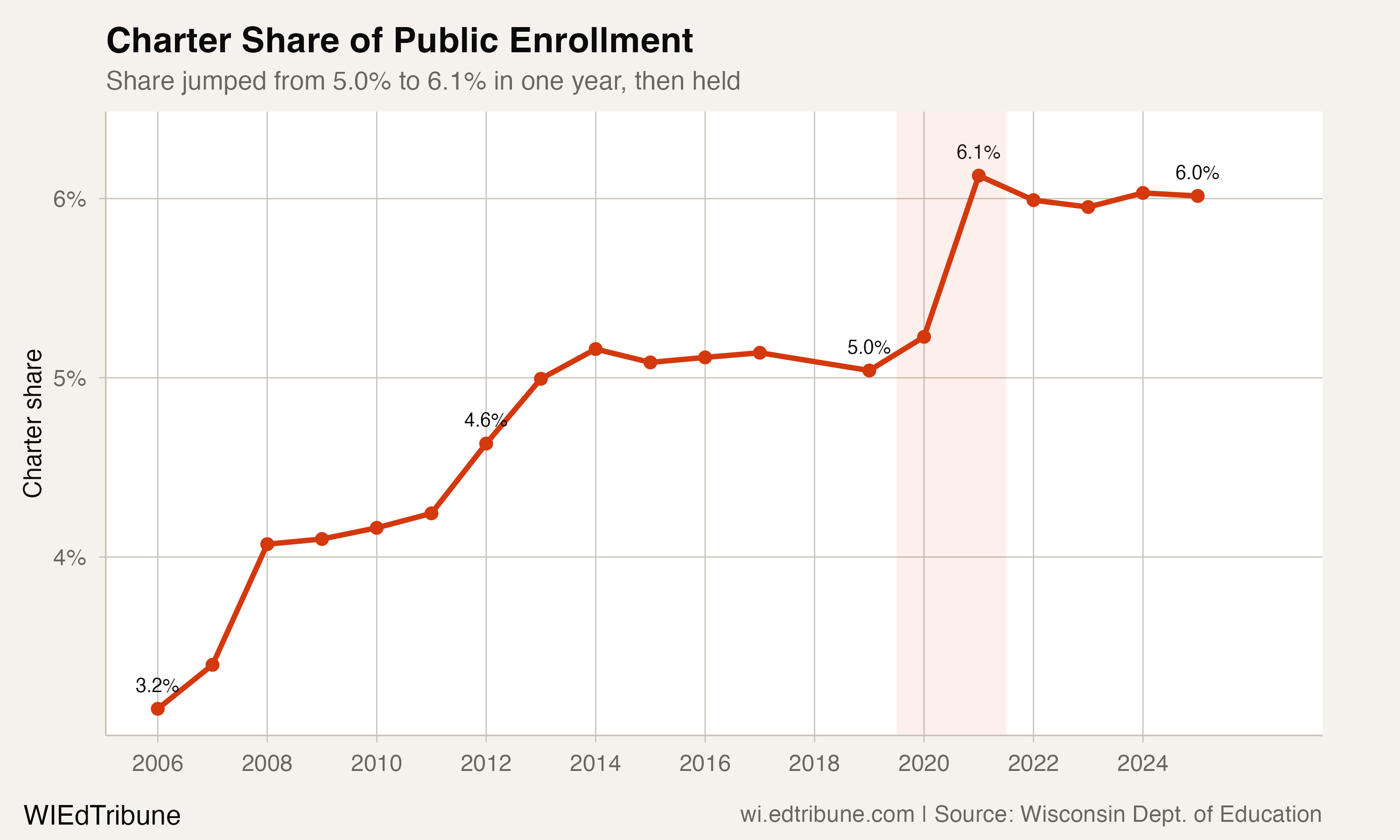
Before COVID, charter share had been essentially flat for five years, hovering between 5.0% and 5.2%. The pandemic moved it to 6.1% in one year, and it has stayed between 5.9% and 6.0% since. This plateau suggests the sector has absorbed a new baseline of demand but is not continuing to gain ground. Post-COVID annual charter growth has turned slightly negative, at -1.2% per year from 2021 to 2025.
Virtual charters explain part of the stabilization. After doubling during COVID, virtual enrollment fell to 10,888 in 2022, then stabilized around 10,100 to 10,900 through 2025. Virtual schools still enroll 10,856 students, 67% above their pre-COVID level, but the initial surge has partially receded. Virtual charters now account for 22.4% of all charter enrollment, up from 15.0% before the pandemic.
Brick-and-mortar charters, meanwhile, have barely moved. They enrolled 36,789 students in 2019 and 37,617 in 2025, a gain of just 828 students (2.3%) over six years. The charter growth story in Wisconsin is almost exclusively a virtual school story.
The academic trade-off
The enrollment gains come with documented academic costs. Stanford researchers found that virtual charter students nationally received "58 fewer days of learning in reading and 124 fewer days in math per year" compared to peers in brick-and-mortar public schools, based on data from 2014 to 2019, before the pandemic further strained virtual models.
Wisconsin-specific results are similarly weak. In 2023-24, only about one-quarter of virtual charter students met state reading expectations and roughly one-fifth met math expectations. At WIVA's K-8 school, one in five students was proficient in English and one in ten in math. More than 40% of virtual charter students opted out of state testing entirely, further clouding the picture.
"But the data that we do have should give us a moment of pause." -- Kevin Lawrence Henry Jr., researcher, quoted in Capital Times
The tension is real: virtual charters serve families who actively chose them, often for reasons (medical needs, bullying, geographic isolation, scheduling flexibility) that traditional metrics do not capture. Low test scores may reflect the population these schools attract as much as the quality of instruction they deliver. But 10,856 students attending schools where fewer than one in four meets state reading benchmarks is a policy question Wisconsin has not resolved.
Where charters concentrate
Charter enrollment is not evenly distributed. Milwaukee↗ET accounts for 8,866 charter students, 18.3% of all charter enrollment statewide and 13.5% of Milwaukee's total district enrollment. The next-largest charter concentrations are in McFarland (3,584 charter students, 60.5% of district enrollment, almost entirely WIVA), Appleton (2,894, 19.3%), and Waukesha↗ET (1,586, 14.5%).
Several districts exist solely as charter operators. Milwaukee Science Education Consortium, United Community Center, Seeds of Health, Rocketship Education Wisconsin, The Lincoln Academy, and Milwaukee Scholars Charter School are all 100% charter entities authorized under Wisconsin's independent charter school statute, which allows non-district authorizers including UW-Milwaukee, the City of Milwaukee, and the Office of Educational Opportunity. Independent charter schools receive $12,369 per pupil in 2025-26.
Virtual charters create a particular distortion in district-level data. McFarland's enrollment of 5,921 appears to make it a mid-sized district, but only 2,337 of those students attend brick-and-mortar schools in the McFarland community. The remaining 3,584 attend WIVA from homes scattered across hundreds of districts statewide. Grantsburg↗ET (56.3% charter, driven by iForward) and Medford↗ET (37.2%, driven by Rural Virtual Academy) show the same pattern.
Two sectors pulling apart
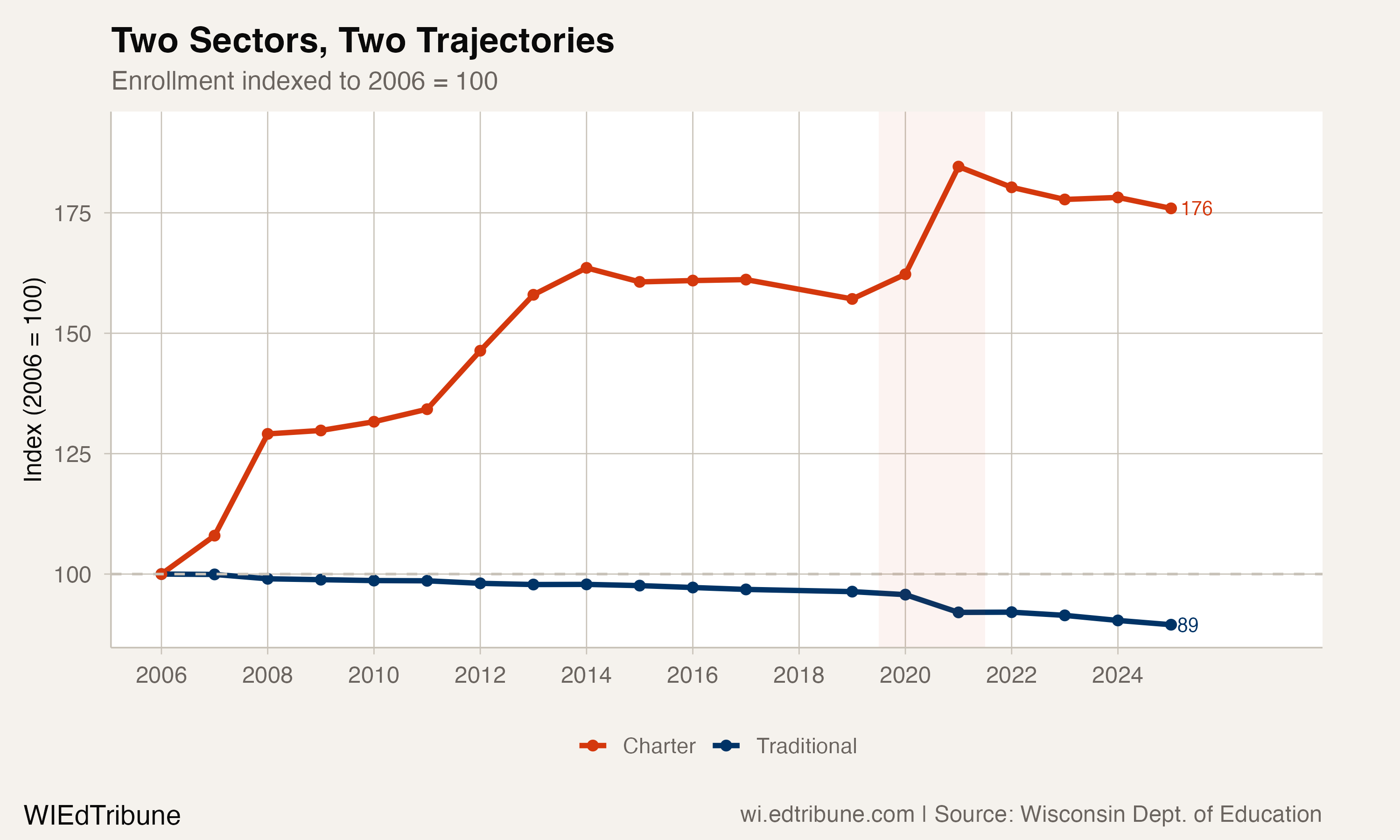
Indexed to 2006, charter enrollment stands at 176 while traditional enrollment has fallen to 89. The sectors are moving in opposite directions, though at very different scales: charter's 20,920-student gain over 19 years is dwarfed by traditional's 89,003-student loss.
The divergence accelerated during COVID and has not reversed. From 2019 to 2025, charters gained 5,182 students while traditional schools lost 58,134. Even with the charter sector's post-2021 drift downward, the gap between the two trajectories continues to widen.
Combined with the state's four voucher programs, which enrolled more than 29,949 students in Milwaukee alone in 2025 plus additional participants in the statewide, Racine, and Special Needs Scholarship programs, Wisconsin's public school system is losing enrollment to choice alternatives at a steady pace. The Wisconsin Parental Choice Program's per-district enrollment cap has risen by one percentage point annually since 2017, and once it reaches 10%, no enrollment limit will apply, removing the last structural constraint on statewide voucher growth.
The 313 charter schools operating in 2025 are not going away. Neither is the 124-day math learning gap that Stanford researchers documented in virtual programs nationally. Wisconsin now has 10,856 students enrolled in virtual charters where fewer than one in four meets state reading benchmarks -- and more than 40% opt out of testing entirely. Those families chose these schools. The state has not yet decided what it owes them.
Detailed code that reproduces the analysis and figures in this article is available exclusively to EdTribune subscribers.
Discussion
Sign in to join the discussion.
Loading comments...