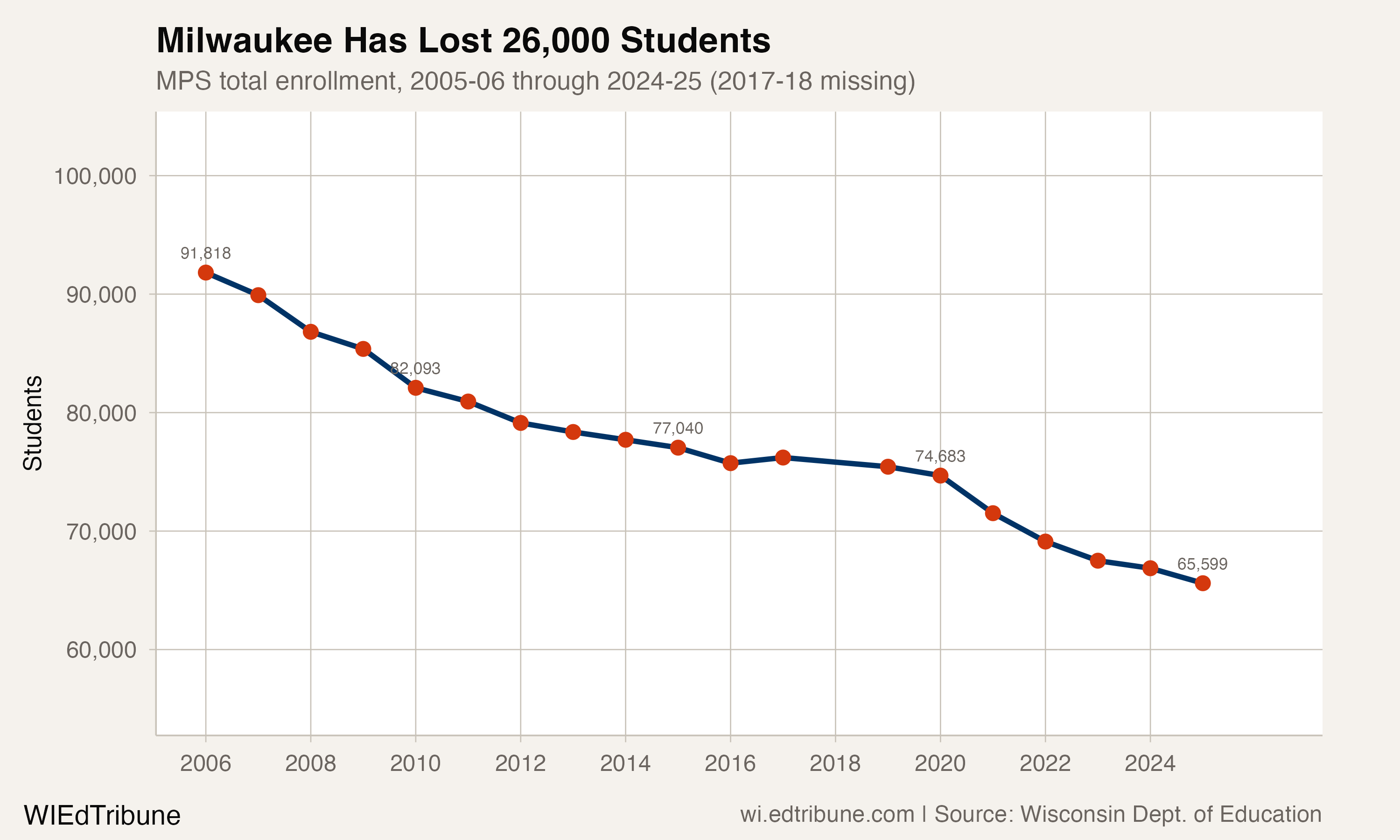
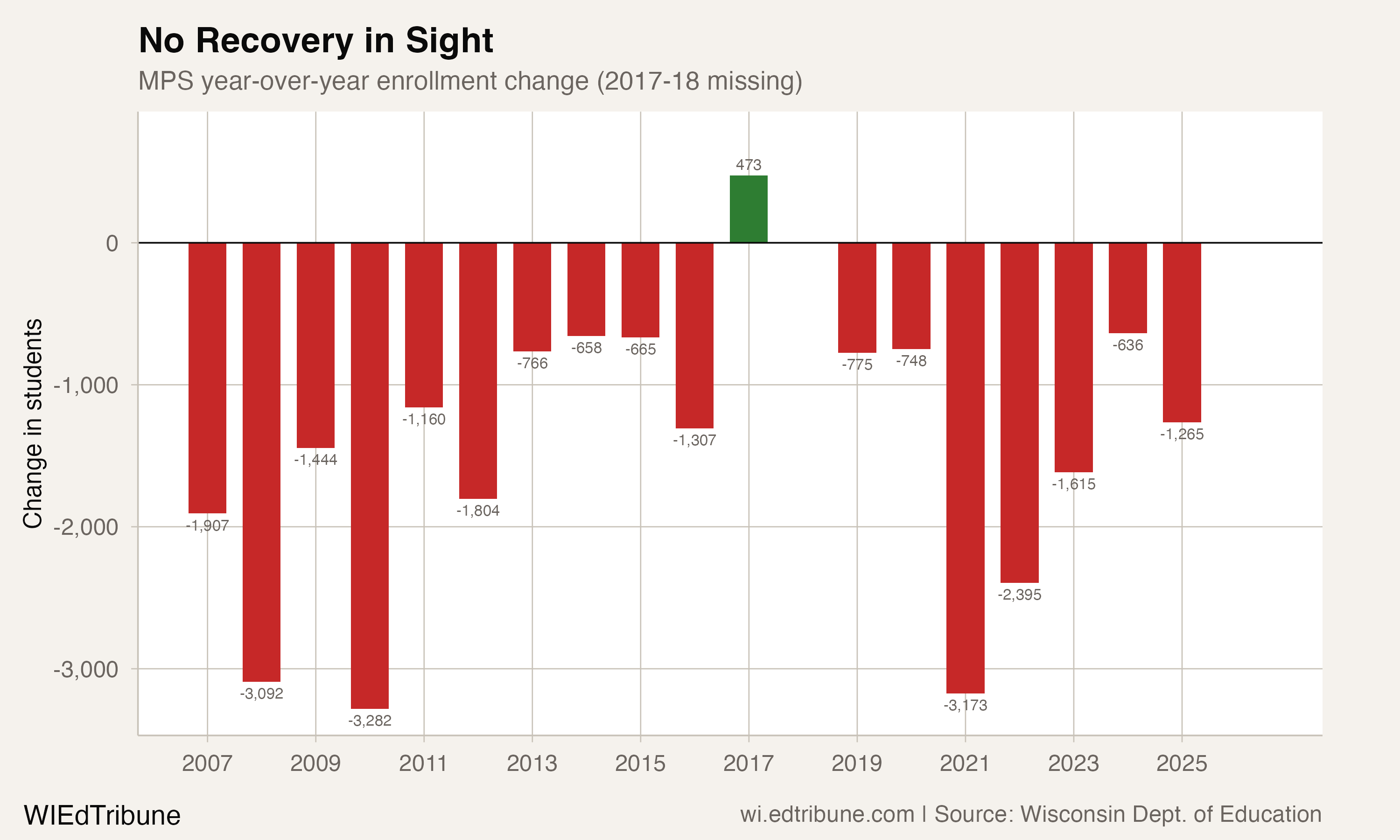
In 19 years of Wisconsin enrollment data, Milwaukee↗ET Public Schools recorded a single year of growth. It was 2016-17, when the district added 473 students. Every other year, the line moved in one direction.
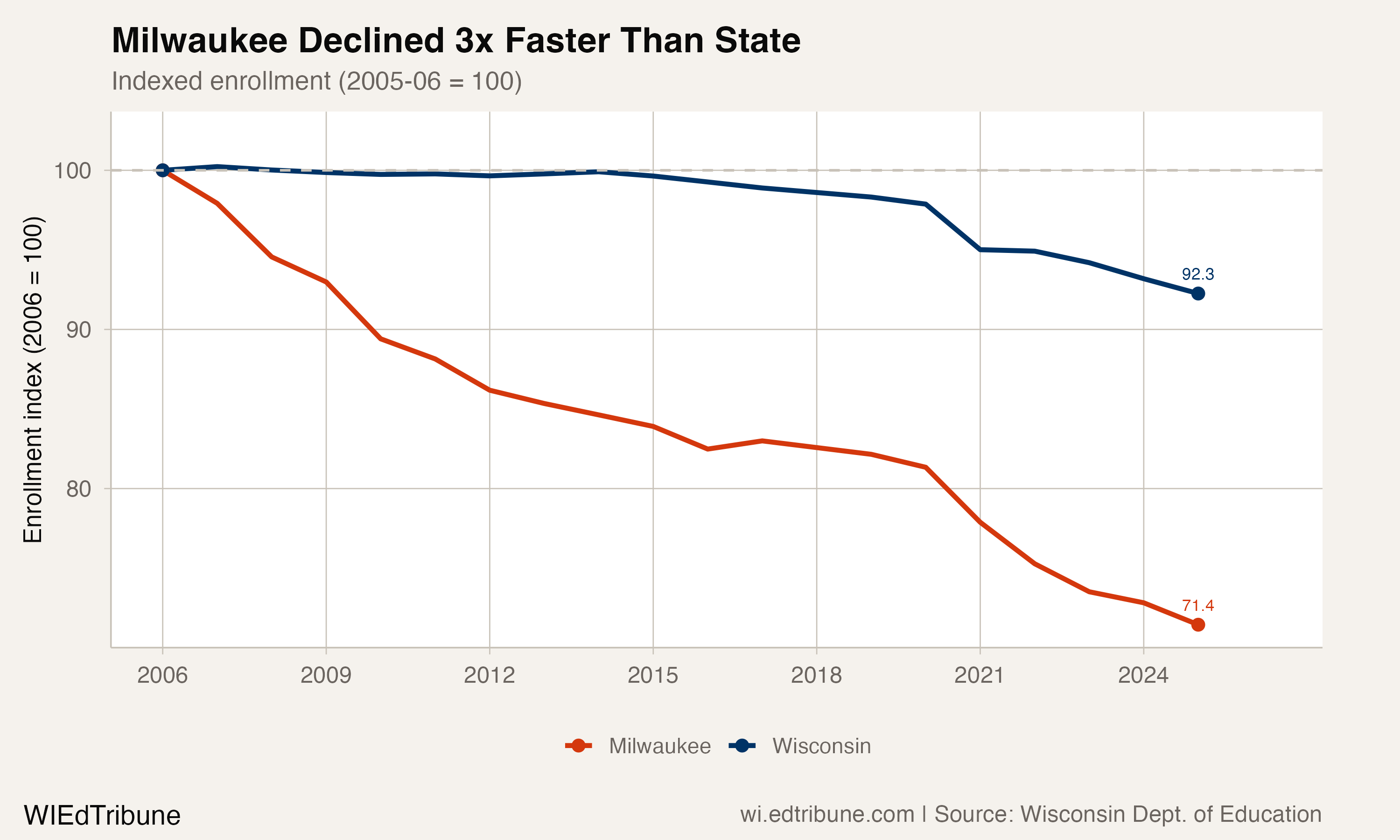
The result: MPS enrolled 91,818 students in 2005-06 and 65,599 in 2024-25, a loss of 26,219 students, or 28.6%. Over the same period, Wisconsin as a whole lost 7.7% of its enrollment. Milwaukee's decline has been nearly four times faster than the state's.
That gap translates directly into money and staff. In March 2026, the district announced plans to eliminate 263 positions to close a $46 million structural deficit for the 2026-27 school year.
A district that never recovered
Most Wisconsin districts lost students during the pandemic. Milwaukee's distinction is that it was already in steep decline when COVID hit, and the pandemic made it worse without triggering any rebound.
MPS enrolled 74,683 students in 2019-20, lost 3,173 during the COVID year (a 4.2% drop), and has continued falling every year since. By 2024-25, the district sat 5,911 students below its COVID-era low. There has been no recovery. MPS has posted seven consecutive years of decline since 2018-19 (with 2017-18 missing from state data).
The year-over-year pattern shows two distinct eras of loss. From 2006-07 through 2009-10, MPS shed between 1,400 and 3,300 students per year. After a period of slower losses in the mid-2010s, the pace reaccelerated starting in 2020-21, with annual declines between 636 and 3,173 students.
The competition for Milwaukee's children
Milwaukee is not a city where children disappeared. It is a city where they enrolled elsewhere. The district operates in the most competitive enrollment environment in the country: the nation's oldest voucher program, an uncapped open enrollment system, and a growing charter sector all draw from the same pool of families.
A Wisconsin Policy Forum report found that private choice enrollment in Milwaukee rose 90% between 2006 and 2024. The Milwaukee Parental Choice Program, created in 1990, now serves more than 29,000 students across 135 private schools, with vouchers worth $10,877 for K-8 and $13,371 for high school students. There is no enrollment cap.
Wisconsin's open enrollment program compounds the outflow. Under this system, families can transfer to any public district in the state, with per-pupil funding following each student. A Badger Institute analysis found MPS lost roughly 3,200 students net to other districts through open enrollment in a single recent year. Milwaukee's child population declined approximately 8% between 1997 and 2022, from 151,000 to 139,000, meaning demographic shrinkage accounts for only a fraction of MPS's enrollment collapse. The rest reflects families choosing alternatives.
The suburban ring surrounding Milwaukee tells part of the story. While MPS shrank 28.6%, suburban districts in the metro area followed a different path. Franklin Public grew 14.4%, Whitefish Bay added 6.3%, and Elmbrook gained 2.5%. Not all suburbs grew; Cudahy fell 31.3% and South Milwaukee dropped 22.5%. But the net suburban flow was outward, with most inner-ring districts losing students and outer-ring districts gaining them.
A different student body in a smaller district
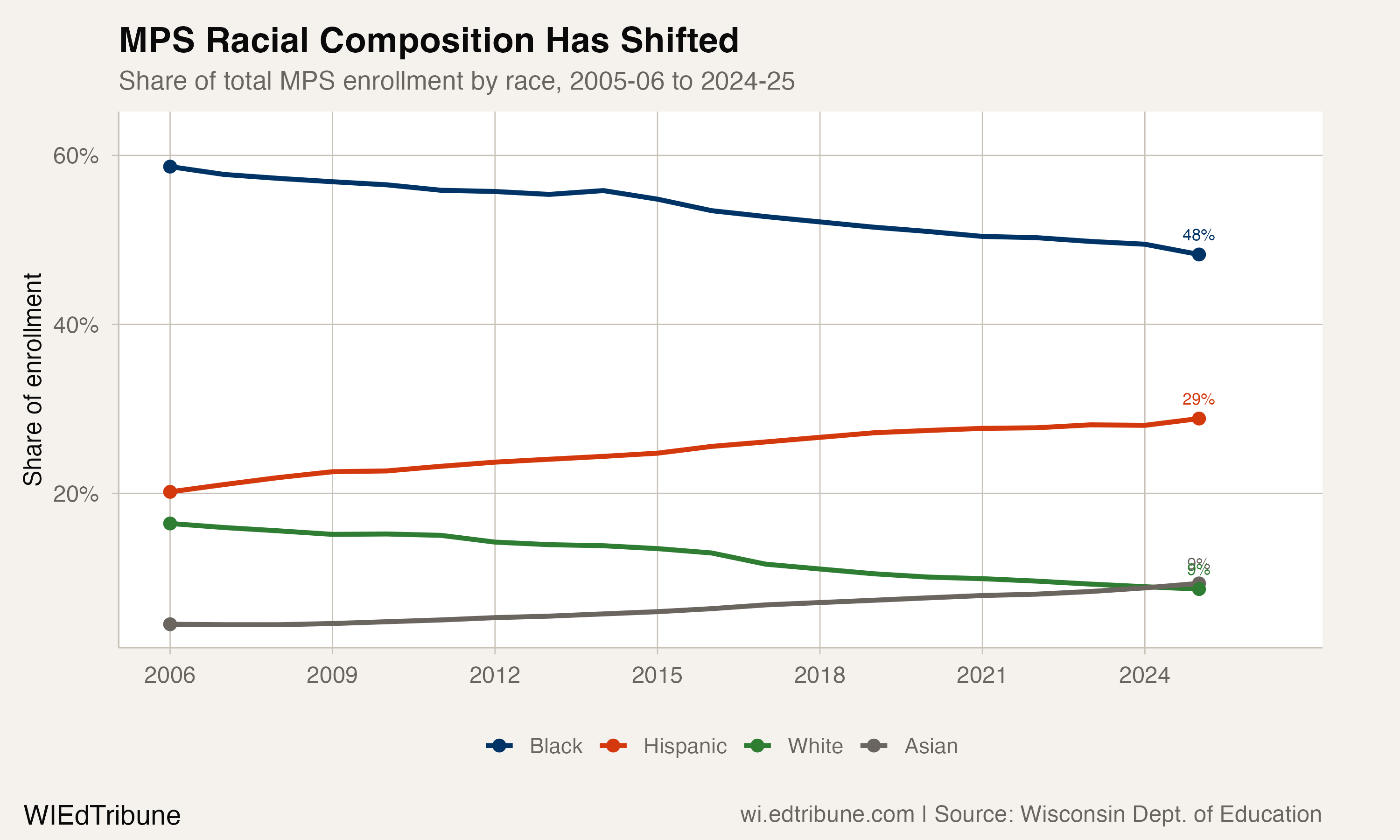
The students who attended MPS in the latest data differ substantially from those who attended in 2006. Black enrollment has fallen from 53,870 to 31,665, a loss of 22,205 students, or 41.2%. Black students made up 58.7% of MPS in 2006; they now account for 48.3%. White enrollment dropped even more steeply in percentage terms: 15,087 to 5,685, a 62.3% decline that shrank white students' share from 16.4% to 8.7%.
Hispanic enrollment held nearly flat in absolute terms, rising by just 402 students to 18,927. But because the overall district shrank, Hispanic students' share grew from 20.2% to 28.9%. Asian enrollment grew 48.0%, from 4,139 to 6,127, pushing its share from 4.5% to 9.3%.
Separately, the instructional profile has shifted. English learner enrollment nearly doubled, from 5,846 to 11,498 (a 96.7% increase), raising the EL share from 6.4% to 17.5%. This overlaps heavily with the Hispanic and Asian enrollment trends but reflects growing demand for bilingual instruction and EL services. Special education enrollment declined in absolute terms (14,977 to 13,281) but grew as a share of the shrinking district, from 16.3% to 20.2%. One in five MPS students now receives special education services.
The kindergarten signal
The pipeline into MPS is narrowing. Kindergarten enrollment fell from 6,657 in 2005-06 to 4,825 in 2024-25, a 27.5% decline that slightly trails the district's overall loss but shows no sign of reversing. The steepest kindergarten drop came between 2014-15 and 2022-23, when the entering class fell from 6,259 to 4,783, a 23.6% decline in eight years.
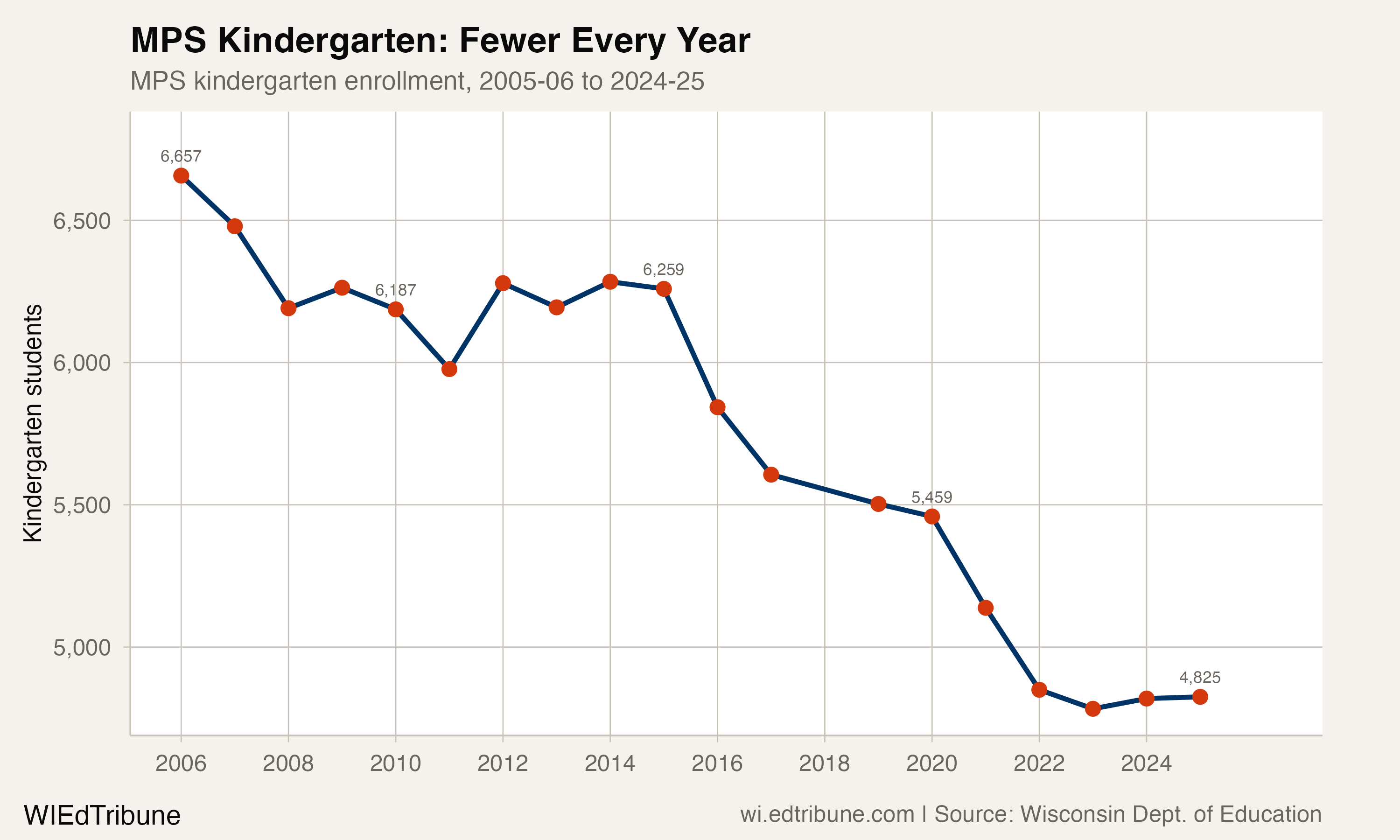
Smaller kindergarten classes feed directly into smaller first-grade classes the following year, locking in future enrollment declines regardless of what happens with transfers or school choice. Even if MPS stopped losing students to vouchers, charters, and open enrollment tomorrow, the kindergarten pipeline would keep total enrollment falling for years.
$46 million in the red
The fiscal consequences are immediate. MPS Superintendent Brenda Cassellius proposed eliminating 263 positions for the 2026-27 school year, saving roughly $30 million against the $46 million gap. The cuts target 116 Central Services positions and 147 school-based non-classroom roles, including assistant principals and deans of students. About 40 of the eliminated positions were already vacant.
"Protecting classrooms and supporting high-quality instruction remains our top priority throughout this budget process." -- Superintendent Brenda Cassellius, MPS press release
The Milwaukee Teachers' Education Association and the Administrators & Supervisors Council jointly opposed the plan, warning that cutting support staff would undermine school safety and the district's restorative practices infrastructure. The MPS Board approved the proposal 5-2.
State funding makes the position worse. Wisconsin's legislature provided no increase in general state aid for the current biennium, despite a projected $2.3 billion state budget surplus. The state did lock in a $325 per-pupil revenue limit increase through a gubernatorial veto, but without additional state aid to back it, the cost falls entirely on local property taxpayers.
What the next decade looks like
MPS's share of Wisconsin's total enrollment has fallen from 10.5% to 8.1% since 2006. At the current pace of decline, the district could fall below 60,000 students within three to four years.
MPS is no longer the district that the budget was built for. It serves 65,599 students instead of 92,000, but one in five of them requires special education services, and one in six is an English learner, populations that cost substantially more per pupil than the general enrollment the district lost. The 263 positions Superintendent Cassellius just cut include assistant principals and deans of students, the staff who run restorative practices and keep hallways safe. The union warned those cuts would undermine school safety. The board approved them 5-2 anyway, because the alternative was insolvency.
Detailed code that reproduces the analysis and figures in this article is available exclusively to EdTribune subscribers.
Discussion
Sign in to join the discussion.
Loading comments...