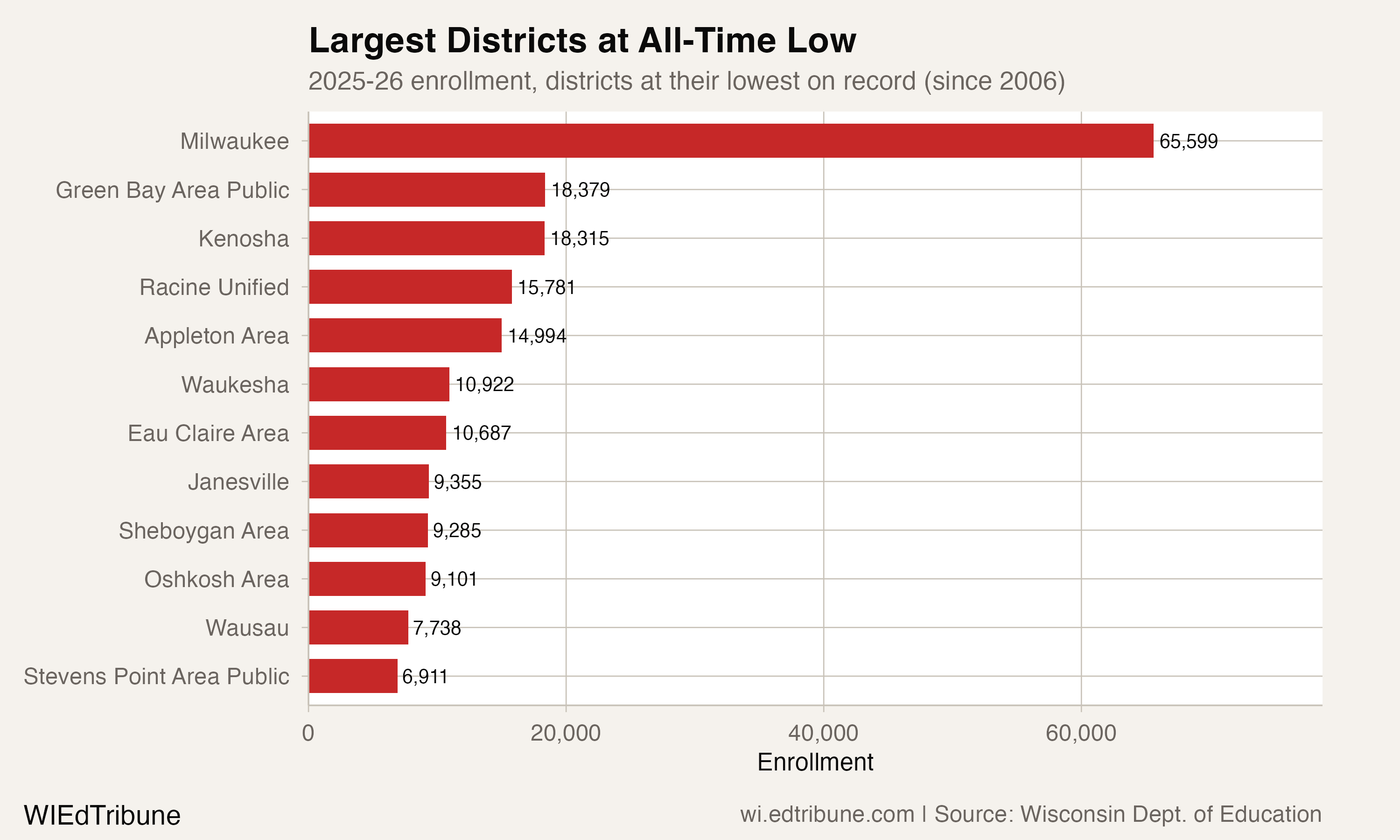
Nine of the 10 largest school districts in Wisconsin enrolled fewer students in 2025-26 than in any other year on record. Milwaukee↗ET, Green Bay↗ET, Kenosha↗ET, Racine↗ET, Appleton↗ET, Waukesha↗ET, Eau Claire↗ET, Janesville↗ET, Sheboygan↗ET, and Oshkosh↗ET all hit bottom. The only top-10 district not at its all-time low is Madison↗ET, and even Madison is down 7.8% from its 2015 peak.
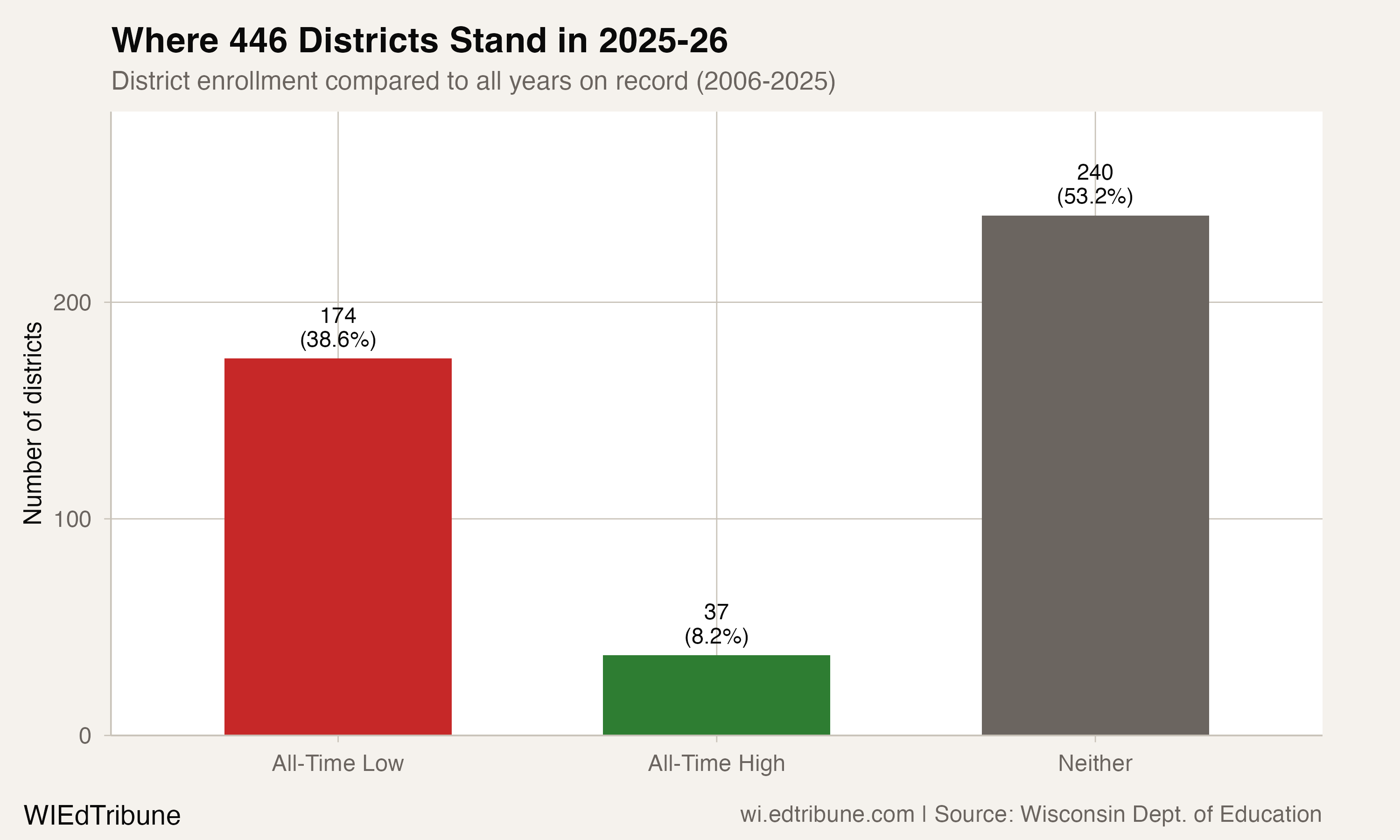
In all, 174 of 446 districts, 39.0%, recorded their lowest enrollment in the 19 years of available data. Those districts collectively educate 400,273 students, nearly half of Wisconsin's public school enrollment. Just 37 districts hit all-time highs.
The sheer scale
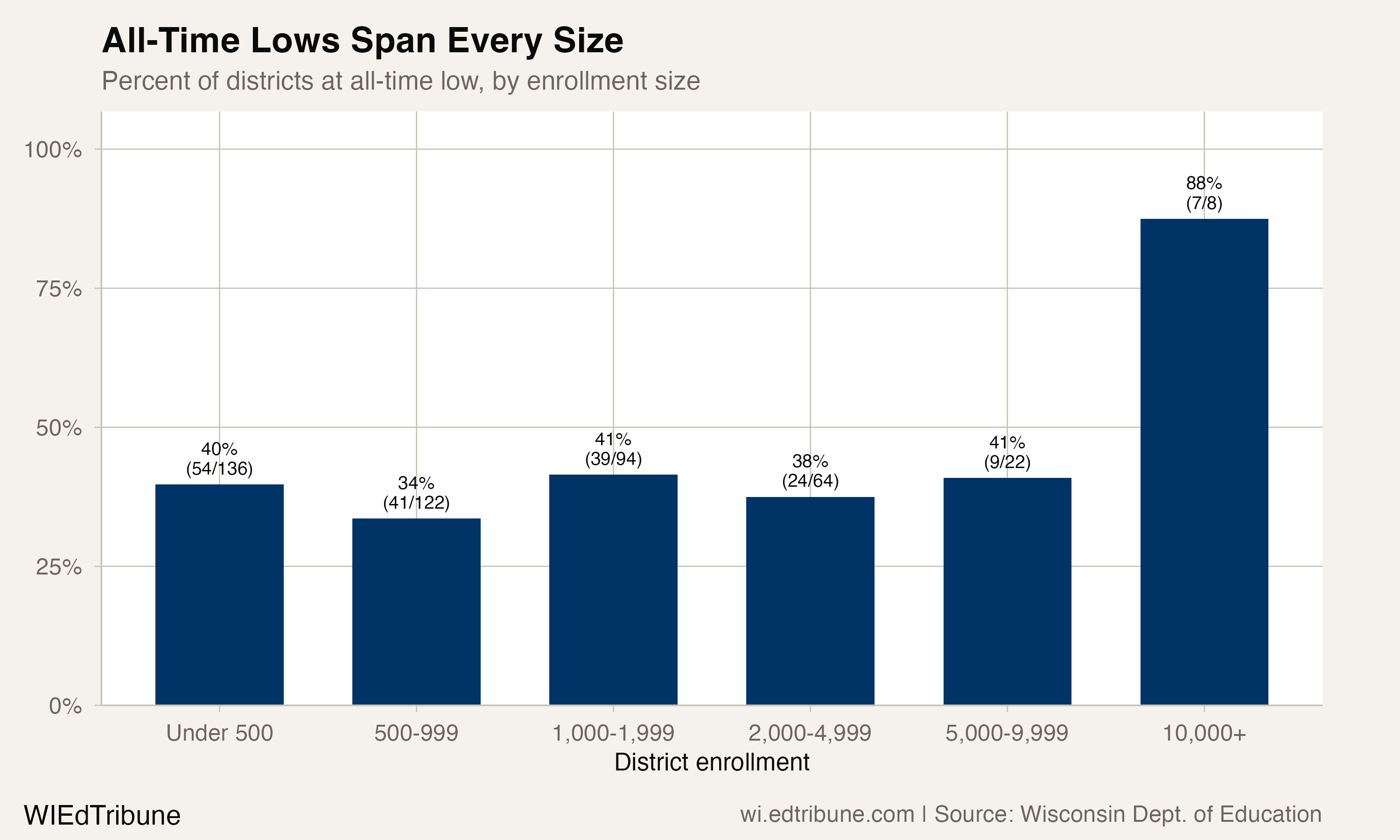
The 174 districts at all-time low are not concentrated in one region, one size category, or one type of community. Among districts with 10,000 or more students, seven of eight are at record lows. Among districts with fewer than 500 students, 54 of 136 are. The rate is remarkably consistent across size: roughly 34% to 41% of districts in every size bracket are at their minimum, with the largest districts hit hardest at 88%.
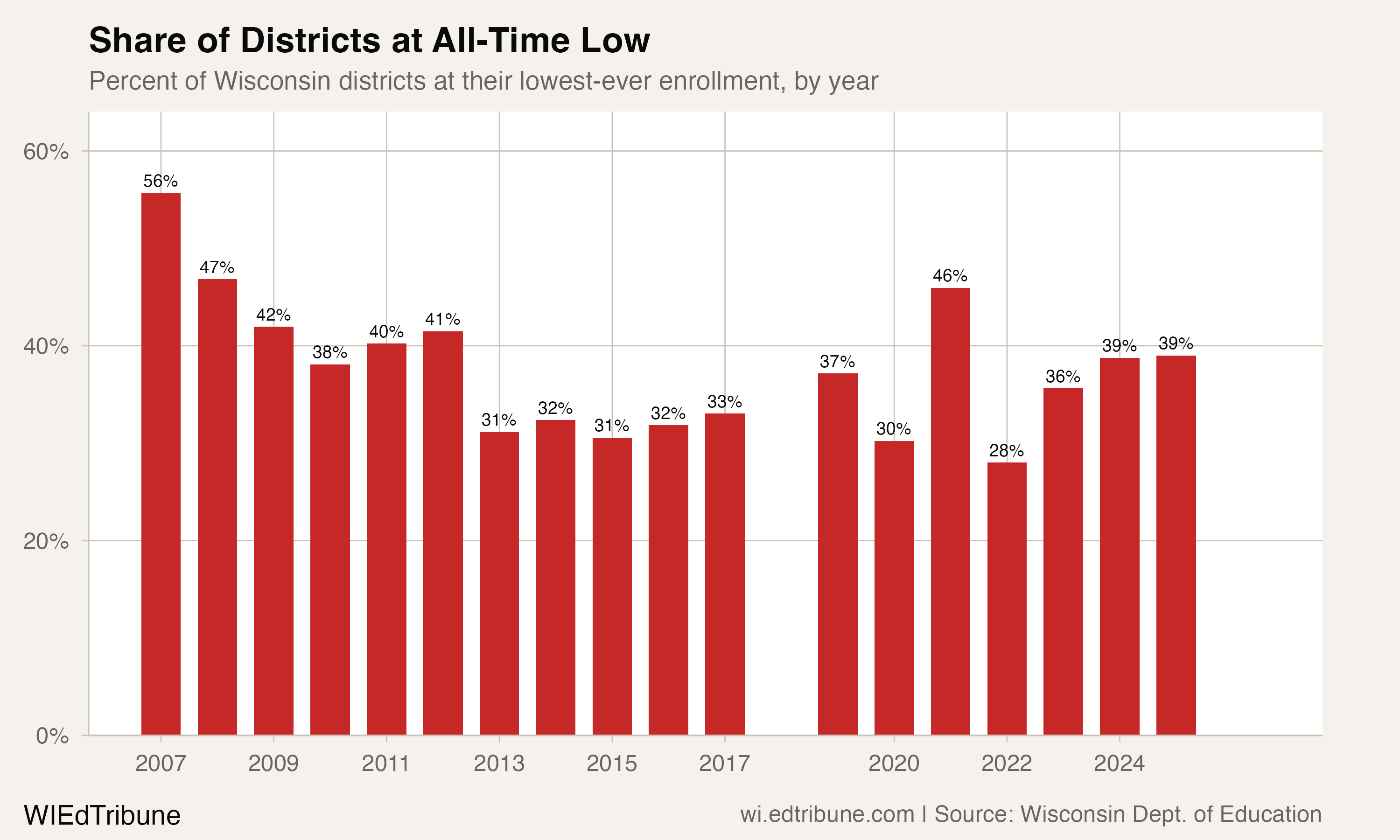
This is not a static problem. In 2022, only 28% of districts were at all-time lows. By 2024 it was 39%, and 2025-26 held at that level. The COVID year of 2021 was worse, at 46%, but the pre-pandemic baseline hovered around 30-33% for most of the prior decade. The current rate means Wisconsin never recovered from the pandemic surge in record lows; it merely paused briefly before resuming.
Who is at the bottom
The list of districts at all-time low reads like a roster of Wisconsin's legacy cities. Milwaukee↗ET (65,599 students, down 28.6% from its 2006 peak of 91,818) anchors the list. Racine↗ET has lost a quarter of its enrollment since 2011. Kenosha↗ET is down 20.3%. West Allis-West Milwaukee↗ET has shed a third of its students since 2015.
Smaller districts have been hit even harder in percentage terms. Palmyra-Eagle↗ET has lost 57.2% of its enrollment since 2008. Mercer↗ET, a district in Iron County, has dropped from 187 students to 92, a 50.8% decline. Across all 174 districts at their floor, the median decline from peak is 21.5%.
A funding system that amplifies the losses
Wisconsin's school funding formula ties state aid directly to enrollment. Each lost student removes dollars from the budget. Unlike states that smooth funding over multi-year averages, Wisconsin calculates aid based on a three-year rolling enrollment count, which means districts in sustained decline see compounding cuts.
Revenue limits compound the problem. Wisconsin decoupled its per-pupil revenue limits from inflation in 2009, and school districts have not received a regular inflationary increase since. Kenosha↗ET Superintendent Jeffrey Weiss captured the bind in a 2024 interview with Wisconsin Watch: "Schools are funded based on the number of students we have, so as we have fewer students, our budget shrinks." Districts lose twice: once from enrollment, again from the frozen revenue cap.
The result is a referendum surge. In 2024, 241 referendum questions went before voters across 192 districts, seeking nearly $6 billion. Voters approved $4.4 billion, but the 66% approval rate on operational referendums was the lowest in a midterm or presidential election year since 2012.
"Losing students forces tough choices on educators looking out for our kids and taxpayers funding our schools. Wisconsinites must attract families and businesses to our great state, or we will never escape the cycle of referenda and layoffs." -- Quinton Klabon, Institute for Reforming Government, March 2026
What the birth rate portends
The most likely driver of this systemic decline is demographic. Wisconsin's birth rate has fallen nearly 22% over the past three decades, and the UW-Madison Applied Population Lab has linked district enrollment changes primarily to declining births rather than net outmigration. The birth cohorts entering kindergarten today are substantially smaller than those graduating from 12th grade, and that pipeline imbalance will continue pressing enrollment downward for at least another decade.
School choice adds a second layer. Wisconsin operates the nation's oldest voucher program, with more than 60,000 students now using private choice across four programs statewide. Open enrollment allows inter-district transfers at $8,618 per student with no cap. The combination means districts at all-time lows are losing students not only to demographics but to competing sectors, particularly in the Milwaukee metro area where voucher participation has grown 90% since 2006.
The 37 districts that bucked the trend
Against this backdrop, 37 districts hit all-time highs. The pattern is narrow and specific: Madison-area suburbs and virtual school operators dominate the list.
Sun Prairie↗ET (8,596 students), Hamilton↗ET (5,131), Waunakee↗ET (4,415), De Forest↗ET (4,246), and Oregon↗ET (4,186) are all within commuting distance of Madison and are absorbing families in the Dane County growth corridor. 68 of 72 Wisconsin counties lost public school students in 2025-26; Dane County was one of only four that gained. The growth is real, but it is geographically concentrated in a way that makes it invisible at the state level.
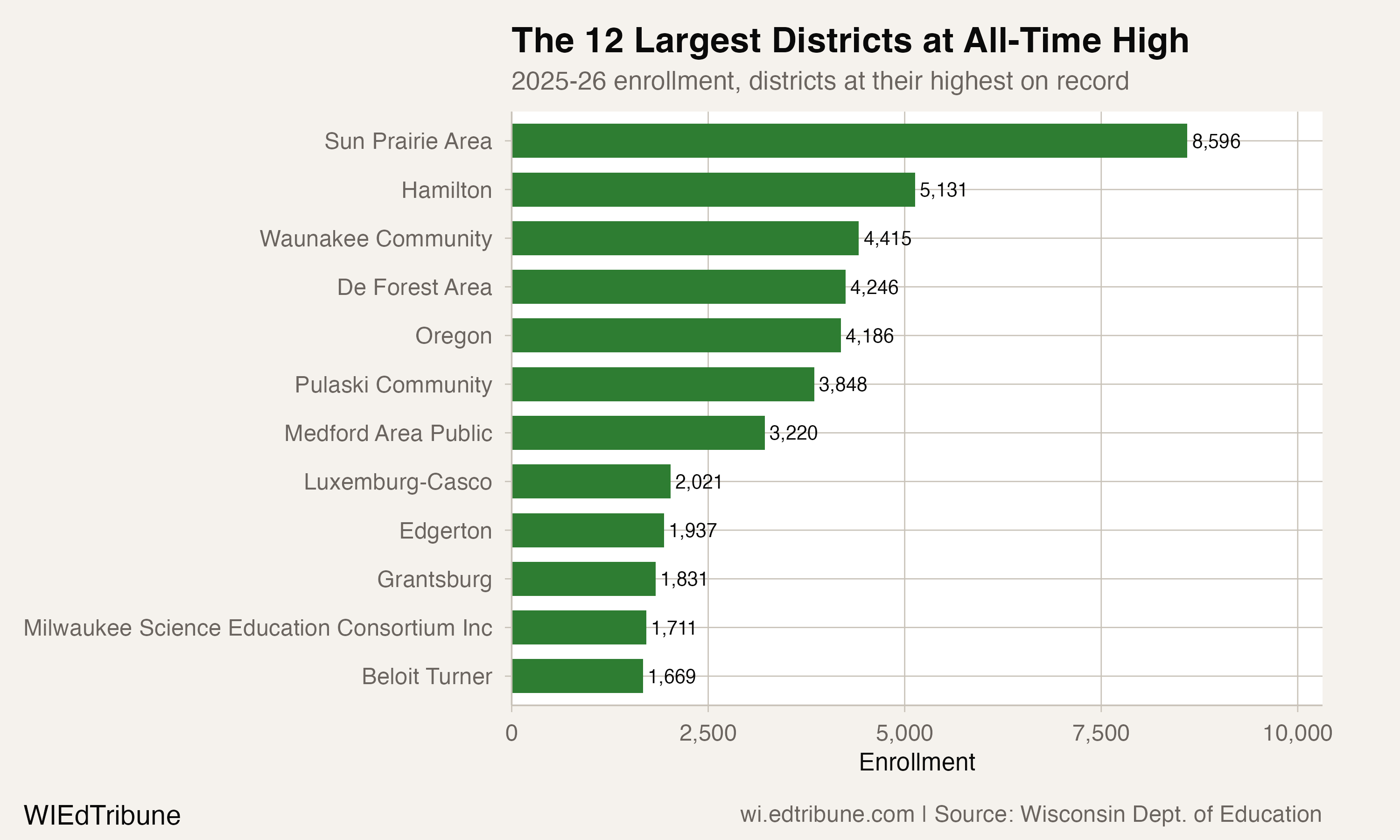
Two of the all-time-high districts, Medford Area Public↗ET (3,220) and Grantsburg↗ET (1,831), are inflated by large virtual school operations that draw students from across the state. Their growth reflects a shift in where students are counted, not where families live.
The consolidation question
In November 2025, Republican lawmakers introduced bills to encourage school district consolidation, offering $2,000 per pupil to districts that merge by 2028, up from the current $150. Only five consolidations have occurred in the past 20 years. Waukesha↗ET voted to close Bethesda Elementary and Hawthorne Elementary and sell the Whittier Elementary building, citing an expected 2% annual enrollment drop through 2034. Sixty-nine Wisconsin schools have closed in the past two years.
For the Lake Country↗ET and Hustisford↗ET school districts, the paths split in April 2026: Lake Country voters approved an operational referendum, while Hustisford voters rejected one, sending the district toward dissolution.
Hustisford's dissolution track shows how quickly an all-time-low district can move from warning to final decision. It will not be the last district under pressure. At 39%, the share of districts at all-time low is near its post-COVID peak and shows no sign of retreating. The $2,000-per-pupil consolidation incentive on the table is 13 times the current $150, and it still may not be enough to overcome the political pain of closing a town's school.
Detailed code that reproduces the analysis and figures in this article is available exclusively to EdTribune subscribers.
Discussion
Sign in to join the discussion.
Loading comments...