Dr. Jeff Fleig's working day at the Randall Consolidated School District↗ET starts at the front door. "I enjoy welcoming students as they arrive each morning, visiting classrooms, and having daily conversations with teachers and staff," he wrote in answers to questions from The WIEdTribune. "Those interactions help me understand the organization in ways that reports and data alone cannot."
Fleig began as Randall's interim district administrator on July 21, 2026, and is serving for the 2026-27 school year, he confirmed to The WIEdTribune in September. The appointment is a single school year. "While my appointment is for one year, my commitment is to provide steady leadership, strengthen the organization, and position the district for continued success under its next permanent leader," he wrote.
Back to district leadership
Fleig described the path that brought him to Randall in his own words. "After more than 30 years in public education, including serving as superintendent of the Fond du Lac School District, I spent a year working in the private sector in leadership development," he wrote.
That year sharpened what he wanted from his work. "While I enjoyed developing leaders in the private sector, I realized that my greatest professional fulfillment comes from working directly with students, teachers, and families to improve educational outcomes," he wrote. "That realization reinforced my desire to return to district leadership."
Randall, a prekindergarten through eighth grade district in Kenosha County that the state lists as Randall J1, was the kind of place he was looking for. "I was particularly drawn to the opportunity to lead a smaller K-8 district where I could build meaningful relationships and be directly involved in the daily work of schools," he wrote.
Trust as the year's first task
Fleig named four priorities for the year: "Our priorities are centered on providing a high-quality educational experience for every student, maintaining a safe and supportive learning environment, exercising sound fiscal stewardship, and strengthening our organizational culture."
He is candid that a change at the top unsettles people. "Leadership transitions can create uncertainty, so I believe it is especially important to establish trust through transparency, consistent communication, and meaningful opportunities for staff to have a voice in decisions," he wrote. He said the district has already acted on that: "We recently engaged our teaching staff in a comprehensive assessment of our organizational culture and established a District Administrator Advisory Team to help identify priorities and strengthen collaboration."
For Fleig, culture is a means rather than an end. "I often say that culture moves at the speed of trust, and building that trust is essential to creating an environment where people feel empowered to do their best work," he wrote.
A smaller district than it was in 2018-19
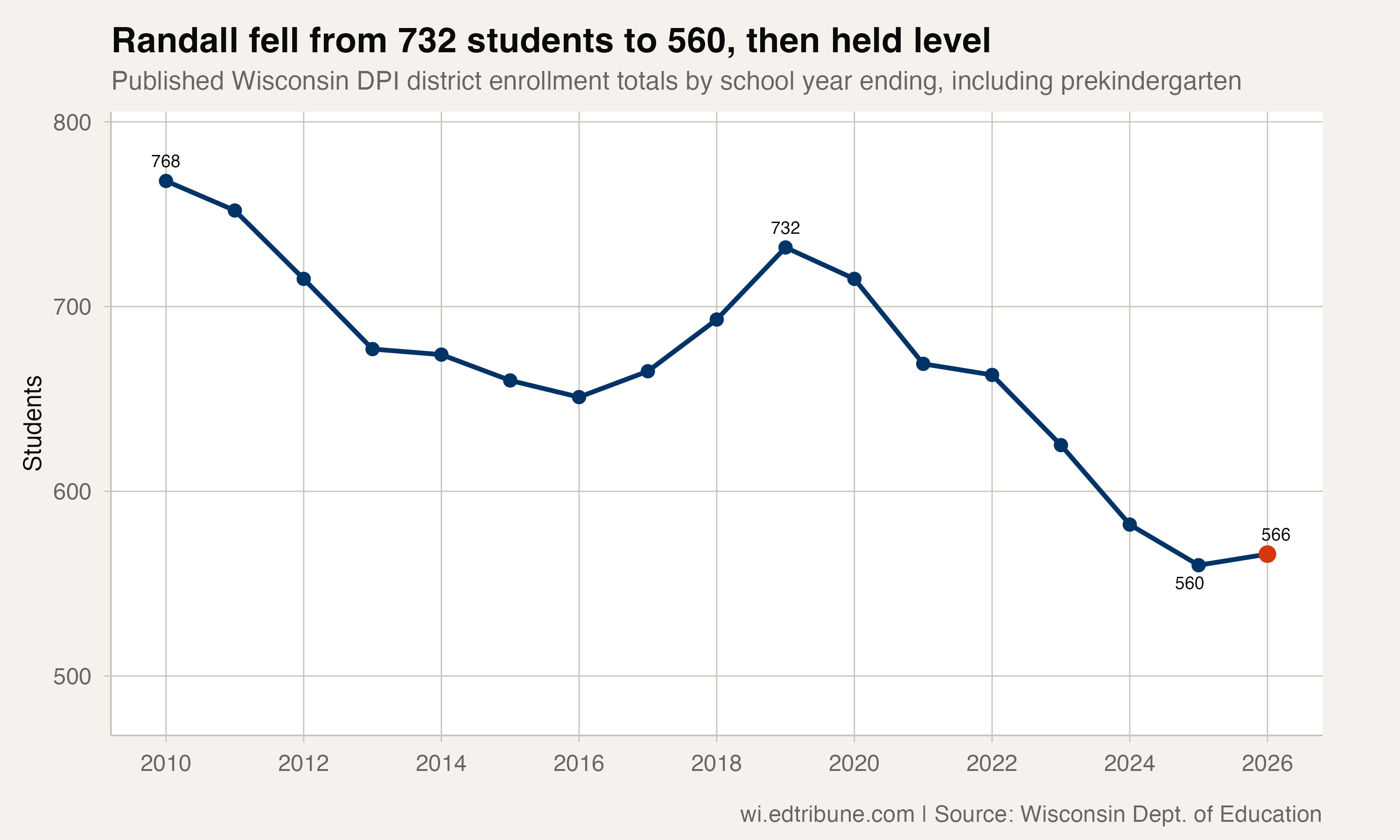
Randall enrolled 566 students in 2025-26, the most recent school year in the Wisconsin Department of Public Instruction's published data, 49 of them in prekindergarten. That was six more than in 2024-25, and the first year-over-year increase in the district's published enrollment since 2018-19. Counts for the current 2026-27 school year are not yet published and will differ from these figures once DPI releases them.
The rise followed a long slide. Randall enrolled 732 students in 2018-19, then declined in six straight years to 560 in 2024-25, a drop of 172 students, or about 23 percent. Statewide enrollment fell about 8 percent between 2018-19 and 2025-26 while Randall's fell about 23 percent. The district was larger still at the start of the published record, with 768 students in 2009-10.
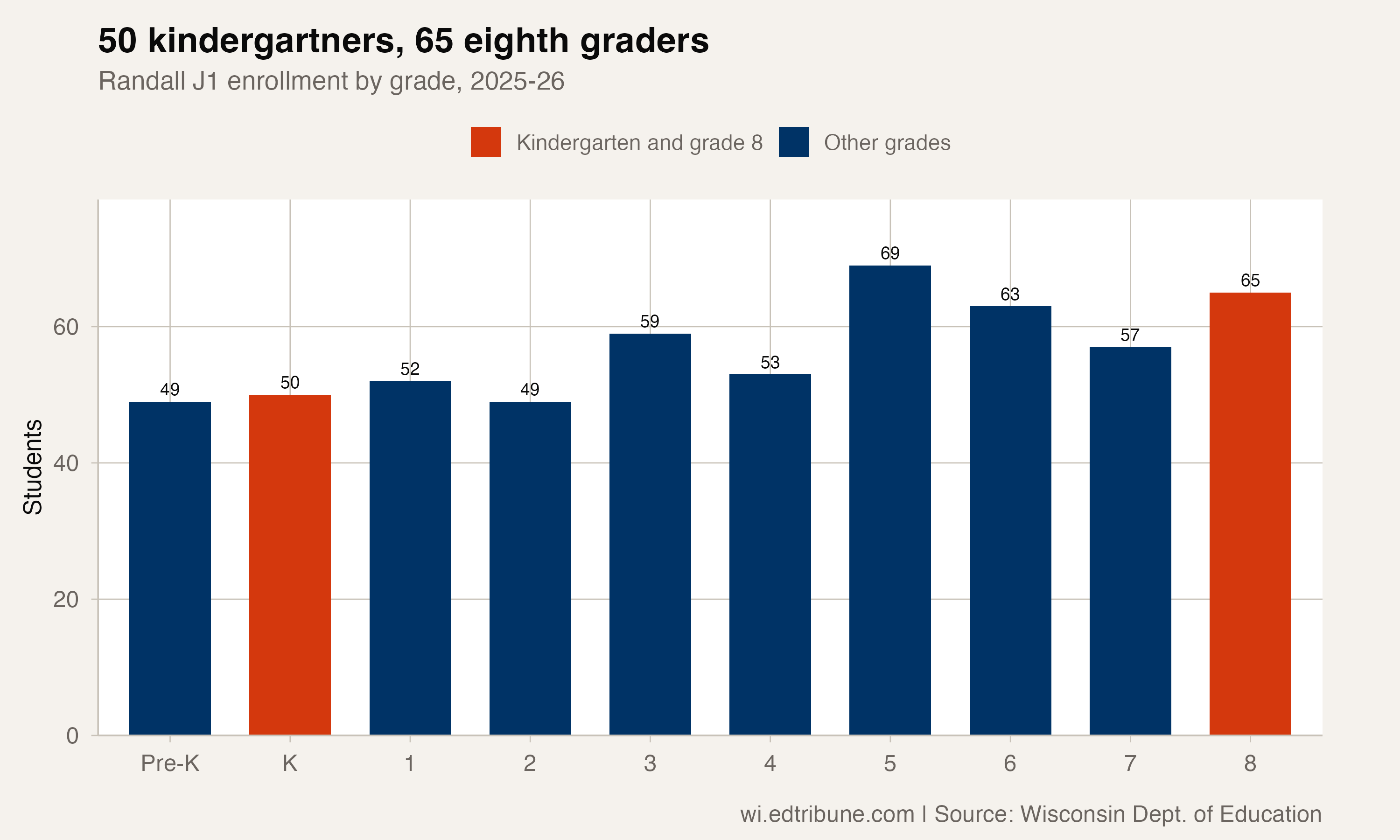
The grade-by-grade counts show the same pattern from the inside. Randall's 2025-26 enrollment included 50 kindergartners and 65 eighth graders. Kindergarten was smaller than eighth grade in all 17 years of the published record, so the gap is a long-standing feature of the district rather than a single small class. It describes past enrollment, not a forecast; families moving in or out after kindergarten can change the size of a class as it moves up.
The state's enrollment files record how many students attend, not why. They cannot say how much of the decline reflects births, housing, open enrollment or other schooling choices.
Asked what a district of Randall's size needs from its leadership, Fleig began with what does not change. "The size of a district may change the structure of leadership, but it does not change the importance of having a clear vision, high expectations, strong instructional systems, and accountability for results," he wrote. Then he named what does. "Smaller districts also require leaders to be adaptable, resourceful, and intentional about how limited resources are allocated. Decisions can have an immediate and significant impact across the entire organization."
Attendance moving in the right direction
One of Fleig's priorities is a safe and supportive learning environment, and attendance is one place the state's data reach into that. In 2022-23, 16.5 percent of Randall students were chronically absent. By 2024-25, the most recent year of Wisconsin's attendance data, the rate was 11.0 percent, compared with 17.3 percent statewide. Randall's rate was below the statewide rate in each year compared here.
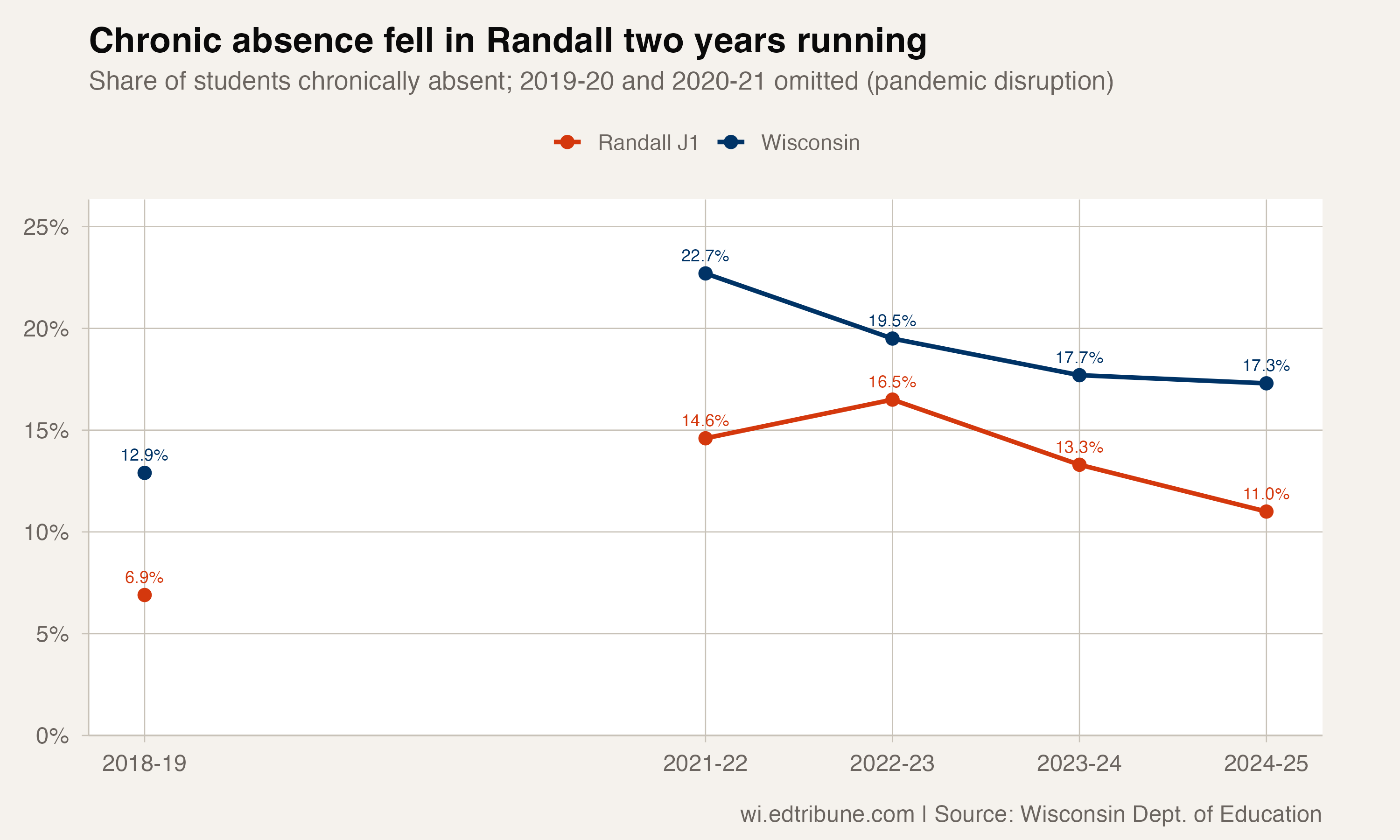
Those gains came before Fleig's arrival, and the rate has not returned to the 6.9 percent the district recorded in 2018-19, before the pandemic. The attendance files do not say why students miss school, so they show the direction of the change without explaining it.
A foundation for the next leader
Fleig sees the advantage of a district Randall's size in how close its people are to one another. "Ultimately, I believe one of the greatest advantages of a smaller district is the opportunity to build a highly connected school community where every student is known, supported, and challenged to succeed," he wrote.
His measure of the interim year reaches past it. "Although this is a transitional year, the work we do should have a lasting impact," he wrote. "My goal is to ensure that the work we accomplish this year establishes a strong foundation that will continue to benefit students, staff, and families well beyond my appointment."
Enrollment and attendance figures come from the Wisconsin Department of Public Instruction, which publishes district enrollment and chronic absence data by year.
Detailed code that reproduces the analysis and figures in this article is available exclusively to EdTribune subscribers.
Discussion
Sign in to join the discussion.
Loading comments...