Dr. Nicki Ells took over Adams-Friendship Area↗ET with a problem she had already seen from inside its business office: fewer students to serve, and decisions about what the district can keep offering them. Wisconsin's most recent published count put the district at 1,225 students in 2025-26, last school year. That is its lowest total in the state's available series from 2009-10 through 2025-26.
Ells became district administrator and superintendent this summer, succeeding Dr. Tom Wermuth after serving as the district's business manager. She confirmed that sequence in writing to The WIEdTribune. The Wisconsin Interscholastic Athletic Association's directory lists her as superintendent.
Ells wrote: "I think what drew me to the role was the opportunity to make a difference at a time when the district was facing some pretty significant challenges." She named difficult financial decisions, declining enrollment, facility needs, and work to rebuild trust and stability. In the same answer, she emphasized that people across the district care about its students and community.
Her stated priorities are stability for students and staff, a more sustainable financial path, and stronger confidence and connection with the community. They put the everyday work of schools beside decisions about staffing, health insurance, facilities, and how buildings are used. Ells said the district has already made difficult choices in those areas. She described transparency about those choices as part of her responsibility, not as an answer to every problem.
A district planning for the students it has
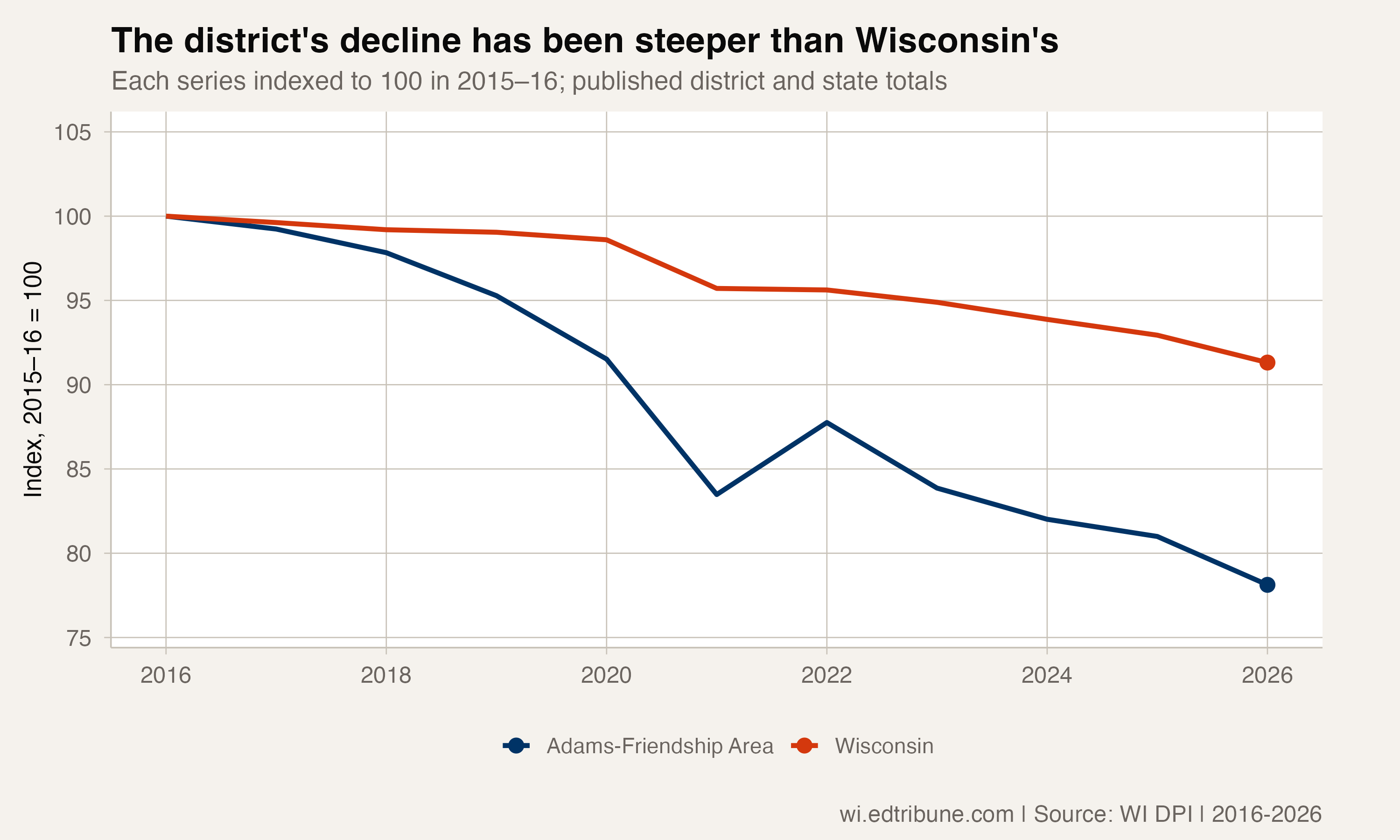
The enrollment pressure Ells described is visible across years of Wisconsin Department of Public Instruction counts. Adams-Friendship enrolled 1,568 students in 2015-16 and 1,225 in 2025-26, a decline of 343, or 21.9%. Wisconsin's public school total fell 8.7% over the same span. The district's loss was proportionally deeper than the statewide decline, though the statewide figure describes a much larger and more varied set of districts.
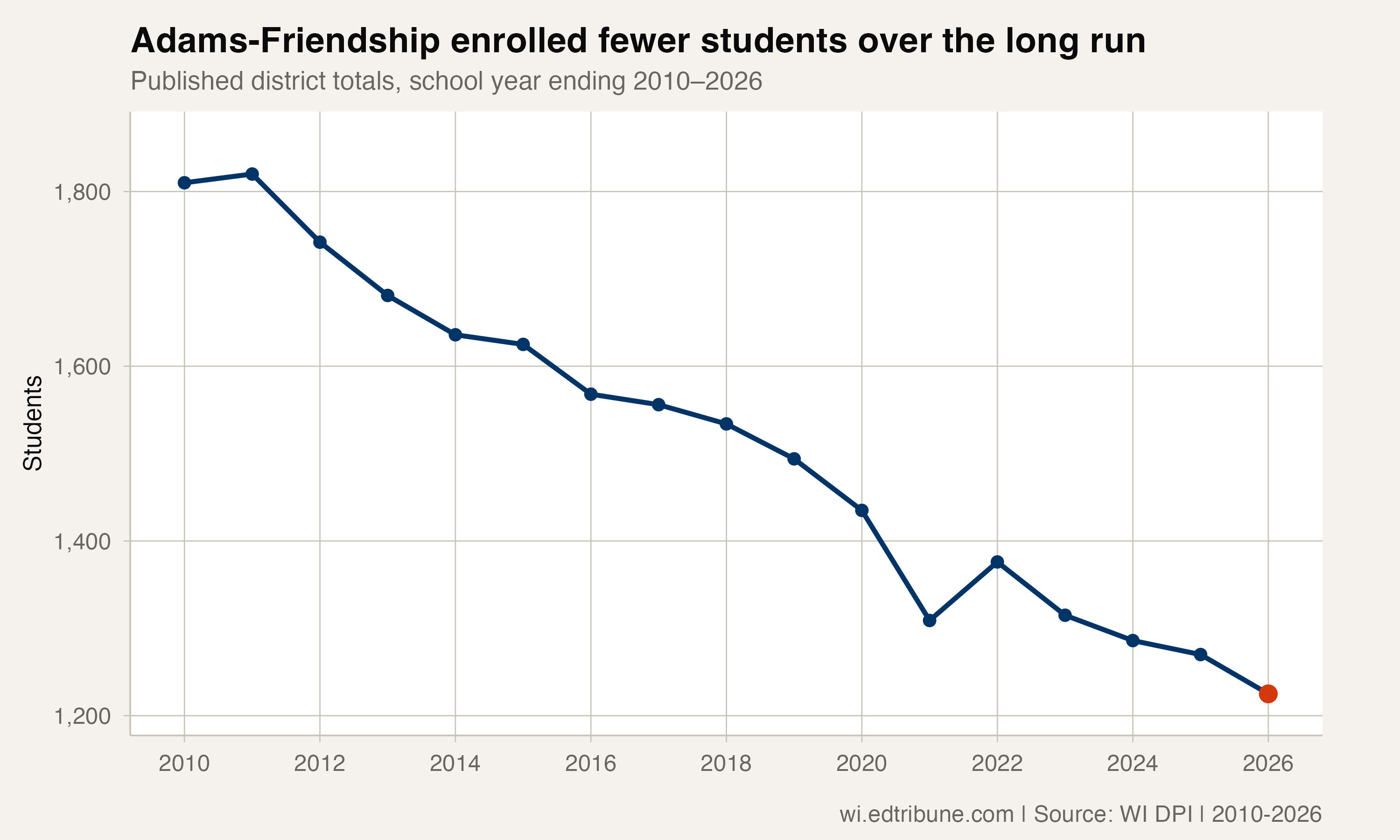
The 2025-26 count was 45 below 2024-25's 1,270. The longer line was not a smooth descent: two of the annual changes in the available series were increases. Even so, every earlier year in the series ended above the 2025-26 count. Ells is building plans against a smaller student body than the district had in those earlier years.
Ells put the operational consequence plainly: "We can't build our budget, staffing, or facilities around students we hope might someday come back." She said the district must fit its operations to actual enrollment while making Adams-Friendship a place families want to choose. That means a financial plan for the students in its classrooms now, with programs strong enough to give families a reason to stay. She was clear that the size of the district is a condition she is responding to, not a target: "becoming a smaller district isn't our goal."
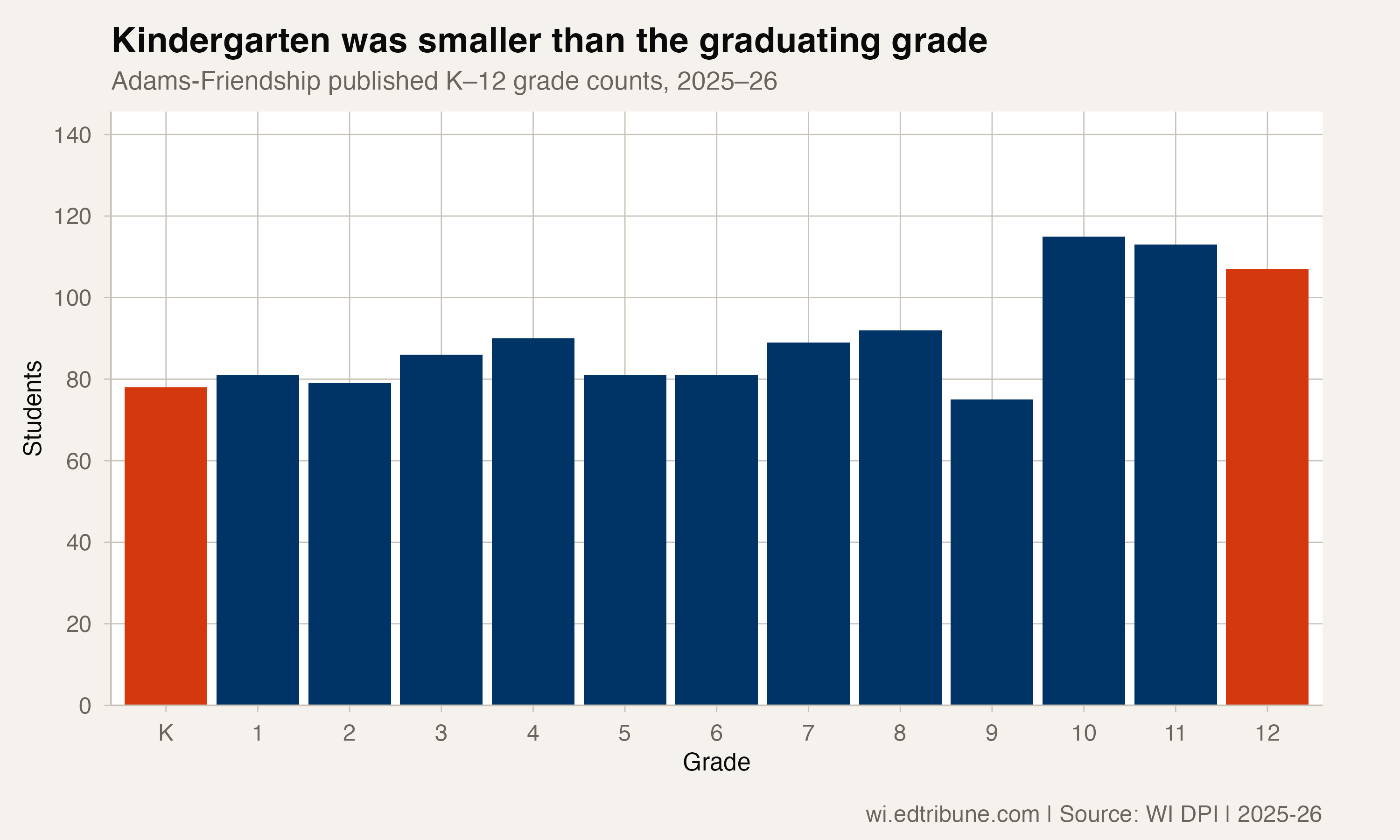
The state's 2025-26 grade counts show 78 kindergarteners and 107 twelfth graders. Those are students in different grades in the same year, not a forecast of how many children will enter school in the future. They do show why a district planning staffing and space cannot assume that every graduating class will be replaced by an equally large entering class.
Two buildings instead of three
The clearest example Ells gave of that planning is the district's decision to consolidate from three school buildings to two. She said the move was about more than a smaller footprint. "We were facing millions of dollars in needed repairs to an aging middle school building," she wrote. "By reorganizing our grade levels and making better use of our existing facilities, we're avoiding significant future expenses and creating ongoing operational savings."
She described it as a hard choice made early so the district is in a better position later.
Ells also pointed to the district's November 3 operational referendum as part of its current financial picture. She said Adams-Friendship has already made significant reductions and operational changes, and that "the referendum is an important part of the conversation about how we sustain educational opportunities moving forward." The decision belongs to the district's voters.
What a count cannot explain
Ells offered several reasons she thinks the district has fewer school-age children. She described Adams County as a place drawing retirees more readily than young families. In a large geographic district, she said, some families live closer to a neighboring school system. She also pointed to online schooling as another option families may choose.
Those are her explanations, not separate findings from the enrollment file. Wisconsin's annual counts show how many students were enrolled at Adams-Friendship; they do not record why a child entered, left, or chose a different school. They cannot separate births from moves, commuting patterns, and online choices. Ells said the district can respond by making its own programs attractive and listening to families, even though it cannot change geography or create more young families in the county.
Her description of the district's strengths was specific. Ells named agriculture and career and technical education, the arts, athletics, and personalized learning. She said staff know students and families, and that school buildings also host community organizations, food distributions, youth programs, and other gatherings. These are the opportunities she wants the district to protect. Her answer did not claim that every program is untouched by the decisions ahead.
Ells wrote: "One of the things I feel strongly about is making sure their ZIP code doesn't determine what opportunities are available to them." The line explains why she pairs right-sizing with investment in what students can do at school. A smaller enrollment figure describes the scale of the work; it does not describe the potential of the children in those classrooms.
Ells also acknowledged the strain of making choices in public. She wrote that avoiding difficult decisions does not make the problems go away, and said the district needs to be candid about where it stands. She does not want that candor mistaken for a goal of managing decline: "We're making some difficult decisions precisely because we believe our students deserve a strong future here." Stability for students and staff, a sounder financial path, and renewed community confidence are her stated priorities. This profile captures what she says she will try to do at the start of the job, not a verdict on results that have yet to arrive.
Ells wrote: "We can acknowledge that we're likely to be a smaller district and still be really ambitious about what we want that district to offer kids." The next test is how those ambitions survive the staffing, facilities, and program decisions she has begun to make.
Enrollment figures come from the Wisconsin Department of Public Instruction, which publishes district and grade counts by school year. Dr. Ells answered questions in writing and later commented on a draft of this profile; quotations, her account of the building consolidation and referendum, and her descriptions of district priorities come from those replies.
Detailed code that reproduces the analysis and figures in this article is available exclusively to EdTribune subscribers.
Discussion
Sign in to join the discussion.
Loading comments...