
Dr. Antoine Reed has spent his first months as superintendent of the Sun Prairie Area School District↗ET listening, and he says students have been specific about what they want back.
"I've also heard directly from our scholars that they don't just want to be heard. They want to know we're listening and that their voices are making a difference. That's important to me," Reed said in written answers to The WIEdTribune, provided through the district's communications office.
Reed began as superintendent on July 1, 2026, the district's director of strategic communications confirmed to The WIEdTribune. The Sun Prairie Board of Education selected him in April, and he agreed to a two-year contract beginning July 1. He succeeded Dr. Brad Saron, who concluded his tenure at the end of the 2025-26 school year after being chosen to lead the Chippewa Falls Area Unified School District.
From Rockford to Sun Prairie
Reed came to Sun Prairie from Rockford Public Schools in Illinois, where he was chief of culture and student engagement, according to Madison365. Before that he was chief of schools and a high school principal for Milwaukee College Prep, and earlier a principal in South Bend and Chicago. He holds a doctorate in educational leadership from DePaul University, a master's degree in social science from Chicago State University and a bachelor's degree in sociology from Missouri State University, and he completed graduate studies at the Relay Graduate School of Education.
Asked what he most wanted to bring from that work, he pointed to support systems around the classroom.
"One of the things I wanted to bring from my previous experience is a strong focus on wraparound supports and a multi-tiered system of supports that meets scholars where they are. Sun Prairie already has a strong foundation in teaching and learning, and I see opportunities to build on that by strengthening the additional supports available when scholars need them," he said in written answers.
He described the conviction underneath it in response to our questions: "I often talk about making sure every door is open for our scholars, whether they choose college, a career, military service, or another path. Their future should be shaped by their choices and dreams, not by limitations placed in front of them."
In written answers, he named what has stood out about his new district: "What has stood out to me here is the tremendous pride people have in their schools and community."
A district that held its size
Sun Prairie has stayed close to its size from before the pandemic. Wisconsin Department of Public Instruction figures put the district at 8,518 students in 2025-26, the most recent school year in the state's published data. That is 3 fewer than the 8,521 it enrolled in 2018-19. Over the same years, statewide enrollment fell 7.8 percent.
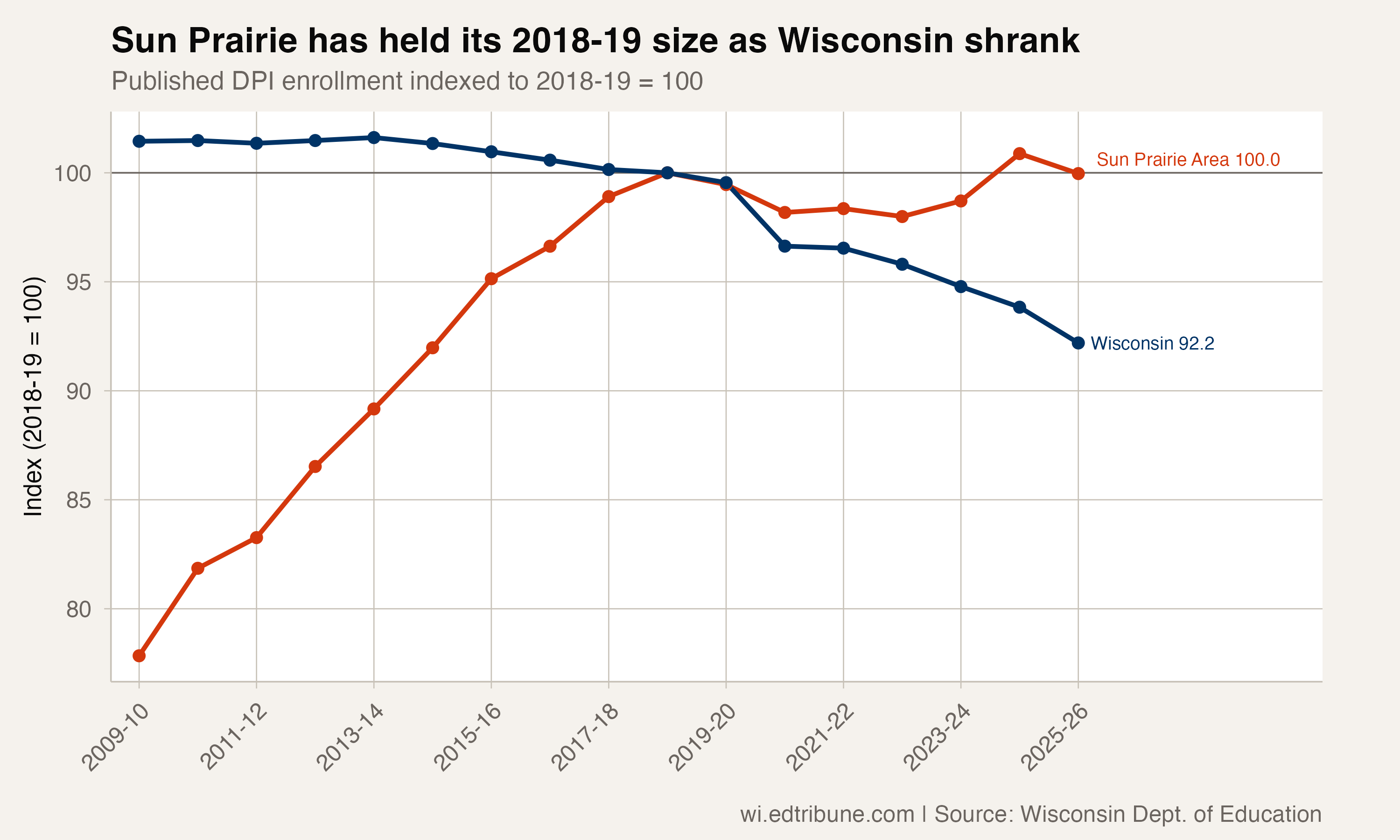
The district's growth came earlier. It enrolled 6,633 students in 2009-10, so the 2025-26 count is 1,885 higher, about 28 percent. Since 2018-19 the total has stayed between 8,350 and 8,596, the highest count in the published record, reached in 2024-25. Counts for the current 2026-27 school year are not yet published and will differ from these figures.
Reed credits the community. "Sun Prairie is a thriving, welcoming, innovative, and family-oriented community. I believe those qualities, along with the educational opportunities available to our scholars, are important reasons families continue to choose Sun Prairie," he said in written answers. "While we've remained relatively steady compared with many districts across Wisconsin, we know we can't take that for granted."
The state's files record how many students enroll, not why families choose a district, so they cannot test that explanation either way.
The total held while the mix changed
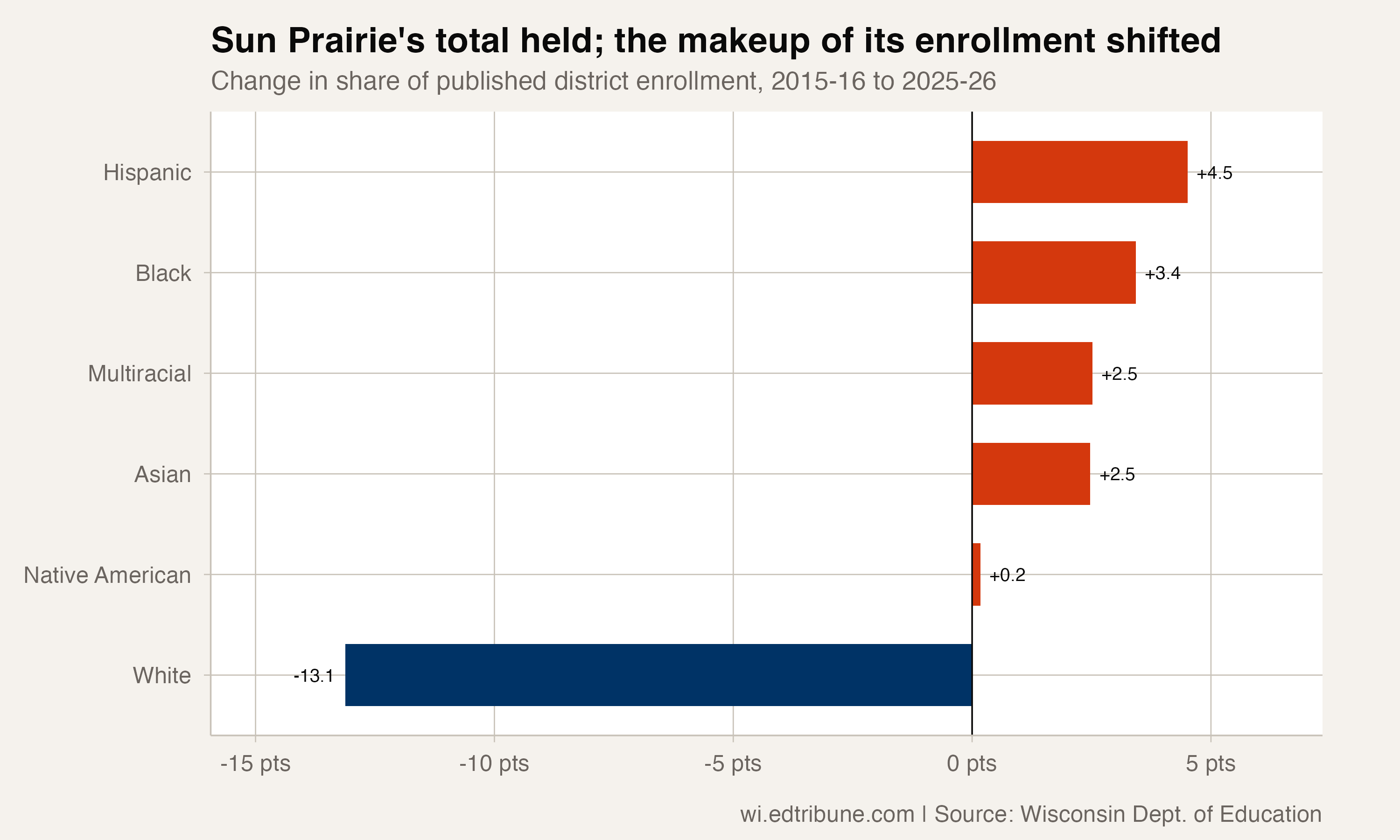
The district's steady total sits on top of a changing student population. In 2015-16, White students made up 65.8 percent of enrollment; in 2025-26 they made up 52.7 percent. Over the same decade the Hispanic share rose from 8.6 percent to 13.1 percent and the Black share from 10.0 percent to 13.4 percent. The published race and ethnicity counts add up exactly to the published district total in both years, so these shares describe all students rather than a subset.
Gaps he has named
Reed was direct about where the listening has led. "Those conversations are shaping two of my biggest priorities: closing achievement and opportunity gaps so a scholar's success isn't predictable by race or ZIP code, and strengthening safety across our schools. It's about taking what we've heard and turning it into action," he said in written answers.
Attendance is one place the state's data show the gap he described. In 2024-25, the most recent year of Wisconsin's attendance data, 20.0 percent of Sun Prairie students were chronically absent, compared with 17.3 percent statewide. The rate was 36.5 percent for Black students, 28.2 percent for Hispanic students and 13.0 percent for White students.
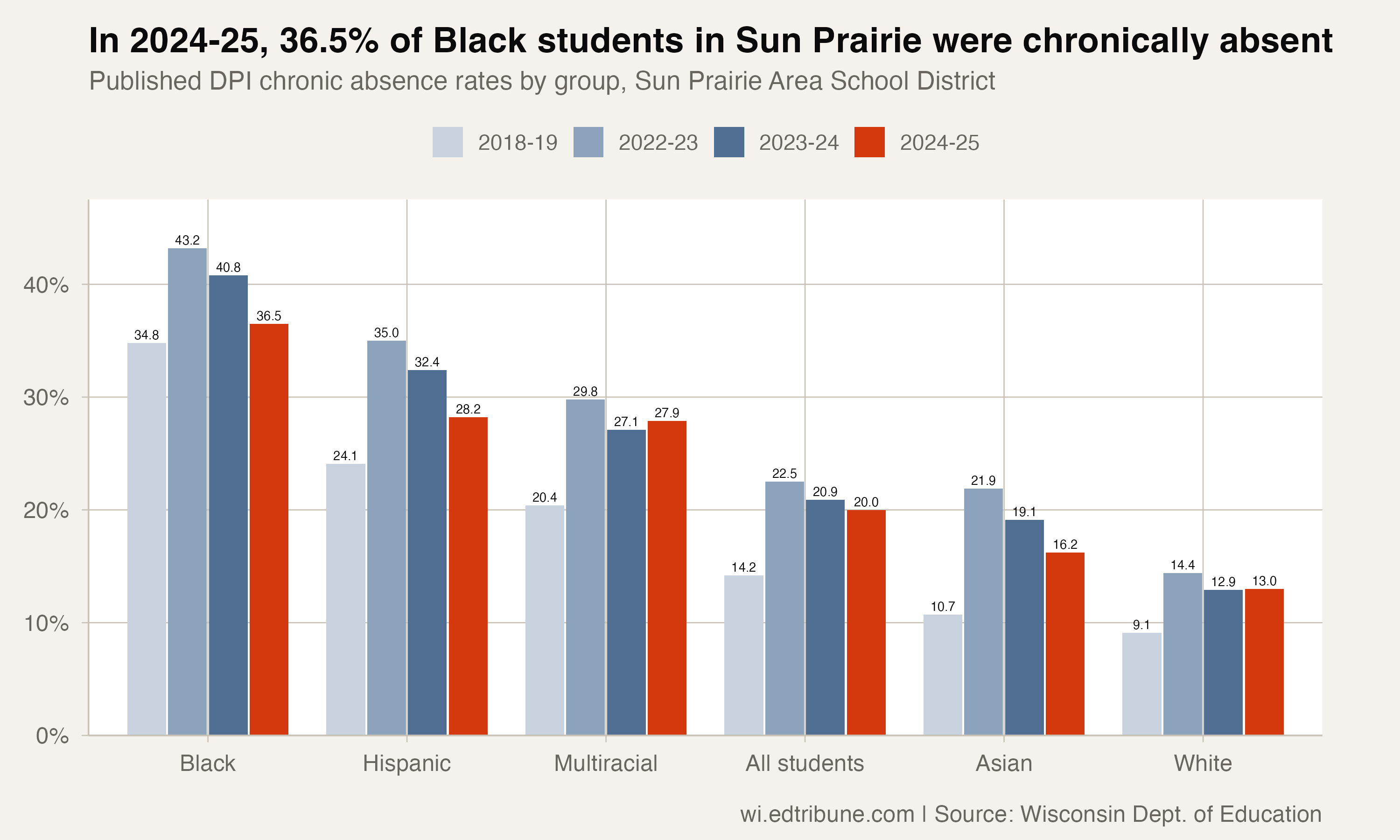
Some of those rates have come down. The rate for Black students was 43.2 percent in 2022-23, and the 2024-25 rate was below the statewide rate for Black students, 46.3 percent. The district's overall rate was 14.2 percent in 2018-19, before the pandemic. The attendance files do not say why students miss school, and race overlaps with income and other factors the files track separately, so the numbers describe the gap without explaining it.
Choice and staying power
Reed's goal for the district reaches past the next school year. "One of my priorities is making Sun Prairie a district of choice, a place where families want to come and where they want to stay," he said in written answers.
The district has held its size while the state around it lost students. Whether families keep choosing Sun Prairie, and whether the gaps he named narrow, is the work his two-year contract now covers.
Enrollment and attendance figures come from the Wisconsin Department of Public Instruction, which publishes district enrollment and chronic absence data by year.
Detailed code that reproduces the analysis and figures in this article is available exclusively to EdTribune subscribers.
Discussion
Sign in to join the discussion.
Loading comments...